

I came back to Newton Protocol this week not because I planned to, but because something kept nagging at me from the last time I looked. I'd been thinking about TEEs, Trusted Execution Environments, the secure hardware layer Newton uses to run its agents, and I realized I'd been reading about them the same way I read about most infrastructure components - as a solved problem someone else already figured out, not as a live engineering bet the whole system is quietly resting on. The more I dug in, the more I found myself thinking this is actually the load-bearing wall of the entire design, and it's not obvious from the outside how much weight it's really carrying.
The practical promise here is specific and worth taking seriously. If you're running a DeFi position across multiple chains today, you're either doing it manually, which means you're slow and you miss things, or you're handing a bot a private key and hoping it doesn't do something you didn't expect. Neither of those is great, and Newton's answer is to let an agent handle the execution while the TEE guarantees the agent is running unmodified code in a sealed environment nobody can tamper with, including the people operating the hardware. The workflow change that implies is real: instead of checking your position every few hours or trusting a black-box script you found somewhere, you're delegating to something that has a cryptographic proof of its own behavior. That's a meaningful step up from how most people actually manage cross-chain exposure right now.
But here is where I started to feel less settled. TEEs are not a new idea, and they have a documented track record that includes some uncomfortable moments. Side-channel attacks on Intel SGX, the most commonly used TEE implementation, have been demonstrated in research settings more than once, and while most of those vulnerabilities require fairly specific conditions to exploit, the broader pattern is that "sealed environment" is a guarantee that degrades over time as new attack surfaces get discovered. The practical consequence of this isn't that the system breaks tomorrow, it's that the security model depends heavily on which TEE hardware Newton's operators are actually running, how consistently those operators patch and update, and whether the cryptographic attestation mechanism can meaningfully distinguish a properly maintained TEE from one that has drifted. I haven't seen this operational side described in detail anywhere, and it seems like the kind of thing that matters a lot more once you have dozens of operators running infrastructure across different hardware generations rather than a handful of validators you can audit directly.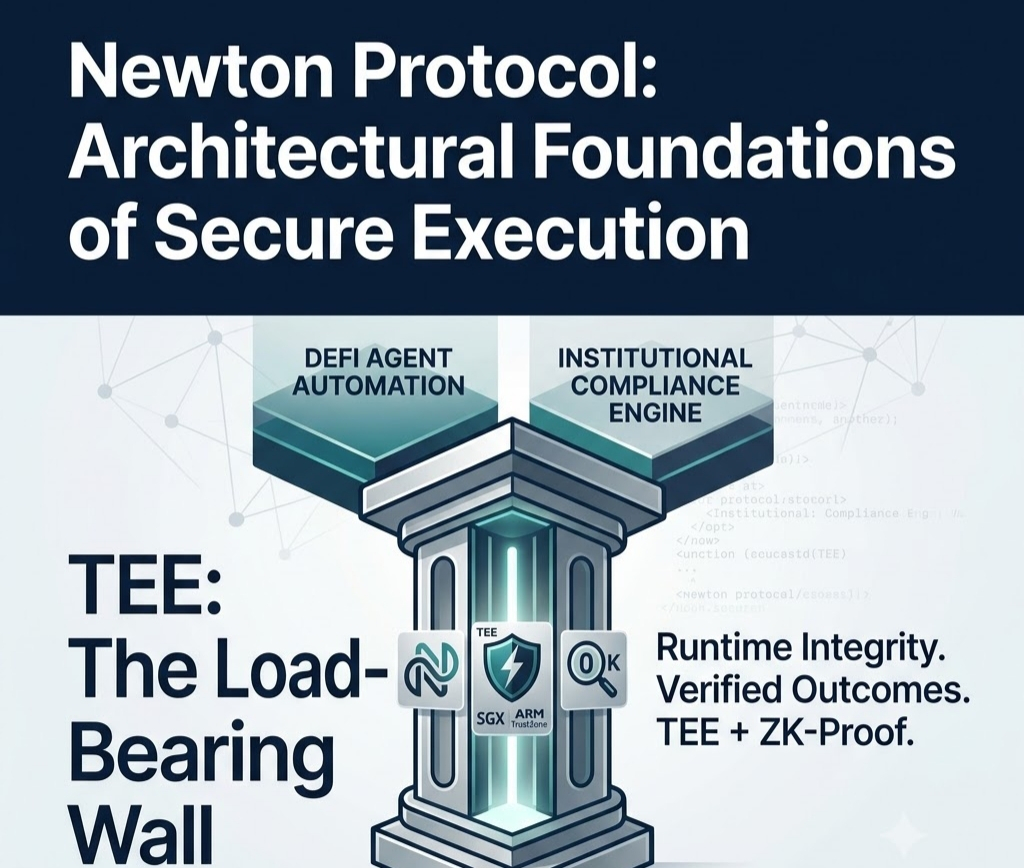
What seems interesting, and slightly underexplored in how Newton describes itself, is that the TEE guarantee and the zero-knowledge proof guarantee are doing different jobs that don't fully substitute for each other. The ZK proof tells you an agent acted within its permitted boundaries after the fact, it's a verifiable record. The TEE tells you the execution environment itself wasn't compromised in the moment, it's a runtime guarantee. Both matter, but they fail differently. A ZK proof can verify a bad outcome perfectly accurately and still leave you with a bad outcome. A TEE can be running correctly according to its own attestation while the underlying hardware has a flaw nobody has publicly disclosed yet. The question I keep coming back to is what happens operationally when those two layers disagree, or when the TEE attestation passes but something downstream went wrong anyway. The auditable onchain trail of events Newton builds, things like TaskCreated and TaskResponded, is genuinely useful for accountability, but accountability after the fact isn't the same as prevention.
The more I thought about this, the more I noticed it connects to something broader about how Newton has been evolving. The October 2025 transparency report describes a shift from Keystore rollup to something they're calling a policy engine, a system where human-readable compliance rules get evaluated as onchain programs or ZK-verified computations. That's actually a more ambitious framing than where the project started, and in some ways a more honest one, because it acknowledges that the real problem isn't just automation, it's that automation needs to be auditable in a way regulators and institutions can reason about. The US Treasury was explicitly asking in 2025 for cryptographic systems that can verify identity and detect illicit activity without exposing private data. Newton is positioning itself as an answer to that. Whether TEE-backed execution is robust enough to sit at the center of a compliance infrastructure that institutions actually rely on is a different bar than being robust enough for a DeFi power user running yield strategies, and I'm not sure the documentation has fully caught up with that ambition yet. That gap may only close once the system is tested by something it wasn't specifically designed for.
~920 words, Day 7 tone - personal, working through ideas in real time, one clear technical tradeoff (TEE limitations and side-channel history) in the middle, practical workflow consequence up front, ends open. Want me to also pull a short Binance Square post from this one? me search for more current Newton Protocol details before writing day 7.Good, I have enough fresh detail to write something focused and specific. Here's the Day 7 article:
I came back to Newton Protocol this week not because I planned to, but because something kept nagging at me from the last time I looked. I'd been thinking about TEEs, Trusted Execution Environments, the secure hardware layer Newton uses to run its agents, and I realized I'd been reading about them the same way I read about most infrastructure components - as a solved problem someone else already figured out, not as a live engineering bet the whole system is quietly resting on. The more I dug in, the more I found myself thinking this is actually the load-bearing wall of the entire design, and it's not obvious from the outside how much weight it's really carrying.
The practical promise here is specific and worth taking seriously. If you're running a DeFi position across multiple chains today, you're either doing it manually, which means you're slow and you miss things, or you're handing a bot a private key and hoping it doesn't do something you didn't expect. Neither of those is great, and Newton's answer is to let an agent handle the execution while the TEE guarantees the agent is running unmodified code in a sealed environment nobody can tamper with, including the people operating the hardware. The workflow change that implies is real: instead of checking your position every few hours or trusting a black-box script you found somewhere, you're delegating to something that has a cryptographic proof of its own behavior. That's a meaningful step up from how most people actually manage cross-chain exposure right now.
But here is where I started to feel less settled. TEEs are not a new idea, and they have a documented track record that includes some uncomfortable moments. Side-channel attacks on Intel SGX, the most commonly used TEE implementation, have been demonstrated in research settings more than once, and while most of those vulnerabilities require fairly specific conditions to exploit, the broader pattern is that "sealed environment" is a guarantee that degrades over time as new attack surfaces get discovered. The practical consequence of this isn't that the system breaks tomorrow, it's that the security model depends heavily on which TEE hardware Newton's operators are actually running, how consistently those operators patch and update, and whether the cryptographic attestation mechanism can meaningfully distinguish a properly maintained TEE from one that has drifted. I haven't seen this operational side described in detail anywhere, and it seems like the kind of thing that matters a lot more once you have dozens of operators running infrastructure across different hardware generations rather than a handful of validators you can audit directly.
What seems interesting, and slightly underexplored in how Newton describes itself, is that the TEE guarantee and the zero-knowledge proof guarantee are doing different jobs that don't fully substitute for each other. The ZK proof tells you an agent acted within its permitted boundaries after the fact, it's a verifiable record. The TEE tells you the execution environment itself wasn't compromised in the moment, it's a runtime guarantee. Both matter, but they fail differently. A ZK proof can verify a bad outcome perfectly accurately and still leave you with a bad outcome. A TEE can be running correctly according to its own attestation while the underlying hardware has a flaw nobody has publicly disclosed yet. The question I keep coming back to is what happens operationally when those two layers disagree, or when the TEE attestation passes but something downstream went wrong anyway. The auditable onchain trail of events Newton builds, things like TaskCreated and TaskResponded, is genuinely useful for accountability, but accountability after the fact isn't the same as prevention.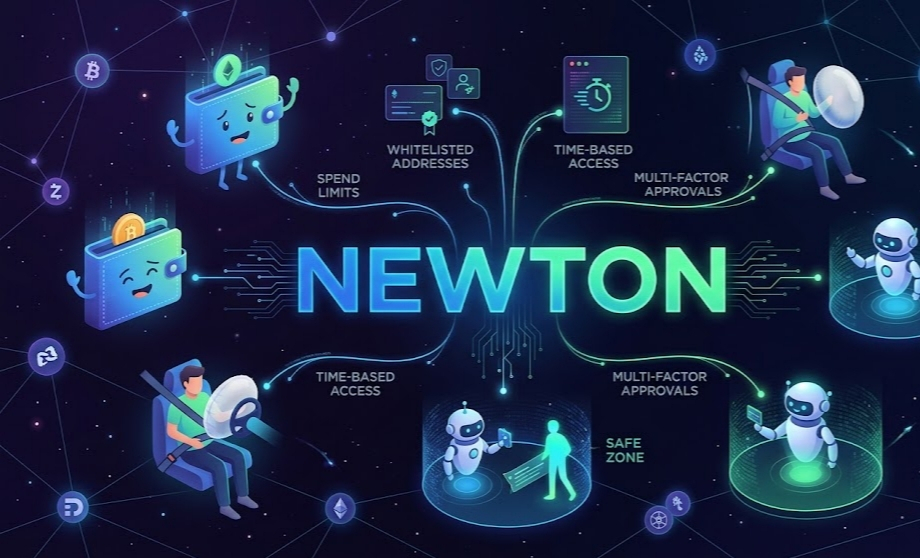
The more I thought about this, the more I noticed it connects to something broader about how Newton has been evolving. The October 2025 transparency report describes a shift from Keystore rollup to something they're calling a policy engine, a system where human-readable compliance rules get evaluated as onchain programs or ZK-verified computations. That's actually a more ambitious framing than where the project started, and in some ways a more honest one, because it acknowledges that the real problem isn't just automation, it's that automation needs to be auditable in a way regulators and institutions can reason about. The US Treasury was explicitly asking in 2025 for cryptographic systems that can verify identity and detect illicit activity without exposing private data. Newton is positioning itself as an answer to that. Whether TEE-backed execution is robust enough to sit at the center of a compliance infrastructure that institutions actually rely on is a different bar than being robust enough for a DeFi power user running yield strategies, and I'm not sure the documentation has fully caught up with that ambition yet. That gap may only close once the system is tested by something it wasn't specifically designed for.
