

Onchain compliance has never had a shortage of proposed solutions.
The problem isn't a lack of attempts. It's that each existing approach has a structural limit — one that tends to show up at exactly the wrong moment.
Here's how the current landscape actually breaks down.
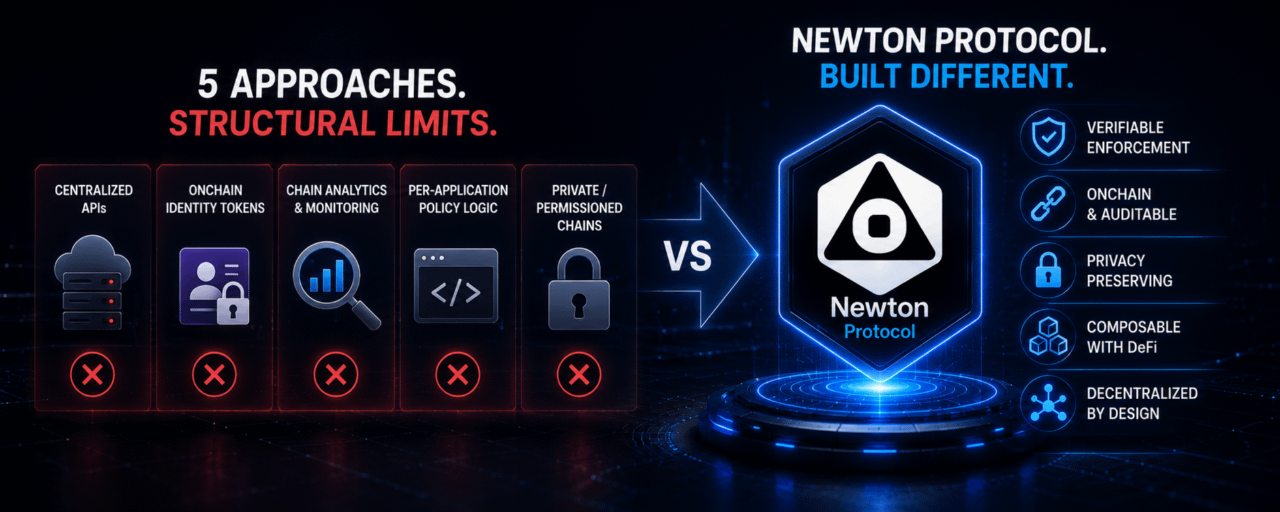
Centralized compliance APIs are the most common approach. A KYC provider or blockchain analytics firm exposes an API. Applications call it before transactions, or more often, after the fact for monitoring. The result is an advisory signal — a risk score, a pass/fail flag — that the application is free to act on or ignore. There's no enforcement binding. A developer with access to the API can build around it. The API response has no onchain existence, so there's no audit trail a regulator can verify independently. And the entire model depends on trusting one company's infrastructure to be accurate, available, and honest.
Onchain identity tokens — soulbound tokens and similar schemes — attempt to put compliance status directly on the blockchain. An address either holds the credential or it doesn't. The structural problem is selective disclosure: every attribute the token encodes is publicly visible. A soulbound KYC token proves a user completed verification, but it also exposes that fact to every observer permanently. Complex compliance rules — eligibility based on accreditation tier, jurisdiction, and transaction velocity combined — are difficult or impossible to express as a token state. And tokens are static: they reflect a credential at issuance time, not at transaction time.
Chain analytics and monitoring platforms are the backbone of most institutional DeFi risk management today. They're excellent at pattern recognition, behavioral scoring, and forensic investigation. The structural limit is temporal: they observe what happened after transactions settle, not before. An alert about a flagged transaction means the funds have already moved. Post-hoc detection is not enforcement.
Per-application policy logic — each protocol building its own compliance rules into its own smart contracts — produces a fragmented landscape where the same investor completes KYC separately for every application, the same compliance rule gets implemented differently across ten contracts, and audit evidence is scattered across incompatible systems. The enforcement quality is only as good as each individual team's implementation.
Private and permissioned chains attempt to solve compliance by controlling who can participate at the network layer. The structural cost is composability: a permissioned chain can't access the liquidity depth of public DeFi. Assets locked in a compliance-gated environment can't interact with Uniswap, Aave, or any of the open protocols where actual market depth lives. The model trades compliance for liquidity isolation.
@NewtonProtocol occupies a distinct position that none of these approaches share.
It provides verifiable enforcement — cryptographic attestations, not advisory signals.
It operates onchain — compliance receipts recorded on the chain, independently verifiable by anyone.
It preserves privacy — the blockchain sees proofs and aggregate attestations, never identity data or credential contents.
It's composable with public DeFi — Newton authorizes transactions that execute on Ethereum, Arbitrum, Optimism, Base, and other EVM chains, without requiring a permissioned fork.
It's decentralized — no single entity controls policy outcomes, the operator network is independently staked through EigenLayer, and dispute resolution is handled by mathematics.
The comparison that matters isn't Newton versus any single alternative.
It's whether the compliance infrastructure onchain needs actually requires all five properties simultaneously — verifiable, onchain, privacy-preserving, composable, and decentralized.
If any one of those can be sacrificed, existing approaches cover the need.
If all five are required together, Newton is the only structure designed to deliver them.
That's the infrastructure bet the protocol is making.