

I wasn't looking for anything specific when I started reading through Newton Protocol's documentation. I'd seen the token mentioned somewhere, the usual mix of automation and AI agents and onchain everything, and I went in expecting the same story I'd read a dozen times before about giving software limited access to a wallet instead of full custody. That part is fine and sensible and not particularly new. What kept pulling me back, though, was a smaller detail buried in the description of the Keystore component, the part of the system that manages user permissions separately from the chains where those permissions actually get used. It's described almost in passing, as if it were an implementation detail rather than a decision with consequences, and the more I sat with it the more it seemed like the kind of choice that quietly determines how trustworthy the whole system feels once people actually start relying on it.
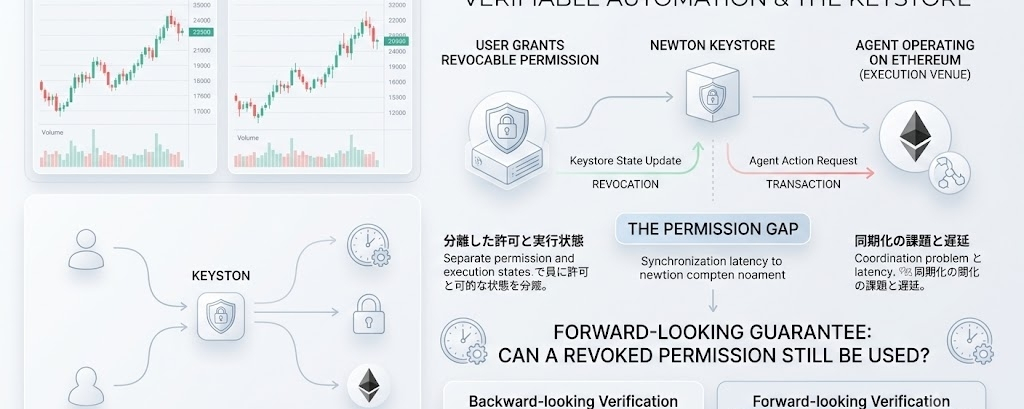
The basic idea is simple enough to state in one sentence. Instead of handing an automation agent your private key, you grant it a narrow, revocable permission, something like a session key or a cryptographic policy that only allows a specific action under specific conditions, and that permission lives in the Keystore rollup rather than on whatever chain the agent is actually operating on. So if you're using an agent to manage a position on Ethereum, the permission that authorizes it doesn't sit on Ethereum. It sits on Newton's own rollup, and Ethereum only sees the result once the agent acts within the bounds of a permission it already holds. What seems interesting is that this separation is presented as a security feature, and in most respects it clearly is one, since it lets permissions be updated, tightened, or expired without touching the underlying chain at all. But separating the place where permission is defined from the place where permission is exercised also means you've introduced a gap between two systems that need to agree with each other, and agreement between two systems is never instantaneous.
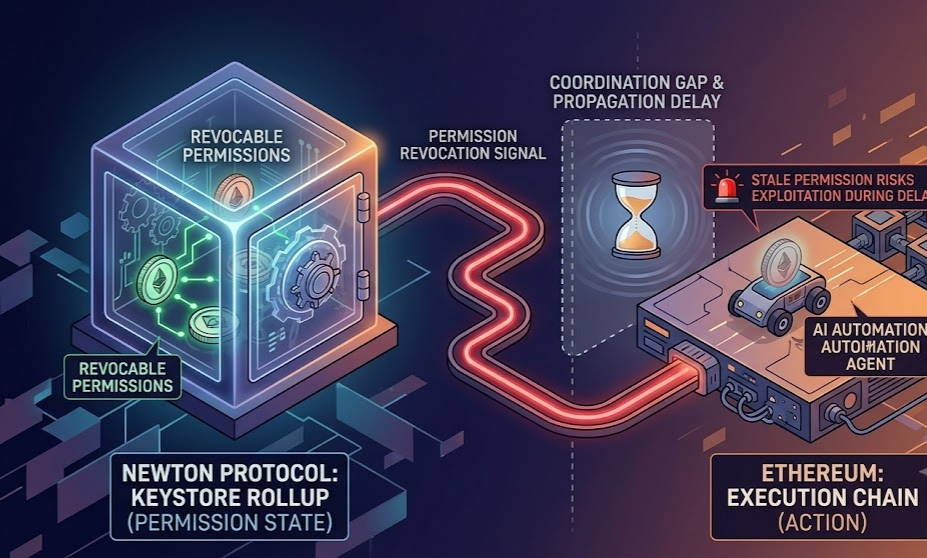
I kept turning this over because revocability is the entire selling point of the design. The pitch is that you can grant an agent access and then take it away the moment you're uncomfortable, and that this is meaningfully safer than a static key that either has full power or none. That's true in principle. But revocation only protects you in practice if it happens before an agent can act on the old permission, and if permission state lives on one rollup while execution happens on another chain entirely, there has to be some window, however small, in which an agent's local view of its own authority is technically stale. It isn't obvious from the documentation how that window is closed, whether by requiring execution venues to check permission state in near real time before finalizing an action, by some kind of freshness proof the agent has to carry with each transaction, or by accepting a small amount of lag as an unavoidable cost of doing this across chains. Each of those choices implies a different failure mode, and each failure mode implies a different kind of incident report someone will eventually have to write.
The more I thought about it, the less this felt like a niche implementation question and the more it felt like the actual crux of what "verifiable automation" is supposed to mean. It sounds straightforward until you notice that verification is usually framed as verifying that an agent's past action complied with its permissions, which is a backward-looking guarantee, something a slashing mechanism or an audit can check after the fact. What I don't see discussed as clearly is the forward-looking guarantee, the promise that a permission you just revoked cannot be used a moment later somewhere else. Backward-looking verification is comforting if you're willing to accept that damage might already be done and simply needs to be attributable and punishable. Forward-looking verification is the harder problem, because it requires the execution environment to always have current information, and distributed systems are notoriously bad at guaranteeing that anything is current everywhere at once.
What makes this difficult isn't the cryptography, which by this point is well understood territory, zero-knowledge proofs and session keys and delegated signing are all mature enough tools. What makes it difficult is the coordination problem sitting underneath the cryptography, the fact that Newton's Keystore and whatever chain an agent operates on are, from a systems perspective, two independently maintained sources of truth that happen to need to stay synchronized for the security model to hold. I sometimes wonder whether this is simply treated as an acceptable tradeoff, the same way a fourteen day unstaking cooldown is treated as an acceptable tradeoff for network stability elsewhere in the protocol, a known cost that gets absorbed rather than eliminated. That would be a defensible engineering choice. It would also mean that the word revocable is doing more reassuring work in the marketing than it can fully do in the mechanics, at least during whatever propagation delay exists between the two systems.
I haven't yet seen this addressed directly in anything public, and I suspect that's partly because it only becomes visible once you start asking what happens between the moment a user changes their mind and the moment that change takes effect everywhere it needs to. Most of the writing about protocols like this focuses on what agents are authorized to do and how misbehavior gets punished, which is important but is a different question from how quickly authorization itself can be withdrawn. As more of these agent based systems get built on architectures that separate permission state from execution state, this gap seems likely to matter more, not less, especially once agents are operating across several chains at once and the number of places a stale permission could be exploited multiplies. Whether that turns out to be a manageable latency problem or a structural weakness in how "revocable" automation is defined is probably not something documentation can settle. It may only become clear once people are actually depending on that revocation happening in time, and something, somewhere, tests it.
