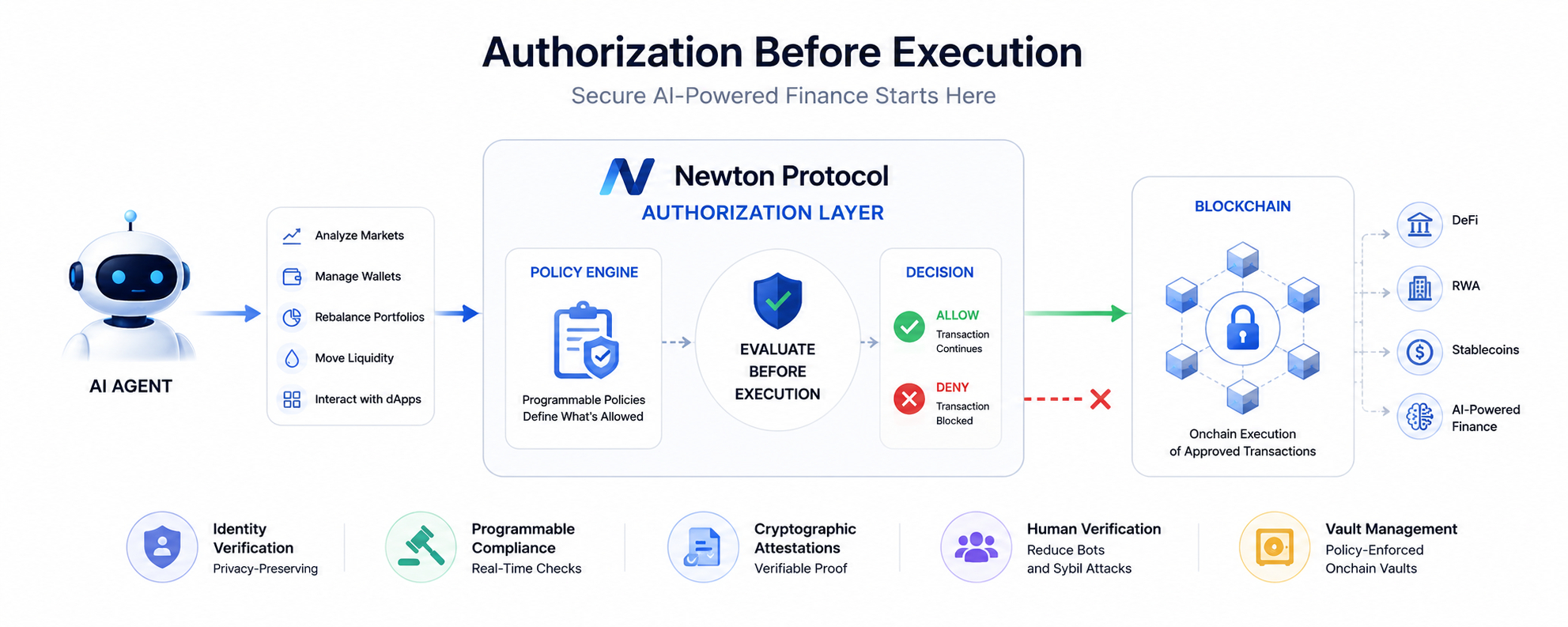

Artificial intelligence is quickly becoming part of the blockchain industry. Today AI agents can analyze markets manage wallets rebalance portfolios move liquidity and interact with decentralized applications without constant human input. Most discussions focus on making these agents smarter or faster but I think there is a much bigger question that deserves attention. Before an AI agent executes a transaction who decides whether it should have permission to perform that action?
After learning more about Newton Protocol I realized this project is trying to solve that exact challenge. Instead of building another AI model or competing to create better automation Newton is developing the authorization layer that sits between an AI agent and the blockchain. In simple terms it helps verify whether a transaction should be allowed before it is executed.
I believe this difference is important because intelligence and authorization are not the same thing. An AI can perform every task exactly as instructed and still create serious financial damage if it receives permissions that are too broad. Imagine an autonomous agent managing a portfolio. It executes every trade correctly signs every transaction and follows every instruction without making technical mistakes. If one policy accidentally gives that agent access to more capital than intended it can move funds exactly as authorized even if the outcome is disastrous. The AI did not fail. The permission system failed.
Newton Protocol approaches this problem through a concept called Authorization Before Execution. Rather than checking activity after assets have already moved every transaction is evaluated against programmable policies before execution. If the requested action satisfies those policies the transaction continues. If it does not the action is blocked before any value leaves the wallet.
One of the most interesting parts of the protocol is its decentralized policy engine. Instead of relying on manual reviews or simple wallet permissions developers can convert business rules into programmable policies. These policies can define which wallets an AI agent can access which decentralized protocols it may use how much capital it can allocate spending limits approved destinations rate limits and which actions require additional human approval. This creates controlled automation instead of unlimited automation.
Another feature that caught my attention is the idea of programmable compliance. Traditional compliance often depends on monitoring transactions after they happen. Newton moves those checks before settlement. Every action is evaluated using real-time onchain and offchain information allowing policies to react to changing conditions instead of relying on static rules created during onboarding.
Privacy is another area where the design feels practical. Many financial applications require identity verification but exposing personal information on a public blockchain creates obvious concerns. Newton addresses this challenge through privacy-preserving verification. Sensitive identity information is processed securely while only the verification result is used during authorization. The blockchain does not need to store personal details to confirm that the required policy has been satisfied.
The protocol also strengthens trust through cryptographic attestations. Every approved transaction can generate verifiable proof showing that the required policies were successfully enforced before execution. These receipts are more than simple records for auditors. They provide evidence that every authorized action stayed within predefined boundaries. Instead of asking users to trust that rules were followed the protocol allows those rules to be verified.
Another detail I found valuable is that authorization is not treated as a one-time event. Access to an application does not automatically grant permission for every transaction. Identity attributes such as residency jurisdiction nationality or other compliance requirements can be evaluated whenever a sensitive action is requested. If any required condition is no longer valid the transaction can be rejected automatically. This makes the system more adaptable as regulations evolve over time.
Newton has also expanded its ecosystem with integrations that strengthen this vision. Its integration with Persona introduces real-time identity and jurisdiction verification helping developers apply compliance policies before transactions are approved. The partnership with Human Passport focuses on verifying real human participants reducing the risks created by bots and Sybil attacks in governance systems decentralized applications and community programs.
Another milestone is the launch of Newton Protocol Mainnet Beta on Ethereum and Base. This demonstrates that the project has moved beyond theory and is now bringing its authorization framework into live blockchain environments. Alongside the mainnet launch Newton introduced VaultKit a framework designed for onchain vault management. Instead of depending only on the promises of vault managers VaultKit allows policies to be enforced automatically for every allocation and risk decision improving transparency and reducing operational risk.
I also think Newton arrives at an important time for the blockchain industry. Stablecoins continue to process billions of dollars tokenized real-world assets are expanding and AI agents are becoming more active across decentralized finance. As these technologies grow simply trusting automated systems may no longer be enough. Secure financial infrastructure will likely require programmable permissions verifiable policy enforcement and privacy-preserving compliance working together.#Newt
While short-term market movements and token unlocks often receive the most attention I believe long-term adoption will depend on real usage. Developer activity policy execution ecosystem growth institutional participation and demand for secure authorization may become more meaningful indicators than daily price changes. Infrastructure projects usually demonstrate their value through consistent adoption rather than temporary market excitement.#newt
After spending time researching Newton Protocol I see it as more than another blockchain project using AI as a narrative. It is focused on solving a practical problem that could become increasingly important as autonomous finance continues to grow. Building smarter AI is valuable but building systems that can define verify and enforce what AI is allowed to do may prove even more important.
For me that is what makes Newton Protocol worth following. The future of onchain finance will not depend only on intelligent software. It will also depend on reliable infrastructure capable of proving that every automated action stayed within clearly defined rules. If AI is going to manage the next generation of digital finance authorization may become just as important as automation itself and Newton Protocol is positioning itself to build that foundation.