

Spent the last few days going back to something I'd skipped over the first three times I read Newton's docs: the Model Registry.
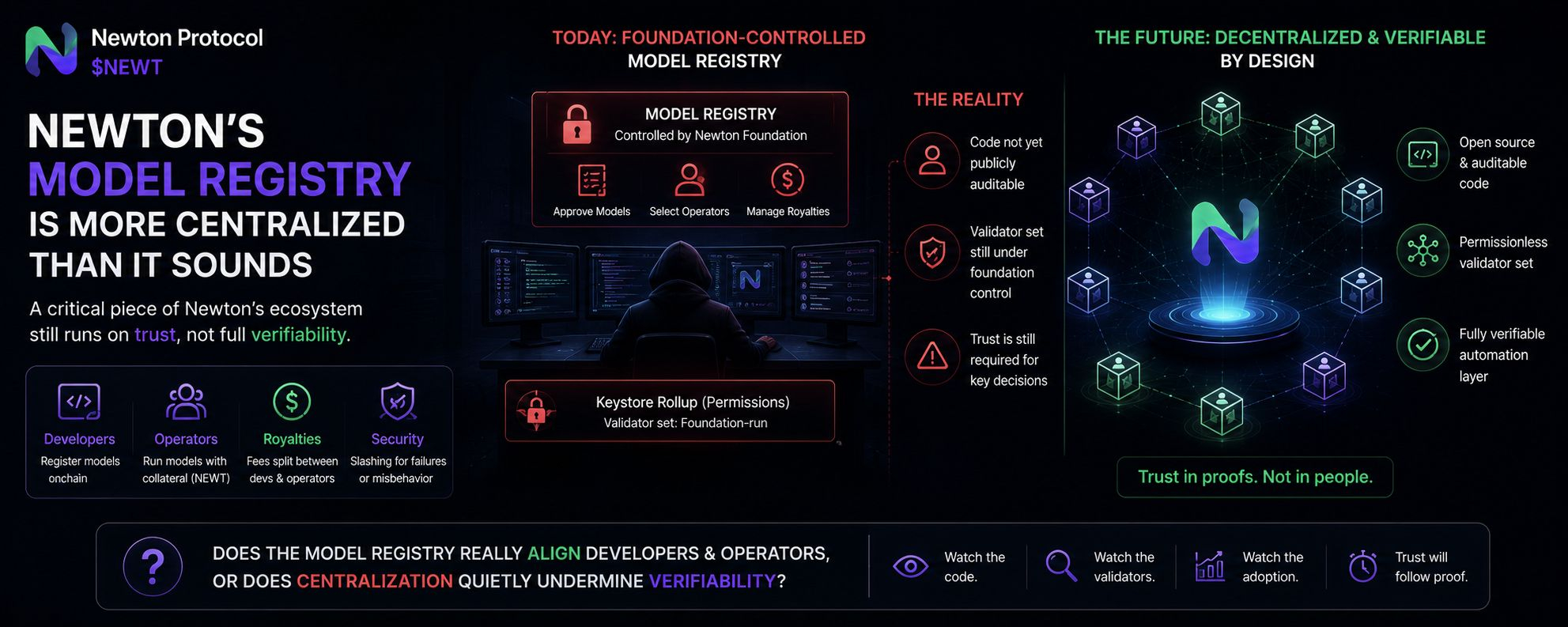
Everyone talks about VaultKit and the policy layer because that's the part that sounds most like a product. The Model Registry is quieter. It's the piece where a developer publishes an agent model onchain, an operator picks it up and runs it, and a fee splits between the two of them every time that model gets used. Register a model, pay the fee, wait for adoption, earn a royalty. Operators post NEWT as collateral to run the thing, and that collateral is what's supposed to get slashed if the model misbehaves or fails validation. On paper it reads like a clean two-sided marketplace. Developers write the logic, operators front the capital and the uptime, and NEWT sits in the middle pricing both sides of the relationship.
I kept sitting with a smaller detail, though.
As of Newton's own transparency report, the Model Registry and the Keystore rollup that stores permissions weren't in a public repository yet. The plan is to publish the code once development finishes, with the target repo already named. That's a normal sequencing decision for a young protocol. It's also worth being precise about what it means in the meantime. A registry that decides which agent models get listed, which operators get to run them, and how royalties get split is currently something the foundation operates rather than something the community can independently verify line by line. The validator set securing the Keystore rollup is described as moving from foundation-run to permissioned, and eventually to permissionless. Eventually is doing a lot of work in that sentence.
None of this makes the Model Registry fake. It means the "verifiable automation layer" pitch and the actual verifiability of the registry itself are running on different timelines right now.
Here's where I think the real tension sits. The pitch is that Newton replaces trust in a person with trust in a proof. An operator runs a policy check inside a TEE, produces an attestation, and anyone can verify that check happened correctly through the Newton Explorer. That's a genuinely different model than a human compliance officer eyeballing a transaction. But the registry that decides which models are even eligible to produce those attestations is, for now, closer to the old model than the new one. Someone at the foundation is still making judgment calls about what gets listed and who gets to operate. The slashing mechanism protects against an operator behaving badly once they're in the system. It says nothing about who decided they belonged in the system in the first place.
Price hasn't been kind to the patience this requires either. NEWT is trading a little under five cents, with a market cap sitting around fourteen million dollars, down roughly 94% from the all-time high it touched last summer, and it actually printed a fresh all-time low in the back half of June before bouncing modestly off it. Circulating supply is a little over a quarter of the billion-token max, and there's another unlock landing later this month worth close to 1.8% of total supply. That's not a chart that rewards a "come back in eighteen months once the registry is fully open" argument, even if the argument itself is sound.
I don't think the centralization is a red flag exactly. Rollups launch this way constantly, and a foundation-operated bootstrap phase is a fairly standard way to get a permission system live before handing it to a validator set that can actually be trusted with it. What I keep circling back to is that Newton's marketing voice and Newton's engineering timeline are telling two slightly different stories at the same moment. One says trust is being removed from the system. The other says, for now, please trust us a little longer while the parts that remove trust get built.
Maybe that's just what an honest early-stage infrastructure project looks like from the inside. The alternative read is less comfortable: that "verifiable" is being used as a finished-state description of an architecture that's still mid-construction, and the gap between those two only closes if adoption arrives before patience runs out.
Does the Model Registry's royalty design actually align developers and operators the way it's supposed to once the registry itself is out of the foundation's hands, or is the whole verifiability pitch quietly resting on the same trusted-party assumption it was built to replace?