
 Blockchains are extraordinary at execution and almost useless at judgment. A smart contract will move funds the instant its conditions are met, but it has no native concept of "this looks wrong, pause and check." Every safeguard — spending limits, sanctions screening, counterparty checks — has historically lived off-chain, bolted on by whichever exchange or custodian happened to build it. @NewtonProtocol Newton's core bet is that this missing layer, a place where a transaction gets evaluated before it settles, deserves to exist on-chain itself, as shared infrastructure rather than a private feature.
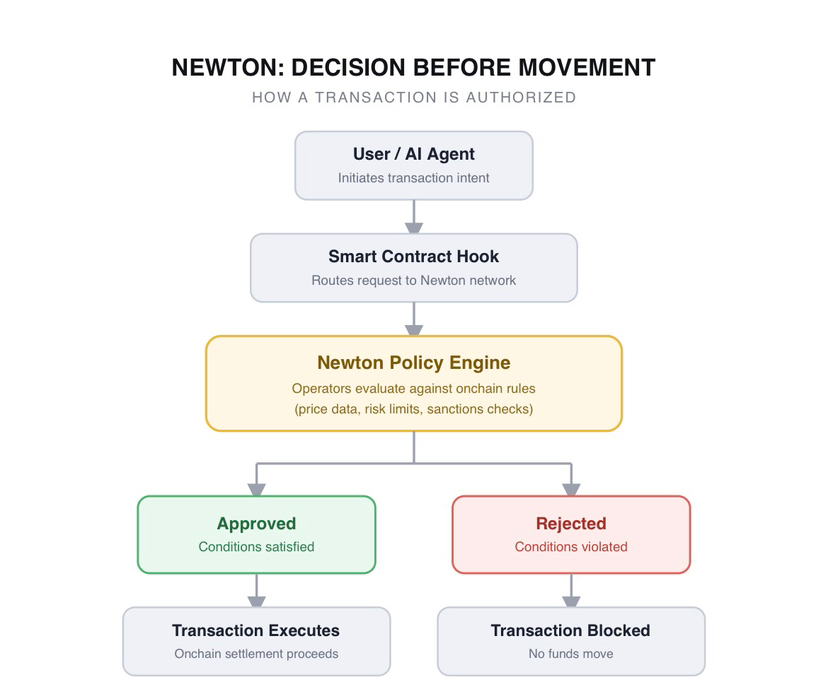
How it does this is worth sitting with, because the story has shifted. Newton's earlier technical documentation describes a system built on trusted execution environments and zero-knowledge proofs, with a dedicated "Keystore" rollup storing user permissions and a delegated-proof-of-stake validator set finalizing state Newton Keystore is a specialized rollup responsible for storing and updating user permissions, such as session keys and zkPermissions, that define which agents can act on a user's behalf. More recent descriptions, tied to its mid-2026 mainnet beta, characterize Newton differently: as an Actively Validated Service on EigenLayer, where a lightweight code snippet in a target smart contract routes a transaction request to the Newton network, whose operators evaluate it against policies written in Rego, a declarative policy language. Both descriptions could be true of different layers of the same system, or they could reflect a real pivot in emphasis as the project moved from concept to production. I haven't found a source that reconciles the two cleanly, so treat this as an open question rather than a settled fact — and it's exactly the kind of thing worth asking Newton or its validators directly before assuming either framing is complete.$NEWT
What does look consistent is the intent: pre-transaction policy enforcement for things like collateral checks, sanctions screening, and spend limits, with data feeds increasingly plugged in from outside partners. RedStone now supplies price data for collateral conditions, and Newton already works with Credora, a credit risk assessment provider, suggesting a strategy of assembling specialized inputs rather than building everything internally. That's a reasonable architecture, but it concentrates risk at each integration point — if Newton's policy engine relies heavily on one oracle for price data, a disruption there could cascade into transaction freezes across the platform.
The #Newt token's job is straightforward — staking for security, gas for permission and execution operations, and governance — with a fixed supply of one billion tokens and no inflationary mechanism planned. Governance itself is deliberately split: parameter changes go through staked-holder votes, but core protocol upgrades to rollup logic or consensus require validator coordination through hard forks, similar to Ethereum's process, which limits what token voting alone can actually change. Decentralization is also incomplete by design so far — the validator set is still transitioning from foundation control toward a permissioned, and eventually permissionless, structure, and a large token unlock in January 2026 has already tested how the market absorbs supply pressure independent of usage.#Newt
None of this makes Newton good or bad. It makes it a system whose real test isn't the pitch — it's whether the policy checks actually catch real bad transactions in production, whether validator decentralization proceeds on schedule, and whether the architecture description stabilizes as the code and audits become public. Those are the three things worth watching, not the analogy someone uses to explain it.$PYTH $YFI