
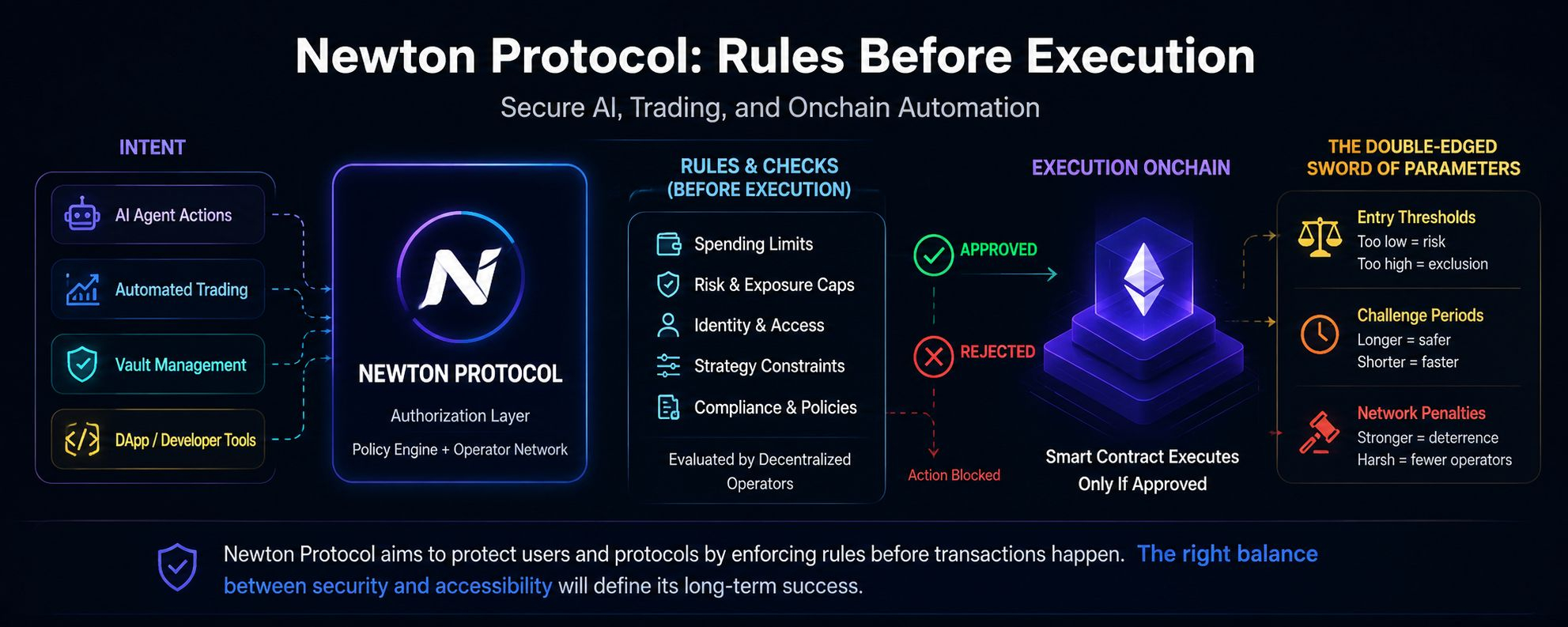

Newton Protocol is working on a problem that usually gets ignored until somebody loses money.
That is how this industry works. Everyone wants automation when markets are moving. Everyone wants agents, vaults, faster execution, cleaner strategy tools, and less manual clicking. Then something breaks, funds move where they should not have moved, and suddenly people remember that speed without limits is just another way to make mistakes faster.
I have seen this cycle too many times.
Newton’s idea is not hard to understand. Before an onchain action happens, there should be a rule that decides whether that action is allowed. Not a vague warning. Not a dashboard alert after the damage is done. A real check before execution. That is the part worth paying attention to.
The project is not only about letting automated systems trade or manage strategies. That is the noisy version of the pitch, and crypto already has enough noise. The more serious version is about putting boundaries around automation. A wallet should not be able to spend beyond a defined limit. A vault should not quietly drift outside its promised risk range. An agent should not get to touch funds just because someone once gave it broad permission and forgot about it.
That sounds sensible. Almost boring, actually. But boring is not always bad in infrastructure.
The harder question is whether Newton can make those rules useful without turning the whole thing into another layer of friction. Because that is where these projects usually start to grind. The first version sounds clean. The diagrams look disciplined. The language is careful. Then real users show up, real developers try to build, real markets move too quickly, and every parameter that looked simple in theory becomes a fight.
Entry thresholds are a good example. Set them low and the system is easier to access, but easier access always brings junk with it. Bots, weak agents, careless developers, bad strategies, recycled scams wearing new language. Set the thresholds high and the protocol looks safer, at least from a distance. Then smaller builders get squeezed out. Normal users fail checks they do not understand. The system becomes cleaner, but also narrower.
That is the uncomfortable part. Security has a cost, and projects usually pretend it does not.
Newton’s model depends heavily on policy enforcement. A transaction or agent action has to pass certain conditions before it moves forward. In theory, that is exactly what automated crypto needs. If an agent is going to manage value, it needs rules. If a vault manager is going to control user funds, there should be hard limits. If developers are going to build tools that act on behalf of users, those tools should not be trusted just because the interface looks professional.
But rules are never neutral. Somebody chooses them. Somebody adjusts them. Somebody decides what counts as risky, what counts as acceptable, and what gets blocked.
That is where I start paying closer attention.
A spending limit sounds harmless until it blocks a user at the wrong moment. A risk cap sounds responsible until a vault cannot react quickly during a market slide. A verification threshold sounds protective until it starts filtering out honest users along with attackers. These are not edge cases. They are the normal mess of crypto, just moved into a different part of the stack.
Challenge periods create the same problem from another angle. If Newton gives the network more time to challenge a bad decision, security improves. Fine. That makes sense. But longer challenge windows also mean slower action, and in markets, slow can be expensive. Automated trading does not wait politely. Vault rebalancing during stress does not happen in a calm room with perfect information. Sometimes the difference between protection and damage is minutes, maybe seconds.
Make the window too short and bad approvals can slip through. Make it too long and the product starts to feel stuck.
There is no magic setting here. That is the point. Anyone pretending there is one perfect parameter for every use case is selling comfort, not infrastructure.
Penalties are another place where Newton has to be careful. If participants who evaluate actions make a wrong call, there need to be consequences. Otherwise the whole security model becomes soft. But if the punishment is too harsh, honest operators may avoid difficult tasks or demand more compensation for taking the risk. That leads to fewer participants, less diversity, and eventually the kind of quiet centralization crypto keeps claiming it has moved past.
I’m not looking for the part where Newton works during calm conditions. Most systems work when nothing is happening.
I’m looking for the moment this actually breaks. A bad data input. A fast market move. A policy written too tightly. A dispute that comes too late. An operator punished for something that was not clearly malicious. A user blocked without a useful explanation. That is where the real character of a protocol shows up.
Newton has a real reason to exist. I will give it that. Crypto is moving toward more automated activity whether people like it or not. Users want tools that act for them. Vaults are getting more complex. Developers are experimenting with agents that can read, decide, and execute. The old model of “just sign this transaction and hope you understood it” is already worn out. It was worn out years ago.
So yes, a permission layer for automated onchain activity makes sense.
The problem is that good ideas in crypto are cheap. Execution is the grind. Adoption is the grind. Governance is the grind. Keeping the system open while making it safe is the grind nobody wants to talk about for too long because it does not fit neatly into a launch announcement.
Governance may be Newton’s biggest long-term test. Not the token branding. Not the first wave of integrations. Not the early excitement around AI agents. The real issue is who gets to change the rules once value is actually flowing through the system.
Who raises the thresholds?
Who shortens the challenge period because users are complaining?
Who increases penalties after something goes wrong?
Who decides whether a strict rule is protecting people or quietly shutting them out?
These questions sound procedural, but they are not. They decide what kind of project Newton becomes. A useful safety layer. A compliance-heavy bottleneck. A developer tool with too much overhead. A serious piece of infrastructure. Another overbuilt system that scares away the very users it needs.
The token side does not escape this either. NEWT is supposed to support security, fees, registry activity, usage, and eventually governance. That gives it a role inside the protocol. But I have seen plenty of tokens with roles. Roles are easy to list. Demand is harder. Real usage is harder. Surviving unlock pressure, market boredom, and fading attention is harder.
If Newton gets real adoption from developers, vaults, automated strategies, and projects that actually need pre-transaction control, then the token has something to stand on. If usage stays thin, the token will be left carrying a story that the product has not earned yet.
That is usually where the market gets tired.
The strongest thing about Newton is that it is not chasing only the shiny part of automation. It is looking at the duller, heavier part: permission, limits, review, enforcement. That matters. The weakest thing is that this same focus can make the system feel restrictive if it is handled badly. Too many rules and people leave. Too few rules and the whole security pitch weakens.
There is a narrow path here.
Newton has to protect users without making them feel trapped. It has to help developers without burying them in process. It has to give automated agents room to operate without letting them become loose machines with access to capital. It has to make governance strong enough to adjust, but not so powerful that every parameter change feels like a political risk.
That is a lot to ask from any crypto project.
Maybe Newton becomes useful infrastructure for the next stage of onchain automation. Maybe it becomes one of those technically serious projects that never quite escapes its own complexity. I am not ready to call it either way.
For now, I’m watching the parameters. That is where the truth usually leaks out.