
Newton’s privacy angle clicked for me when I stopped thinking about policy checks as public checklists.
The anchor mechanism is simple: a transaction intent can be checked against a policy using sensitive inputs, but the blockchain does not need to see every raw detail. The chain only needs a verifiable result: did the action pass or fail the rule?
That is where Newton becomes more serious.
It is not asking DeFi to choose between blind trust and full public exposure. It is trying to create a middle path where private context can influence authorization, while the onchain layer still receives proof that the policy outcome was valid.
That matters a lot.
Because the more DeFi moves toward vaults, RWAs, stablecoins, agents and institutional flows, the more private inputs become part of the transaction decision.
A vault may need counterparty risk data.
An RWA platform may need investor eligibility.
A stablecoin flow may need compliance checks.
An agent wallet may need spending permissions.
A treasury may need internal approval limits.
A smart account may need user-specific restrictions.
These are real rules, but not all of the raw data should live publicly onchain.
That is the tension Newton is solving.
Onchain systems love transparency. That is one of crypto’s biggest strengths. Anyone can check transactions, balances, contract calls and state changes. But transparency has a limit when the rule depends on sensitive information.
A user’s identity status does not need to be public.
A risk score does not always need to be public.
A compliance screening result may not need to reveal the full source data.
A vault’s proprietary risk model may not need to expose every internal parameter.
A credit or counterparty check may be useful for policy enforcement, but dangerous or unfair if fully published.
This is where many systems become awkward.
Either they keep the private data offchain and ask users to trust the operator, or they put too much information onchain and damage privacy.
Both extremes are weak.
Blind trust is weak because users cannot verify whether the rule was followed.
Full exposure is weak because privacy gets sacrificed just to prove a transaction was allowed.
Newton’s stronger idea is that sensitive inputs can affect the policy decision without becoming the public output.
The public output can be much cleaner:
This exact intent passed the required policy.
This exact intent failed the required policy.
The raw private context does not have to become the story.
The verifiable policy outcome becomes the story.
That is an important design shift.
In traditional finance, private information is used in decisions all the time. A bank may check identity, risk, sanctions, account status, limits and transaction behavior before approving a payment. The user does not expect every detail of that check to be printed publicly.
Crypto is different because it wants verifiability. But verifiability should not automatically mean exposing everything.
Newton sits in that gap.
It brings policy-based authorization closer to the transaction, while allowing the result to be checked without forcing all sensitive inputs into public view.
For me, this is the phrase that explains it best:
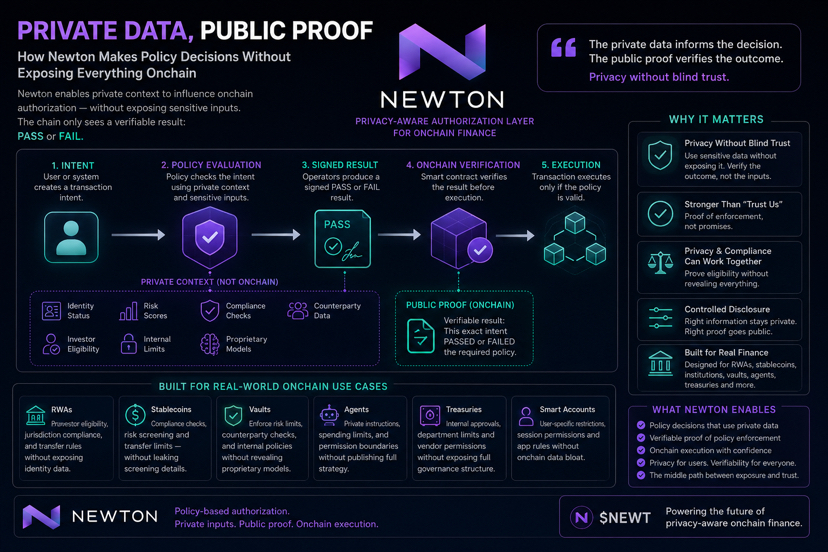
The private data informs the decision. The public proof verifies the outcome.
That is the privacy without blind trust model.
This matters most for RWAs.
Real-world assets do not behave like normal open tokens. They often come with rules. There may be eligibility conditions, jurisdiction limits, KYC requirements, investor type restrictions, transfer rules, redemption conditions or asset-specific compliance boundaries.
If an RWA transfer depends on user eligibility, the chain does not need to expose the user’s full identity. But the contract still needs to know whether the user passed the rule.
Newton’s policy model can make that cleaner.
The policy can evaluate the required condition. The signed result can tell the smart contract whether the transfer is allowed. The contract can act on the result without needing every private detail behind it.
That is a practical structure for bringing real-world constraints into onchain finance.
It also matters for stablecoins.
Stablecoins are payment-like rails, and payment rails often need rules. Some flows may need compliance checks, risk screening, transfer limits or blocked-address logic. The system does not need to publish every screening detail for every user. But it does need a way to prove that the policy was checked before movement.
Newton’s approach is useful because it turns the check into an authorization result.
The stablecoin transaction does not have to reveal the entire background process. It only needs to prove that the transaction passed the required rule before execution.
That is stronger than saying “trust us, we screened it.”
It is also cleaner than exposing every screening input onchain.
The same idea applies to vaults.
A vault policy may depend on information that is not always public or simple. Maybe the vault checks counterparty exposure. Maybe it checks a risk score. Maybe it uses internal limits. Maybe it has a private allowlist. Maybe it depends on a data provider’s risk signal.
Depositors care about whether the vault followed its rules.
But the vault may not want to reveal every internal risk model or every private counterparty detail publicly.
Newton gives a better model.
The rule can be enforced without turning the vault’s full risk logic into a public leak.
The transaction can pass or fail based on the policy.
The depositor can see that the vault action required policy approval.
The sensitive inputs can stay protected.
That is where privacy becomes useful for adoption, not only personal protection.
Institutions will not bring serious workflows onchain if every internal control, every risk input and every user detail must become public. At the same time, users will not trust serious onchain products if everything important happens behind closed doors.
Newton’s value is in creating a verifiable boundary between those two needs.
It lets a system use sensitive context without making the user fully dependent on private promises.
That is why I see this as a strong project angle.
A lot of crypto privacy content focuses only on hiding transactions. Newton’s privacy angle is different. It is about selective disclosure inside authorization.
The transaction may be public.
The policy result may be public or verifiable.
But the raw inputs behind the policy do not all need to be exposed.
This is more realistic for financial applications.
Because not every secret is suspicious.
Some secrets protect users.
Some protect business logic.
Some protect security.
Some protect compliance processes.
Some protect counterparties.
Some protect the quality of risk systems.
The mistake is thinking every private input means blind trust. It does not have to. The better question is whether the system can prove the outcome without exposing the input.
Newton is built around that kind of thinking.
The policy check becomes a filter between raw private context and public execution.
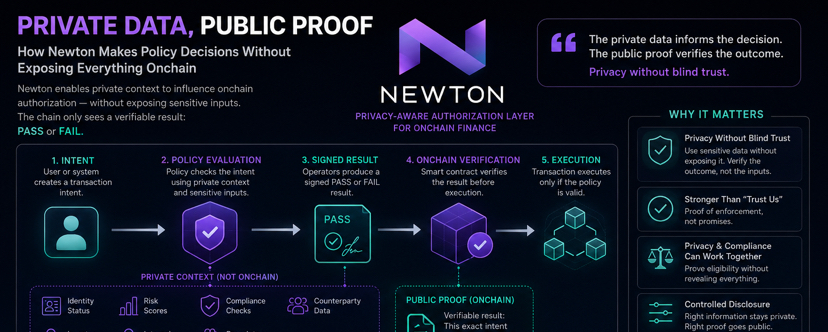
A user or system creates an intent.
The policy evaluates the intent using the needed context.
Operators produce a signed pass or fail result.
The smart contract can verify that result before execution.
Only the necessary proof reaches the execution layer.
That is a clean separation.
The app does not need to throw all private data onto the chain.
The contract does not need to become a privacy leak.
The user does not need to blindly trust that rules were followed.
The transaction can still be controlled.
This is especially important for agents.
Agent wallets are going to need private instructions and limits. A user may not want to publish every agent permission, every spending rule, every preferred app, every budget, or every internal strategy. But the agent still needs constraints.
An agent might be allowed to spend within a certain limit.
It might only interact with approved contracts.
It might require a certain risk condition before acting.
It might be blocked from specific destinations.
It might need session-based permission.
Those rules can involve private user preferences. Newton’s model fits because the policy can decide whether the agent action is allowed without exposing the entire private instruction set onchain.
That is the difference between useful automation and dangerous automation.
An agent should not be fully public in every detail.
It also should not be trusted blindly with capital.
Newton gives a way to place a rule layer between the agent’s intent and the smart contract’s execution.
That is a very practical privacy use case.
The same applies to treasury wallets.
A treasury may have internal approval rules, department limits, vendor permissions, signer thresholds, timing rules or spending categories. Not all of that should be published in raw form. But the treasury still needs onchain control.
Newton can support the idea that a transfer only executes if the policy approves it, while the details of the internal approval structure do not all need to become public.
This is where the project becomes more than DeFi safety.
It becomes transaction governance infrastructure.
Not governance as in token voting only.
Governance as in: how does an onchain system decide what is allowed, using the right information, without leaking everything?
That is a much bigger category.
This is also why privacy and compliance are not opposites here.
A lot of people talk about privacy and compliance like they are enemies. In real financial systems, they often need to work together. A user can prove eligibility without exposing everything. A transaction can satisfy a rule without showing all private data. A vault can enforce risk limits without revealing its full model.
Newton’s policy structure can support that middle ground.
It does not make every transaction private.
It does not make every rule public.
It makes the policy outcome verifiable.
That is the key.
For Binance Square readers, I think this is the high-mindshare angle: the future of onchain finance will not be built on total exposure or total trust. It will be built on controlled disclosure.
Some information stays private.
Some proof becomes public.
The transaction only moves if the proof is valid.
That is a more mature design.
The user does not need to reveal everything to be verified.
The builder does not need to expose every internal input to enforce rules.
The smart contract does not need to understand private context directly.
The network still gets a verifiable policy result before execution.
This is why Newton’s privacy angle matters for adoption.
A small DeFi app may survive with simple public rules. But serious capital is different. Institutions, RWA issuers, stablecoin systems, treasuries and automated agents all need policy decisions that may depend on sensitive inputs.
If Newton can make those decisions verifiable without forcing full data exposure, it gives these applications a stronger path onchain.
That is where NEWT becomes more interesting to me.
The token story is not only about policy checks as a feature. It is about whether Newton becomes the network that helps convert private policy context into verifiable execution permission.
That creates a real demand path.
More vaults needing private risk checks.
More RWAs needing eligibility proofs.
More stablecoin flows needing compliance-aware authorization.
More agents needing private permission boundaries.
More treasuries needing internal spend controls.
More apps needing policy decisions without exposing all user data.
Each of those use cases points toward the same problem.
How can a transaction prove it is allowed without revealing everything that made it allowed?
Newton is built directly near that problem.
This is also why blind trust is not enough anymore.
A team saying “we checked it privately” may work in Web2. It is weaker in crypto because users expect more verifiability. But forcing every detail onchain creates its own problem.
Newton’s better direction is proof of enforcement.
The user does not need every private detail.
The user needs assurance that the policy was checked.
The contract does not need the full identity file.
The contract needs a valid authorization result.
The vault depositor does not need to know every internal risk score.
They need to know the action could not execute without passing policy.
That is a more useful standard.
I also like this angle because it is realistic. It does not pretend that privacy is simple. It does not pretend every app should hide everything. It does not pretend public chains should become private databases.
It accepts the real tension.
Onchain finance needs transparency.
Real financial rules need sensitive inputs.
Newton tries to let both exist in the same flow.
That is a strong architectural position.
It makes Newton more than a monitoring layer and more than a compliance label. It makes Newton a policy engine that can help decide execution without turning every input into public data.
That is how I would frame the project.
Not privacy as darkness.
Privacy as controlled exposure.
Not trust me.
Not show everything.
Prove the decision.
That is the line.
My personal take is that this may become one of Newton’s most underrated advantages. People will focus on pass/fail attestations, vaults, operators and authorization. Those are important. But the privacy layer behind policy outcomes may matter just as much if Newton wants to serve serious applications.
Because serious apps do not only need rules.
They need rules that can use sensitive data safely.
And they need those rules to become enforceable before capital moves.
That is what newton is pointing toward.
A transaction can be checked without exposing the entire reason publicly.
A policy can be enforced without becoming a public leak.
A user can be verified without turning their identity into onchain baggage.
A vault can prove discipline without revealing every internal model.
An agent can follow private limits without broadcasting its whole instruction set.
That is privacy without blind trust.
And if $NEWT becomes the layer that helps onchain systems prove policy outcomes while protecting sensitive inputs, the project story becomes much bigger than another DeFi tool.
It becomes part of the privacy aware authorization layer that serious onchain finance will need.