
I remember When people describe Newton, they usually focus on the mechanism: policies written in Rego, operators reaching consensus, cryptographic proofs. That's the machinery. But machinery only matters as much as what it's fed, and what Newton feeds its policies is a curated list of outside vendors. Look closely at that list and you start to see what Newton actually is: less a compliance engine, more a structured way of deciding which compliance and data vendors get to matter.@NewtonProtocol 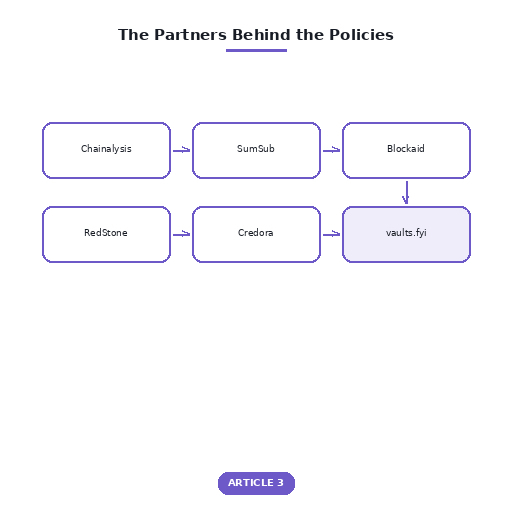
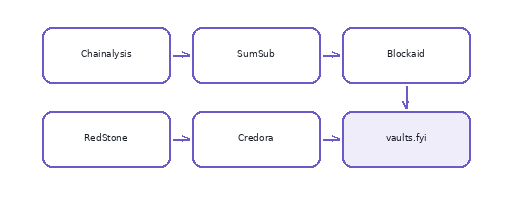
At mainnet beta, the roster splits into two clear jobs. Compliance and identity checks run through Chainalysis for sanctions and address screening, Sumsub for identity verification, and Blockaid for catching malicious transactions before they reach a vault's logic. Risk and market data run through RedStone for price feeds, Credora for risk ratings and collateral intelligence, vaults.fyi for live vault health signals, Balancer for pool composition, and Webacy and Guardrail for depeg and protocol-health monitoring. None of these are Newton's own creations. Newton didn't build a sanctions list or a price oracle — it built the slot these things plug into.$NEWT
That's a deliberate choice, and it's worth sitting with why. Chainalysis is already the blockchain analytics provider regulators and exchanges lean on, so plugging it in imports existing institutional trust rather than asking the market to trust something new. RedStone already serves price feeds across more than a hundred networks for protocols like Spark and Morpho, and vaults.fyi already tracks yield and risk across more than a thousand vaults for clients including Kraken Wallet and Maple Finance. Newton is composing infrastructure that has already been tested elsewhere, instead of reinventing sanctions screening or oracle design from scratch. That's faster and arguably more credible than a lone team building every check in-house.
Newton has also said this ecosystem is deliberately open — any compliance vendor or data provider can, in principle, publish a policy pack, and it's curators who decide which ones to trust rather than Newton picking winners. That's a meaningful design stance. It means Newton isn't claiming to be the authority on what counts as compliant or safe. It's claiming to be neutral plumbing that lets someone else's authority — Chainalysis's sanctions data, Credora's risk models — actually get enforced instead of just referenced in a document.#Newt
But neutrality has a cost, and it's the same cost every dependency chain carries: a policy that checks RedStone for price and Credora for risk is only as good as those two systems being accurate and online at the exact second a transaction is evaluated. Newton's enforcement can be perfectly deterministic and still produce a wrong outcome if the price feed it's reading is stale or the risk score it trusts is miscalibrated. Cryptographic certainty about how a rule was applied says nothing about whether the inputs to that rule were correct. That's not a defect specific to Newton — every system that composes external data inherits this problem — but it's easy to miss when the marketing language centers on "enforcement" rather than "dependency."#newton
The useful question for anyone evaluating Newton isn't whether the architecture is clever, which it is. It's which specific vendors a given policy actually depends on, whether those vendors have a track record of being right under stress rather than just under normal conditions, and what happens to that policy's guarantees the moment one of its data sources goes dark or gets it wrong. Newton didn't remove the trust problem in DeFi compliance. It relocated it, made it explicit, and left it for the reader to check$A .$GRAM
