
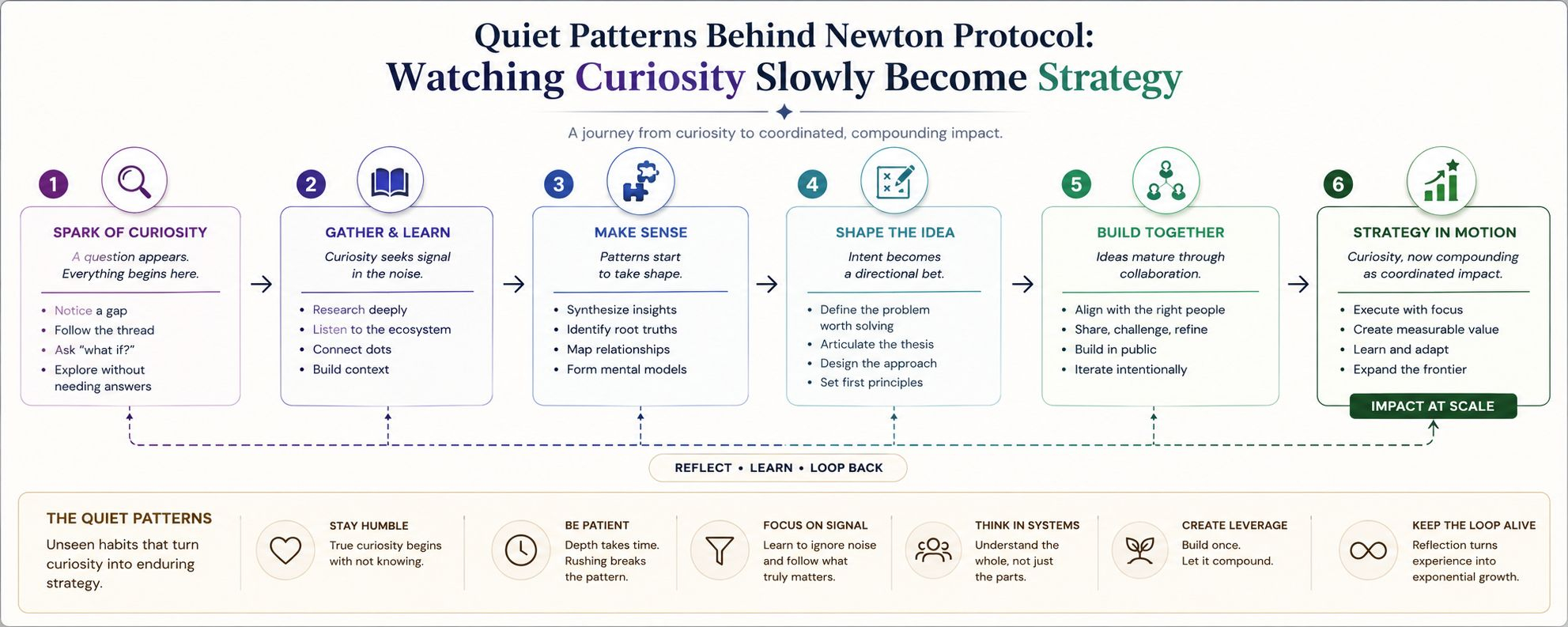

I’ve been watching this corner of the space for long enough to recognize the familiar pattern before it fully settles in. At first, people usually arrive with a kind of plain curiosity. They look at a protocol like Newton and see possibility, maybe even usefulness, before they start seeing angles, incentives, and ways to turn attention into an advantage. That shift is small at first. Almost invisible. But I keep noticing it.
What begins as interest often turns into habit. People stop asking what something is for and start asking how it performs, how it ranks, how it compares, how quickly it can be used. The early talk is usually about what could be built. Later, it becomes about what can be captured. I’m starting to wonder if that change says more about us than it does about the system itself. The structure may invite it, but people still walk in willingly.
With something like Newton Protocol, the promise sounds clean on the surface: a place where AI-driven strategies, automated trading, and developer marketplaces can meet inside a more secure framework. But I’ve noticed that whenever a system is built around coordination and rewards, the human side gets complicated fast. The same tools that are meant to make participation easier can also make it easier to chase status, to optimize for appearances, or to follow whatever behavior seems most likely to be noticed.
That is where my skepticism usually starts. Not because I think the idea has no value, but because I keep seeing how quickly fairness becomes difficult to judge once incentives are involved. What looks organic from a distance can sometimes be shaped by quiet advantages underneath it. Recognition, access, and credentials have a way of moving people in subtle directions. They do not need to be announced to be felt. And once enough people adapt to them, the original purpose can become hard to distinguish from the game around it.
Still, I do not think that makes everything empty. I’ve seen enough to know that real curiosity does exist, even after the noise arrives. Some people still come to these systems hoping to make something useful, or to learn, or to find a cleaner way of working. That part matters to me. It is just that sincerity and strategy tend to live side by side, and over time strategy usually gets louder.
So when I look at Newton Protocol, I do not see a finished story. I see another place where intention, reward, and behavior will keep shaping one another in ways that are not always easy to measure. I think that is what keeps me interested, even when I am not fully convinced. I’m still watching, still trying to separate what is truly being built from what people want to believe is being built, and I suspect that tension will tell us more than any polished explanation ever could.
