

The first time I sent money through a blockchain, I remember staring at the transaction hash more than the amount itself. It felt reassuring. There it was—public, permanent, impossible to change. The blockchain had given me proof that something happened. Years later, I realized that wasn't the proof I actually wanted. I didn't just want evidence that a transaction existed. I wanted evidence that it should have happened in the first place. That difference is where Newton becomes interesting.
Crypto has spent years making transactions transparent.
Every transfer leaves a record. Every block becomes part of a permanent history. Anyone can inspect what happened after the fact. Transparency has become one of blockchain's defining strengths.
But transparency answers only one question.
What happened?
It doesn't automatically answer another question that is becoming much more important.
Did the transaction follow the rules it was supposed to follow?
Those are completely different ideas.
Imagine walking into a building where every door is protected by security cameras.If someone enters, the cameras capture it perfectly. Later, everyone can watch the footage.
The recording proves the event happened.
It doesn't prove the person was authorized to enter.
Blockchain works in a surprisingly similar way.
Once a transaction is executed, everyone can verify that it occurred. What often remains harder to verify is whether the action respected the conditions that users, businesses, or automated systems intended to enforce.
Newton focuses on closing that gap.
Instead of treating authorization as an invisible step that disappears after approval, it introduces cryptographic proofs that allow policies themselves to become verifiable. That sounds technical at first, but the underlying idea is surprisingly simple.
Think of a boarding pass at an airport.
The airline doesn't need to know every detail about your life before allowing you onto a plane.It only needs proof that you've satisfied specific requirements-a valid ticket, identity verification, and the correct flight.....
The proof matters more than unnecessary information....
Newton applies a similar philosophy to blockchain authorization.
Rather than expecting applications to simply trust that internal rules were followed, the system aims to produce cryptographic evidence that predefined policies were actually respected before execution occurred.
That changes the role of trust itself.
Most digital systems still rely heavily on reputation.
Users trust applications because they've existed for years.
Businesses trust software because vendors promise compliance.
Developers trust integrations because documentation says they work correctly.
Those relationships aren't necessarily bad, but they're still built on assumptions.
Cryptographic proofs replace some of those assumptions with mathematical verification.
Not because mathematics is more exciting than trust.
Because mathematics doesn't depend on memory, reputation, or promises.
It simply confirms whether conditions were satisfied.
That subtle difference becomes much more meaningful as blockchain grows beyond individual users.
Imagine an investment fund managing digital assets across multiple teams....Portfolio managers initiate trades....
Compliance departments establish restrictions.
Executives approve larger movements...!
Auditors review activity months later....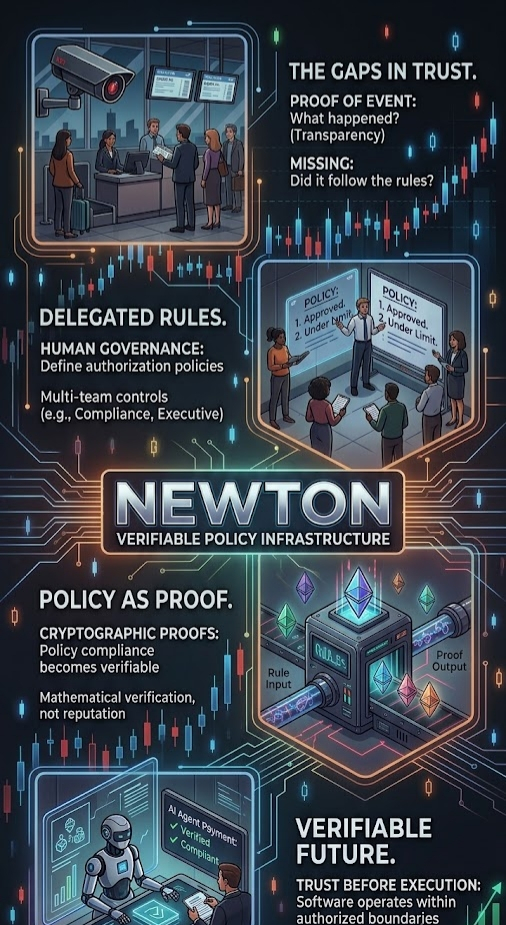
On the surface, everyone simply sees transactions being completed.
Underneath, each transaction may depend on dozens of internal policies.
Without verifiable proofs, organizations often rely on logs, screenshots, internal databases, or manual reporting to demonstrate those policies were respected.
Newton explores a different direction.
The proof itself becomes part of the infrastructure rather than something reconstructed afterward.
That doesn't just improve auditing.
It changes how confidence is established from the beginning.
The same logic applies to artificial intelligence.
One of the biggest questions surrounding AI isn't whether models can make decisions.
It's whether people can verify those decisions stayed inside acceptable boundaries.
Suppose an AI agent manages recurring business payments.
If it pays the correct invoices, everything appears normal.
If someone later asks why one payment exceeded a spending policy, simply pointing to the blockchain isn't enough.
The blockchain proves the payment happened.
It doesn't explain whether the authorization process remained consistent with predefined rules.
Cryptographic proofs begin filling that missing layer.
Instead of asking users to trust that software behaved correctly, the system seeks to provide evidence that software operated within authorized conditions.
That becomes increasingly valuable as automation expands.
Meanwhile, another pattern is quietly emerging across finance.
Financial institutions are showing growing interest in tokenized assets, stablecoins, and programmable financial infrastructure.
These organizations already operate under strict regulatory and internal governance requirements.
They don't simply need transactions to succeed.
They need those transactions to remain explainable.
Every approval.
Every restriction.
Every exception.
Every authorization path.
Traditional finance spends enormous resources documenting these processes because accountability matters long after execution finishes.
Newton appears to recognize that blockchain transparency alone doesn't automatically satisfy those expectations.
Proof of execution and proof of policy are related, but they aren't identical.
Of course, cryptographic proofs aren't a magic solution.
They introduce additional computational work.
Developers must design policies carefully.
Organizations need to decide which conditions deserve verification and which don't.
Complex systems always carry implementation challenges.
There's also a practical question.
Will developers embrace another infrastructure layer if existing systems already function well enough?
That remains uncertain.
Technology succeeds not only because it solves problems but because those solutions become easier than existing alternatives.
Newton still has to demonstrate that balance over time.
What I find compelling isn't simply the technology itself.
It's what the technology suggests about where blockchain is heading.
For years, crypto celebrated immutability.
An immutable ledger guaranteed that records couldn't be altered.
Now attention seems to be shifting toward something slightly different.
Verifiability.
Not just proving history.
Proving behavior.
That feels like an important evolution.
As software becomes increasingly autonomous, users won't only ask whether systems executed correctly.
They'll ask whether systems followed the rules they were expected to follow while making decisions independently.
Those questions aren't answered by faster block times or cheaper transactions.
They're answered by evidence.
Real evidence.
Cryptographic evidence.
When I step back, Newton's work on cryptographic proofs feels less like adding another security feature and more like changing what blockchain records actually represent.
Instead of preserving only the fact that something happened, it pushes toward preserving confidence that the right thing happened for the right reasons.
That may sound like a small distinction today.
But history has a habit of showing that the quietest improvements are often the ones every future system eventually assumes were there from the beginning.
