I can imagine a vault doing everything correctly and still making the wrong move.
The policy is active. The operators evaluate it honestly. The required threshold is checked. A signed attestation is produced. The transaction settles exactly as the system intended.
Yet the decision may still be wrong because the information behind that decision was stale, incomplete, or inaccurate.
That distinction is what I find most important about Newton Mainnet Beta.
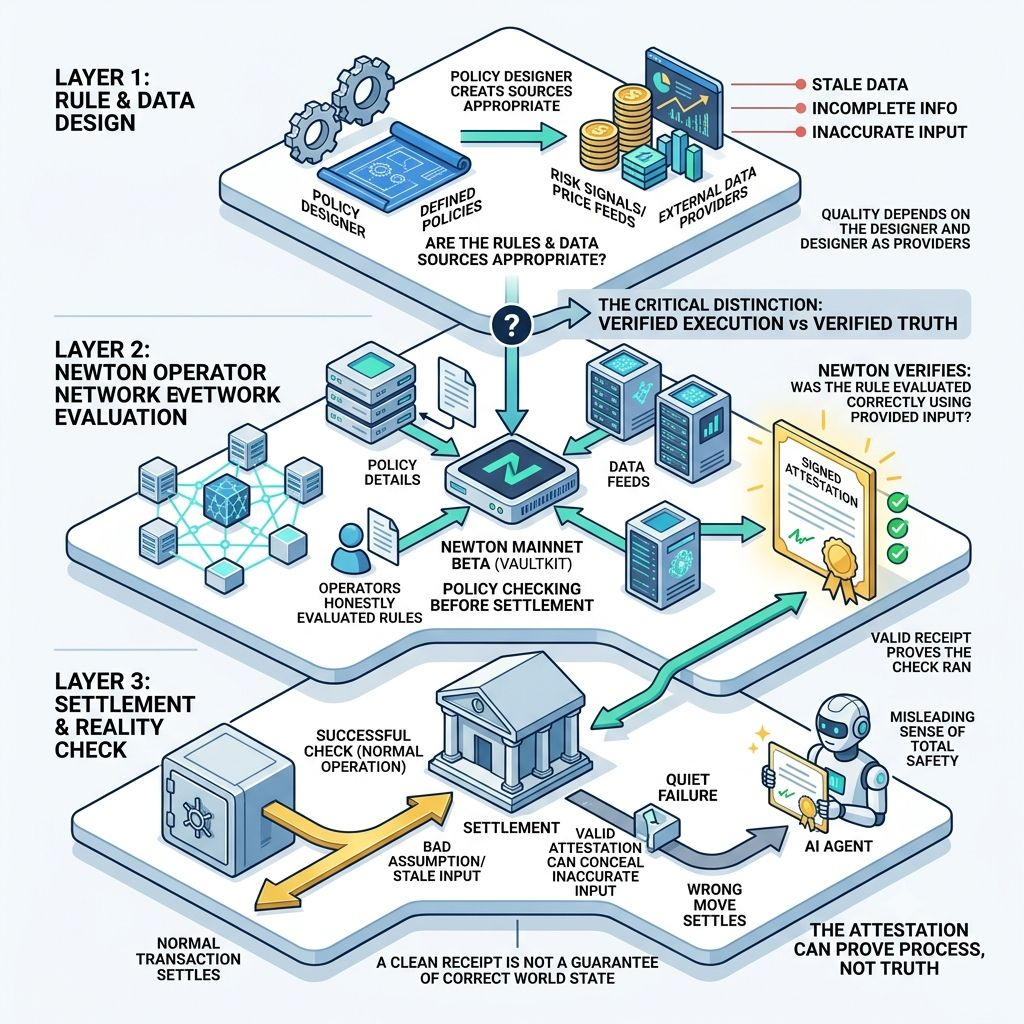
The Decision Has Three Separate Layers
When I look at automated authorization, I separate the process into three questions:
Was the rule appropriate?
Was the input reliable?
Was the rule evaluated correctly?
These questions are connected, but they are not interchangeable.
Suppose a vault is instructed to reduce exposure when its collateral ratio falls below a defined level. Through VaultKit, that policy can be checked before settlement rather than after the position has already changed.
If the policy depends on a RedStone price feed or a Credora risk signal, Newton’s operator network can evaluate the rule using that information and produce a signed attestation recording the result.
That gives me a meaningful guarantee:
The authorization check ran according to the policy and the available input.
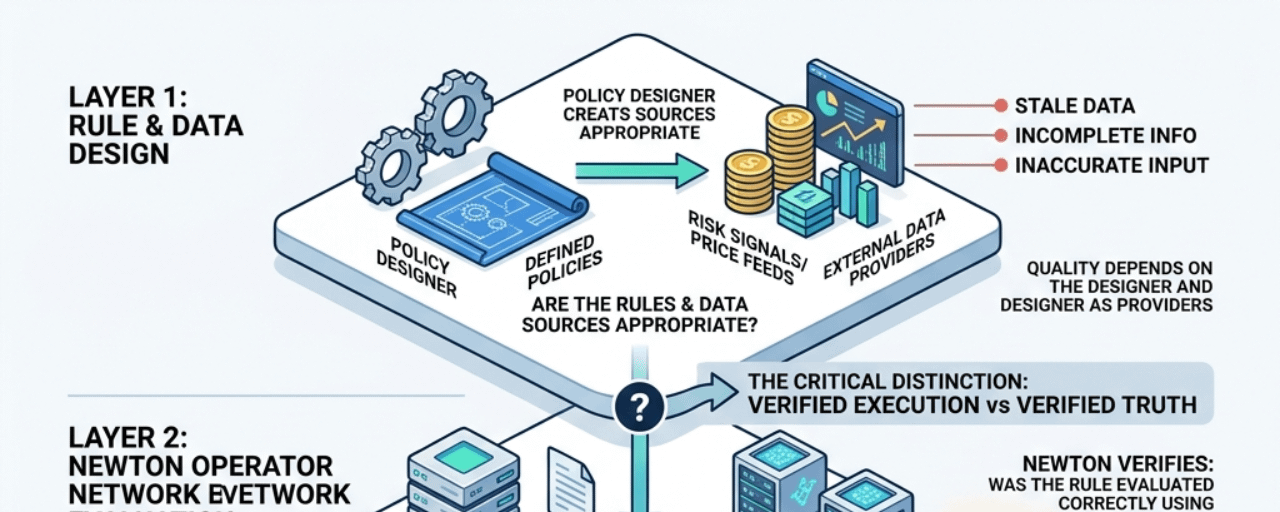
But it does not automatically guarantee that the price feed reflected the market perfectly, that the risk score captured every new development, or that the threshold itself was still appropriate.
I think this is where the word “verified” can become misleading if its scope is not explained carefully.
A Valid Receipt Can Carry a Bad Assumption
What interests me about @NewtonProtocol is that it moves authorization into the execution path.
A frontend warning can be ignored.
A monitoring system may identify a problem only after settlement.
An audit can examine code, but it cannot approve or reject every future transaction.
Newton approaches a different part of the problem. It checks whether an action satisfies a predefined policy before the action becomes final.
That is useful infrastructure.
Still, a signed attestation proves something narrower than total safety.
It can prove that the check occurred.
It can help prove that operators followed the required process.
It can provide an onchain record of the authorization decision.
It cannot make an inaccurate external input true.
For me, this does not weaken Newton’s purpose. It clarifies the division of responsibility.
Newton is responsible for verifiable policy execution.
Data providers remain responsible for the quality and freshness of their information.
Policy designers remain responsible for choosing the correct conditions.
Applications remain responsible for explaining what the attestation actually means.
When these responsibilities are blurred together, a valid receipt may be trusted more broadly than it should be.
The Quiet Failure Is More Concerning Than the Obvious One
An obvious failure is usually easier to recognize.
If a transaction reverts, I know it failed.
If an operator refuses to follow the required process, the network may be able to identify that behavior.
If an action violates a written policy, authorization can block it.
The more difficult failure is one that looks completely normal.
A stale price enters the policy.
The policy evaluates successfully.
The attestation is valid.
The transaction settles.
Every visible part of the authorization process appears correct even though the original input was wrong.
This becomes more important when AI agents act without continuous human review.
An automated strategy may interpret a valid attestation as proof that an action is safe. But the attestation may only prove that the action was consistent with a particular policy and data source at a particular moment.
That is still valuable.
It is simply not the same as proving that the entire decision was correct.
What I Would Look for Beyond the Attestation
As Newton Mainnet Beta develops I would not judge the system only by how many policies or transactions it evaluates.
I would also examine the quality of the decision pipeline around those checks.
I would want to know:
how recent the external data was when the policy ran;
whether a critical decision depended on one provider or several;
what happens when a data source becomes unavailable;
whether an attestation identifies the input and policy version used;
how applications respond when two sources disagree;
whether an agent understands the limits of the proof it receives.
These details may appear less exciting than automated trading or AI-driven strategies, but I think they will determine whether serious capital can rely on the system.
The stronger Newton becomes as an authorization layer, the more carefully its surrounding applications will need to explain the difference between verified execution and verified truth.
My View
I see Newton Mainnet Beta as an attempt to make onchain decisions more acountable before settlement.
VaultKit can help convert broad authority into explicit conditions. The operator network can evaluate those conditions. Signed attestations can make the authorization process observable and verifiable.
That is a substantial improvement over relying only on trust, documentation, or investigation after funds have moved.
But I would not interpret a clean attestation as a guarantee that every assumption behind the decision was correct.
For me, the most accurate claim is also the strongest one
Newton can help prove that a defined policy was evaluated correctly using the information provided.
It cannot replace the need for trustworthy data, careful policy design, and clear communication about what was actually verified.
The receipt can prove the check.
The harder task is making sure the world behind that check was represented accurately.