
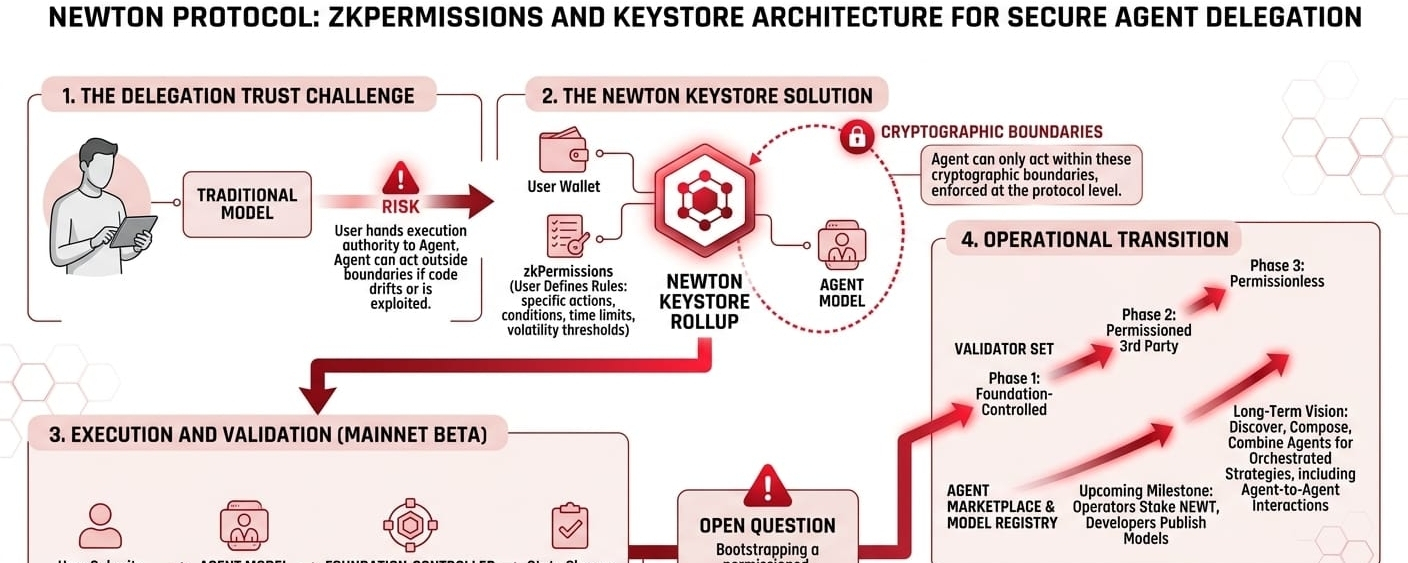
I was reading through some older material on smart account delegation last week, the kind of dry technical writing that accumulates in bookmarks and never gets properly finished. I had been thinking about a specific problem that I don't see discussed enough: when a user hands execution authority to an automated agent, what exactly is being handed over, and what prevents the agent from acting outside the boundaries of what the user intended? In traditional setups the answer is basically nothing enforceable at the protocol level. You trust the operator's code, and if the code drifts or gets exploited, the damage happens before any human can intervene. It seems obvious when you lay it out that way, but I sometimes wonder how many people deploying automated strategies today have actually sat with that thought carefully rather than just accepting it as a background risk of the space.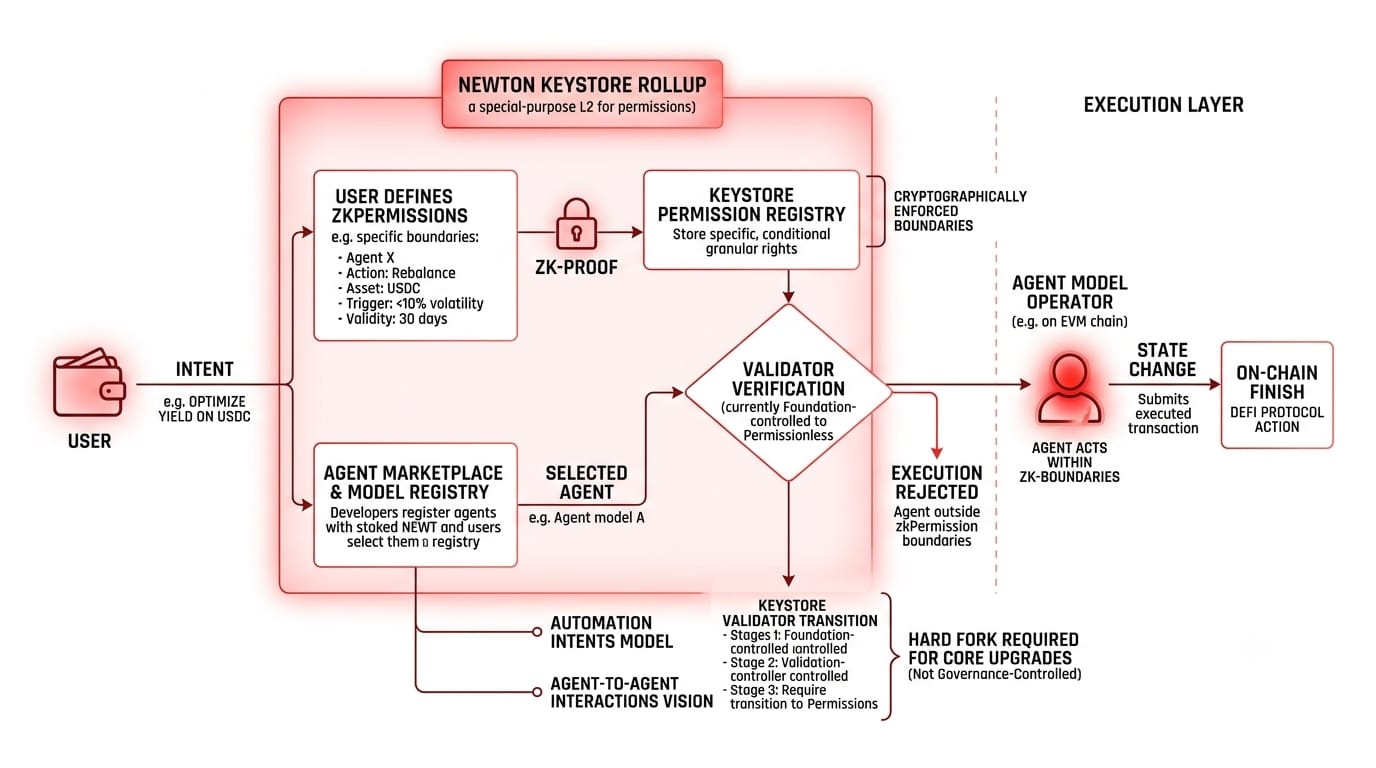
That framing is what eventually led me to spend more time with the Newton Protocol Keystore architecture specifically, which I hadn't paid much attention to in earlier research because I kept getting pulled toward the compliance and attestation side of the system. What seems interesting to me, looking at it fresh, is that the Keystore rollup isn't trying to be a general-purpose layer two. It's a specialized rollup designed for one narrow job: storing and updating user permissions in a form that agents can reference cryptographically before executing anything. The idea is that instead of giving an agent your private key or an open-ended approval, you write a zkPermission that says exactly what the agent is allowed to do, under what conditions, for how long, and then that permission lives in the Keystore where every validator can verify it independently. The agent can only act inside those cryptographic boundaries, and the moment those boundaries are exceeded, the execution simply doesn't proceed. I'm not completely sure how the permission granularity works in practice at current beta stage, but the design intent is that you could write something as specific as a conditional automation rule that only fires when an offchain data condition is satisfied, like a volatility threshold or a price range, and the agent has no ability to deviate from that without revoking and reissuing the permission itself.
The part of this that makes me think more carefully is the automation intents layer sitting above the Keystore. A user links their wallet to a specific agent model from the registry, grants it a zkPermission, and then submits an intent that tells the network when to activate that agent. The validator set, currently still foundation-controlled during this phase of mainnet beta, verifies that the agent is only operating within the permission boundaries and then finalizes the state change. What I keep coming back to is the validator transition. The roadmap describes moving from this foundation-run model to a permissioned set of third-party validators and eventually to a permissionless set, and the technical documentation is explicit that core upgrades to the rollup logic cannot happen through governance votes alone, they require a hard fork with explicit coordination across the validator network. That's a meaningful check against governance capture, but it also raises a question I find genuinely difficult to answer from the outside: how do you bootstrap a permissioned validator set that's decentralized enough to be credibly neutral but coordinated enough to execute upgrades cleanly? The question that comes to mind is whether the intermediate permissioned phase, which could last a considerable time depending on how fast third-party validators onboard, introduces a concentration risk that the cryptographic design was meant to prevent.
Looking from the outside, the agent marketplace dimension is where I feel the most uncertainty about how things unfold. The Model Registry, where developers publish agent models and operators stake NEWT as collateral to run them, is still an upcoming milestone rather than a live feature. Right now Newton is operating as an authorization and compliance layer for specific integrations, but the longer-term vision involves a marketplace where users can discover, compose, and even combine multiple agents into orchestrated strategies, including agent-to-agent interactions where one automated system coordinates with another. I sometimes wonder what the cold-start dynamic looks like for that marketplace. A registry with few agents gives users little reason to explore it, and developers have less incentive to publish quality models if the user base hasn't arrived yet. It makes me think about how other protocol marketplaces have navigated that bootstrapping problem, and whether the existing developer network from Magic Labs, over 200,000 builders already familiar with the embedded wallet infrastructure, is genuinely primed to seed the registry with diverse agent models or whether most of them are web2 developers who haven't yet thought about autonomous onchain execution as something their applications need.
There is also something I haven't seen discussed publicly that I find worth sitting with. The transparency report includes a disclosure that transaction fees may initially be subsidized by the foundation during early stages. That's a reasonable choice for a network trying to attract usage before organic demand establishes itself, and it's honest of the foundation to disclose it clearly. But it introduces a dependency that I think deserves more attention than it gets. If the fee subsidy is meaningful enough to be worth disclosing, it suggests that at current usage levels the native fee demand from zkPermission issuances, agent registrations, and automation executions may not yet be sufficient to sustain operator rewards without that support. The question that comes to mind is not whether this is a red flag, because early subsidization is normal, but rather what the transition plan looks like as the subsidy phases out. Does the network have enough organic fee volume by then? Does the agent marketplace launch in time to create the activity that fills that gap? I'm not completely sure the sequencing of those milestones is publicly documented in a way that lets an outside observer track it cleanly.
What I keep returning to at the end of this particular thread is that Newton Protocol is building something whose value depends heavily on behavioral adoption from a group of people, developers and end users, who don't yet have strong intuitions about why granular permission control over automated agents matters. The zkPermissions concept is technically elegant. The idea of writing a rule that says an agent can only act within specific parameters, with that rule enforced cryptographically rather than by trust, solves a real problem that most DeFi participants carry silently as accepted risk. But translating that into a product that developers actually instrument, that users actually configure, and that generates enough recurring activity to sustain the validator economy is a different kind of challenge entirely. The real answer probably only begins to emerge once the agent marketplace goes live and we can see whether the usage patterns look like genuine autonomous execution or just point integrations with the compliance features doing all the work, anyway, time will tell
#BitcoinFallsOver50%FromOctoberHigh #MoonbeamToMigrateGLMRToBase #GillibrandCallsForDigitalAssetEthicsBan #RevolutToDelistUSDT