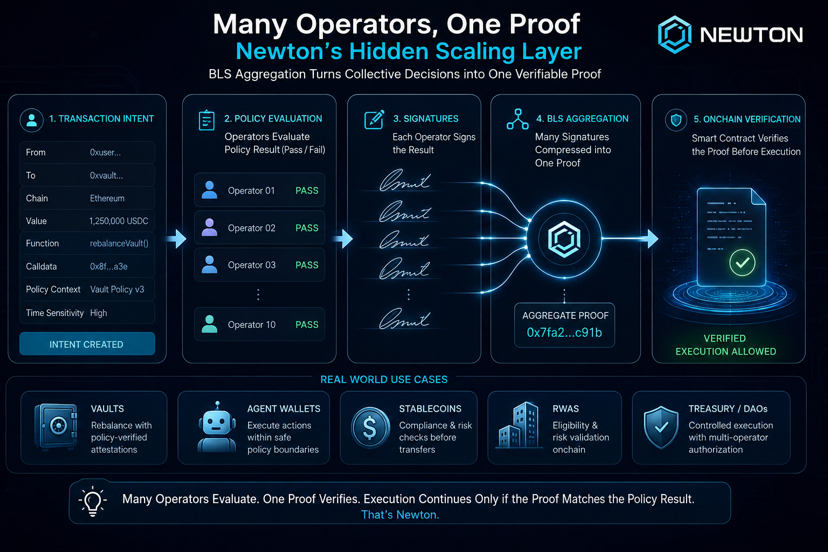
The part of Newton that started feeling serious to me was not only the idea that a transaction can pass or fail a policy.
It was how that result can stay usable onchain.
Because in real infrastructure, the problem is not just making a decision. The problem is making that decision verifiable without forcing the smart contract to carry too much weight.
That is where BLS aggregation matters.
Newton is not built around one private server looking at a transaction and saying approved. That would be weak. It would make the policy layer feel like a normal offchain API with a crypto wrapper around it.
The stronger design is different.
A transaction intent is created.
Operators evaluate that intent against the active policy.
Each operator signs the result.
The aggregator collects enough signatures for quorum.
The result becomes one compact attestation the smart contract can verify before execution.
That is the core idea.
Many operators evaluate.
Many signatures are produced.
One proof reaches the contract.
That is why I see BLS aggregation as Newton’s decision-compression layer.
It turns a group evaluation into something the chain can actually consume.
This is important because Newton sits in a difficult place.
It wants to bring richer policy logic into transaction execution, but smart contracts cannot be overloaded with every detail of the offchain world.
A vault policy may depend on risk data.
A stablecoin rule may depend on compliance context.
An agent rule may depend on spending limits and approved actions.
An RWA rule may depend on eligibility.
The chain does not need to process all of that directly every time.
It needs proof that the required policy process happened and that the protected action is allowed to continue.
That is what the attestation layer is for.
BLS aggregation helps make that attestation efficient.
The simple way I understand it is this:
Operators do the decision work.
The smart contract does the verification work.
BLS aggregation connects both sides without forcing the contract to verify a long list of separate approvals.
That is a real architectural advantage.
If ten operators evaluate a task and enough of them sign the result, Newton does not need to push ten separate signature checks into the final execution path in a messy way.
The aggregate proof represents collective agreement while staying compact enough for contract-level verification.
This matters for cost, speed and usability.
A policy layer that is too expensive will not be adopted.
A policy layer that is too slow will not fit real transaction flow.
A policy layer that is too centralized will not earn trust.
Newton has to balance all three.
BLS aggregation helps because it lets Newton keep operator participation without turning every policy check into a bulky onchain burden.
That balance is where the project becomes more interesting.
People sometimes talk about decentralized operators too casually.
The phrase sounds good, but the deeper question is how those operators become useful inside a transaction system.
If operators only vote somewhere offchain and the chain cannot verify the result efficiently, the architecture remains weak.
If every operator signature has to be checked one by one onchain, the system may become expensive.
If only one operator signs, the system becomes too trust-heavy.
BLS aggregation gives Newton a more practical route:
independent operator evaluation with compact verification.
That is the mechanism worth paying attention to.
In Newton’s flow, a transaction intent comes first.
The intent is not a vague request. It describes the exact action someone wants to execute.
Who is calling.
Which contract is involved.
What value is moving.
Which chain is used.
What calldata is being passed.
Which function is being called.
Then that intent is checked against an active policy.
The policy may be simple, like only allow actions under a spending limit.
Or it may be more advanced, like only allow a vault rebalance if the market is approved, exposure remains below a limit and required risk conditions are healthy.
Operators evaluate the task.
Each operator should reach the same result if the policy, input data and execution rules are deterministic.
That part matters.
Operators are not supposed to guess.
They are supposed to evaluate the same policy logic against the same task context.
After evaluation, operators BLS-sign the result.
The aggregator collects signatures until quorum is reached.
The smart contract can then validate the attestation before allowing the protected action to continue.
This is where Newton turns operator evaluation into an execution-ready object.
A normal report may say this transaction was checked.
Newton’s attestation says this policy result can be verified.
That difference matters.
A report is information.
An attestation is infrastructure.
A BLS aggregate attestation is even more useful because it carries the weight of multiple operators without forcing the chain to deal with each one separately.
The best metaphor for me is not a meeting vote.
It is a sealed document with many witnesses behind one stamp.
The witnesses still matter.
But the stamp is what the receiving system can quickly verify.
That is how I see BLS aggregation in Newton.
It keeps the operator network meaningful while giving the contract one clean proof to check.
This matters especially for vaults.
A vault may want to rebalance capital quickly. The action may be time-sensitive. The curator does not want a slow and expensive verification process every time. But depositors also do not want one weak offchain approval deciding where capital moves.
Newton can sit between those needs.
The vault action becomes an intent.
The policy checks whether the action fits the mandate.
Operators evaluate the result.
The signatures aggregate.
The vault contract receives one proof and verifies it before execution.
The vault gets stronger controls without turning every rebalance into a heavy manual process.
That is the kind of design DeFi needs if vaults are going to become more serious.
The same applies to agent wallets.
An agent may take many small actions. It may need spending limits, contract allowlists, session permissions or rule-based boundaries.
If every action requires slow human review, the agent becomes useless.
If every action is fully open, the agent becomes dangerous.
Newton gives a middle path.
The agent can act, but the action must pass policy.
BLS aggregation helps make that policy result compact enough to fit real execution flow.
That matters because agent safety cannot depend only on logs.
Logs show what happened.
Policy attestations can decide whether the action should continue.
For stablecoins and RWAs, the value is also clear.
Some transactions need eligibility, compliance or risk checks.
A centralized approval server may be easy, but it creates trust problems.
A fully onchain check may be too limited or expensive.
Newton offers another model.
The decision can use richer policy context.
Multiple operators can sign the result.
The final proof can be verified onchain.
That is a cleaner way to bring real-world rules into onchain execution.
This is why BLS aggregation should not be treated as a technical footnote.
It is part of the reason Newton can be practical.
Without aggregation, decentralized authorization can become clumsy.
With aggregation, Newton can make a group decision feel like one verifiable proof at the contract level.
That is powerful.
It also improves the trust model.
If one server approves a transaction, users have to trust that server.
If multiple operators evaluate and sign the result, the system becomes less dependent on a single actor.
The aggregate proof can represent broader agreement without making the contract verify every participant separately.
Of course, this does not magically make every policy perfect.
The policy still has to be well designed.
The data inputs still have to be reliable.
The operators still have to follow the rules.
The contract still has to verify the correct proof.
The application still has to decide which actions require policy checks.
But the architecture is stronger than a simple offchain yes-or-no endpoint.
That is the point.
Newton is not only asking users to believe that a policy check happened.
It is building a way to produce cryptographic evidence that a policy result was signed by the operator set and can be consumed by smart contracts.
This is where project depth comes in.
The important object in Newton is not only the policy.
It is the verified policy result.
A policy alone is a rule.
An intent alone is a request.
An operator alone is a participant.
A signature alone is a claim.
An aggregate attestation turns the result into something the execution layer can use.
That is the full shape.
This is also why the many operators, one proof idea fits Newton’s broader purpose.
Newton wants to stand between intent and settlement.
That space is narrow.
It cannot become slow or overly complicated.
The system has to evaluate rules, produce results and return something contracts can verify before execution continues.
BLS aggregation helps make that possible.
It compresses multiple operator signatures into a single verification path.
That matters because the chain is not built to read everyone’s opinion.
The chain is built to verify proof.
A normal offchain committee produces paperwork.
Newton’s operator network produces signed authorization evidence.
BLS aggregation makes that evidence lean enough for onchain enforcement.
That is why the mechanism has real value.
I also like this angle because it shows Newton is not only about safety.
Safety is a broad word.
Too many projects use it without explaining the mechanism.
Newton’s mechanism is clearer.
It takes a transaction intent, applies policy logic, uses operators to evaluate the result, aggregates signatures, and gives the smart contract proof before execution.
That is not vague safety.
That is an authorization pipeline.
BLS aggregation is the compression step inside that pipeline.
It makes the operator layer usable instead of symbolic.
This is also important for scaling.
If Newton wants to support many apps, many vaults, many agents, many policy checks and many transaction types, it cannot rely on a heavy verification process each time.
The proof system must stay efficient.
Aggregation helps because the number of operators can increase without making the final onchain proof grow in the same painful way.
That is an important scalability idea.
More operators can add stronger evaluation confidence, while the final verification step can remain compact.
That is the kind of design serious infrastructure needs.
Not decentralization in theory.
Decentralization that still fits execution.
There is also an accountability side.
When multiple operators sign a policy result, the system has a clearer way to show that the outcome came from the network process, not from one hidden decision-maker.
A vault depositor may not want to inspect every operator.
But they can value the fact that the vault action required a verifiable policy result.
An RWA platform may not want to expose every private eligibility detail.
But it can still require proof that the policy approved the exact action.
An agent wallet user may not understand BLS signatures.
But they can benefit from the fact that the agent cannot execute sensitive actions without a verified authorization result.
This is the best kind of infrastructure.
The user does not need to understand every layer.
The protection still exists in the background.
The end user sees safer execution.
The builder gets a policy system to integrate.
The smart contract sees verifiable proof.
The operator network provides the signed decision.
That division of roles is clean.
I also think this gives $NEWT a more serious demand story.
Speculation can create short-term attention, but infrastructure demand comes from repeated usage.
If more applications need policy decisions before execution, more tasks need evaluation.
If more tasks need evaluation, operator work becomes meaningful.
If operator work becomes meaningful, the network has a stronger reason to exist.
BLS aggregation is part of that demand path because it helps operator work become usable at scale.
The important metric is not only how many people talk about Newton.
The important metric is how many real transaction flows depend on Newton policy attestations.
Vault rebalances.
Agent actions.
Stablecoin checks.
RWA transfers.
Treasury controls.
Smart account permissions.
Each of these can create demand if policy enforcement becomes required before execution.
That is where the project story becomes stronger than a launch narrative.
Newton is not only building a rulebook.
It is building a way for rules to be evaluated by a network and compressed into proof that contracts can trust.
That is a deeper infrastructure story.
The compression idea matters because blockchains are expensive environments.
Every byte, every verification step and every repeated signature check matters.
If Newton wants to be used in real flows, it cannot make developers choose between stronger authorization and usable execution.
BLS aggregation helps reduce that tradeoff.
Developers can get the benefit of multiple operator signatures while presenting the contract with a compact proof.
That means the policy layer can be stronger without becoming too heavy.
This is exactly the kind of detail that separates serious architecture from nice marketing.
A weaker design would simply say many validators approve it and stop there.
Newton asks the harder question:
how does that approval become efficient and verifiable where execution actually happens?
BLS aggregation is part of that answer.
It is not the whole project, but it is one of the reasons the project can work as infrastructure.
My personal take is that Newton’s BLS aggregation shows the project is thinking about the hardest part of authorization:
not just who decides, but how the decision becomes usable by the chain.
That is where many systems fail.
They can make a decision offchain, but cannot bring it onchain cleanly.
They can make something decentralized, but verification becomes too expensive.
They can make something secure, but user experience becomes too slow.
Newton is trying to compress those tradeoffs.
Many operators evaluate.
One proof verifies.
Execution continues only if that proof matches the policy result.
That is the clean mental model.
For DeFi, this matters because the next layer of onchain finance will not only need more liquidity.
It will need more controlled execution.
Controlled execution means the transaction has to satisfy rules before it moves capital.
But controlled execution also has to be practical.
No vault wants slow policy approval for every action.
No agent system wants huge overhead.
No stablecoin app wants messy verification.
No RWA platform wants to expose unnecessary private data.
Newton’s attestation architecture, supported by BLS aggregation, gives these systems a more realistic path.
Rules can be checked.
Operators can sign.
Proof can be compact.
Contracts can verify.
That is why I see this as one of Newton’s most important technical design choices.
It is quiet, but it matters.
The market may talk more about listings, campaigns, wallets and narratives.
Those things create visibility.
But the real infrastructure question is whether the system can support real policy checks at scale.
BLS aggregation points directly at that question.
It tells me Newton is not only thinking about making authorization possible.
It is thinking about making authorization efficient enough to be used.
A policy layer that cannot scale becomes a demo.
A policy layer that can turn many operator decisions into one verifiable proof has a much better chance of becoming infrastructure.
And if $NEWT becomes tied to that repeated authorization flow, the token story becomes more grounded.
Not only attention.
Not only speculation.
Network work.
Operator evaluation.
Policy attestations.
Proofs used before execution.
That is the serious version of the Newton thesis.
Newton’s BLS aggregation is not just a cryptographic detail.
It is the bridge between decentralized policy evaluation and clean onchain verification.
Many operators decide.
One proof speaks.
The smart contract verifies.
Capital moves only if the result holds.
That is how Newton makes policy enforcement practical.