
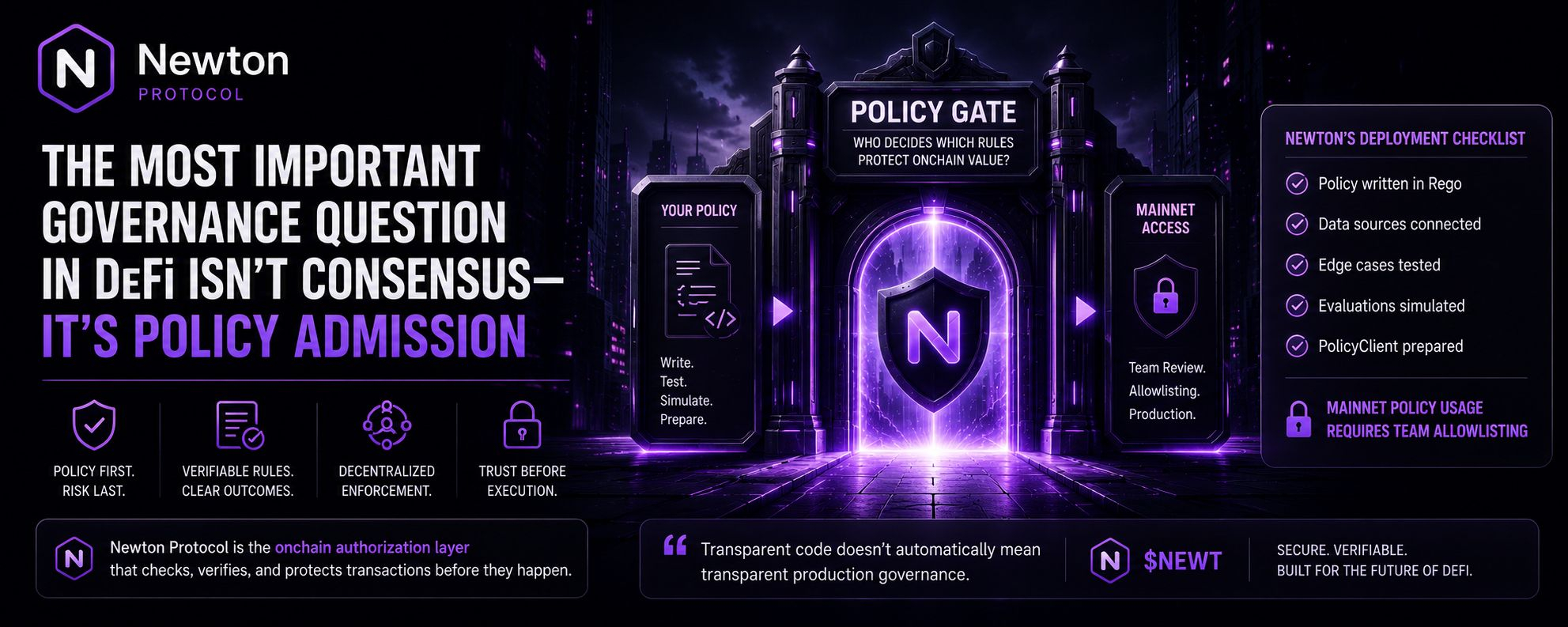
People are underestimating the biggest governance question in DeFi. It isn't who validates transactions. It's who decides which rules are allowed to protect them.
I found myself thinking about this while reading more of @NewtonProtocol 's documentation after checking my small Newton position.
At first, I assumed writing a policy was the hard part.
The more I read, the more I realized deployment may be just as important.
Onchain finance is becoming increasingly automated. Smart contracts interact with other contracts. AI agents are beginning to make decisions. Institutions want programmable controls instead of relying on a single wallet signature.
That creates a new problem.
Most systems can explain what happened after execution.
The next generation may need to prove what should happen before execution.
That's where Newton caught my attention.
Newton introduces an authorization layer where transactions can be evaluated against predefined policies before settlement. Operators evaluate those rules, produce signed attestations, and help create verifiable proof before protected transactions proceed.
To me, that's a shift from monitoring activity to enforcing decision logic.
"A transaction isn't just movement. It's permission."
Most people are missing this: the real infrastructure isn't always the blockchain itself. Sometimes it's the rules standing in front of it.
One detail especially stood out.
During the current mainnet beta, policy admission includes a team-controlled allowlisting step before policies are used in production. I actually think that's a reasonable safeguard for an early network. Poor policy logic sitting in front of real assets can create just as much risk as vulnerable smart contracts.
But it also raises an interesting governance question.
Who ultimately decides which rules become enforceable?
Most people are missing this: transparent code doesn't automatically mean transparent production governance.
That distinction matters.
Markets usually chase what is visible first. Infrastructure is often valued later, after everyone depends on it.
We saw similar patterns with cloud infrastructure and GPU networks. The exciting applications arrived later, but the quiet infrastructure captured enormous long-term value.
The bullish case for $NEWT is easy to understand.
If authorization becomes a standard layer for institutional DeFi, developer adoption could create powerful network effects. Reusable policy frameworks, verifiable enforcement, and growing ecosystem integrations may gradually increase demand for trusted authorization infrastructure.
"The best infrastructure is usually invisible until it disappears."
Still, I don't think the risks should be ignored.
Adoption always takes longer than expected. Developers may hesitate to change existing workflows. Competing authorization frameworks could emerge. And long-term value capture will depend on execution, governance evolution, and whether the protocol can gradually decentralize critical operational processes without sacrificing security.
Most people are missing this: reliability often matters more than innovation once institutions arrive.
That's why Newton interests me.
Not because I think every answer already exists.
But because it's asking questions most of DeFi hasn't fully answered yet.
Who writes the rules?
Who verifies them?
And who decides when those rules are ready to protect billions in onchain value?
This feels like one of those infrastructure narratives that could look completely different a year from now.