
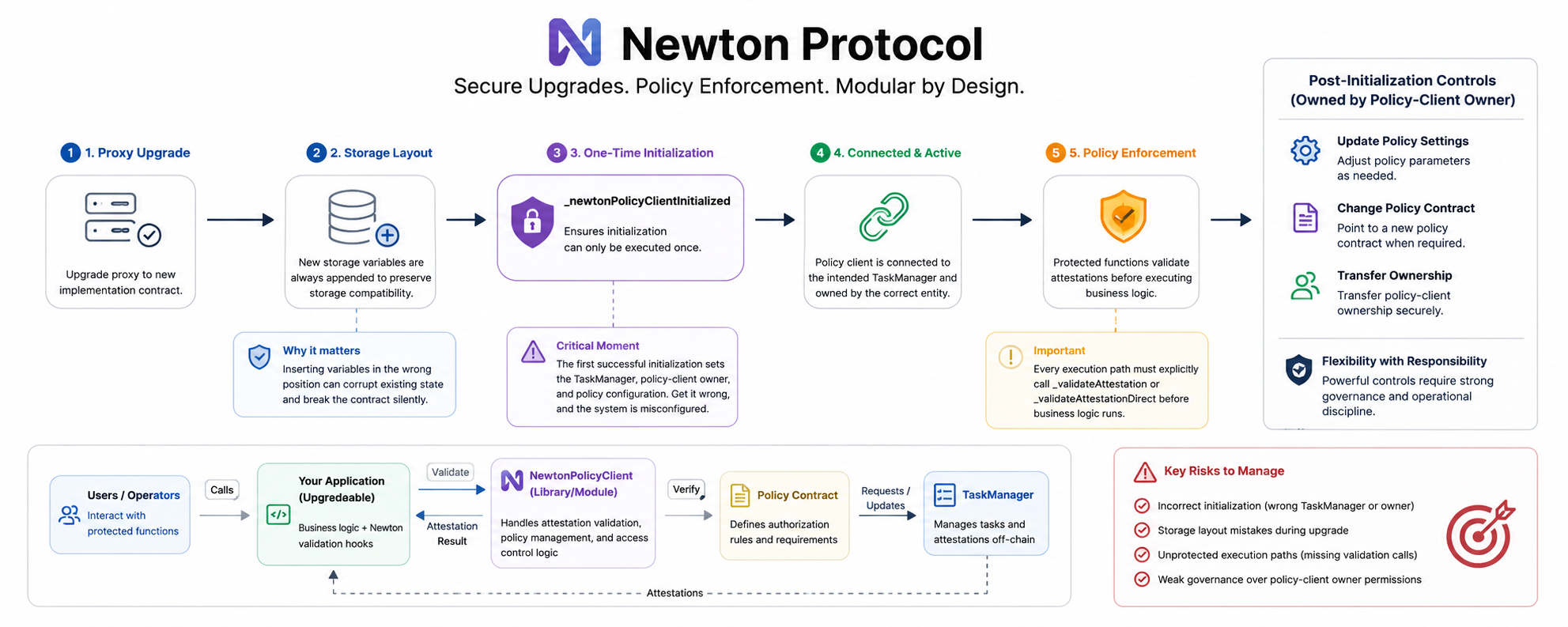

I spent some time reading through the Newton Protocol upgrade guide and I kept coming back to one implementation detail New storage variables are always appended to the existing storage layout instead of being inserted into it
That sounds almost trivial
I don't think it is
I've seen upgradeable contracts break because someone underestimated storage layout. The proxy upgrade succeeds the tests look fine and then weeks later someone discovers that a variable has been overwritten because the storage order changed It's a mess. The contract doesn't necessarily fail immediately. Sometimes it just starts behaving differently which is far harder to diagnose
Newton Protocol avoids that trap by treating the storage layout as something that should be preserved rather than rearranged. I like that approach because it respects how fragile upgradeable proxies can be
Another detail that stood out was the newtonPolicyClientInitialized flag Its purpose is simple. The post-upgrade initialization can only happen once. Newton Protocol also recommends testing upgrades on a fork and using a timelock or multisig when executing the initialization transaction That didn't feel like boilerplate advice to me. It felt like an acknowledgment that the upgrade isn't finished when the new implementation is deployed
The initialization is part of the upgrade
Until that step is completed the authorization logic may already exist inside the contract but the policy client still isn't connected to the correct TaskManager or assigned to the intended policy-client owner If either value is wrong, the authorization layer can fail even though the deployment itself appeared successful
That's why I think the one-time initialization flag matters
It prevents someone from running the initialization again, but it doesn't protect against getting the first execution wrong If the initial configuration contains mistakes locking it behind a one time flag doesn't magically fix them It just makes the first execution one of the most sensitive moments in the entire deployment
I also noticed that Newton Protocol doesn't permanently freeze every configuration after initialization The policy client owner can still update policy settings, change the policy contract address, and transfer ownership later. I actually prefer that over pretending systems never need to evolve. Infrastructure changes Governance changes. Requirements change The challenge is making sure those permissions remain well controlled over time
Storage compatibility creates a different category of risk altogether
One thing I appreciate about Newton Protocol is that it lets teams introduce policy enforcement without rebuilding their application from scratch. That's a practical design choice But the proxy upgrade still has to preserve storage compatibility perfectly. Insert one variable into the wrong position and the authorization layer may look completely healthy while unrelated application state is quietly corrupted underneath
I've seen enough upgradeable systems to know that's not a hypothetical concern
Another detail I don't think should be overlooked is execution flow Adding a new Newton protected function doesn't automatically secure an older function that performs the same action. Every path that should enforce authorization still has to call validateAttestation or validateAttestationDirect before the protected business logic runs. Miss one execution path and you've created inconsistent security guarantees without realizing it
That's probably what I found most interesting about Newton Protocol
The architecture separates NewtonPolicyClient
from the application's business logic instead of forcing developers to redesign everything around a new framework I generally prefer that kind of modular approach because large systems rarely get rewritten from scratch They evolve one upgrade at a time
At the same time. I keep wondering whether the risk actually disappears
Or whether it simply moves
Newton Protocol makes authorization easier to integrate into existing upgradeable contracts I think that's valuable But it also means the proxy upgrade, storage migration and very first initialization call become the points where almost all of the operational risk is concentrated
I don't see that as a weakness of the design
I see it as a reminder that good architecture doesn't eliminate difficult decisions It usually makes them easier to identify
Every upgrade changes code but not every upgrade strengthens security For me Newton Protocol shows that the smallest implementation details often have the biggest impact on building resilient smart contracts




#PhiladelphiaSemiconductorIndexFalls4% #BitcoinFalls44%FromJanuaryPeak #BitcoinReboundsAbove$61K #SouthKoreanStocksRise5%