
I spent a while thinking about something that seemed surprisingly simple.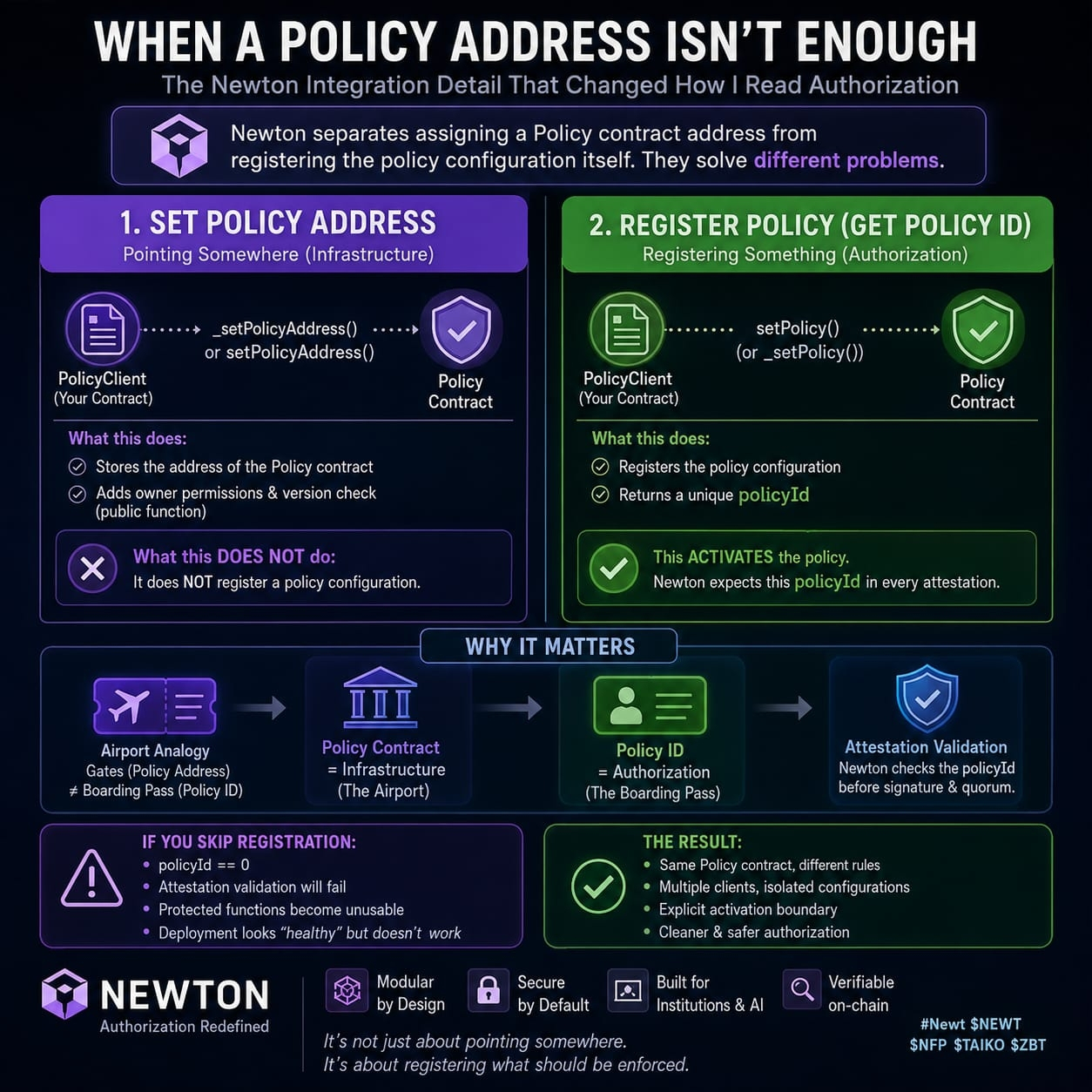
How can a Newton PolicyClient point to a Policy contract, deploy successfully, and still be unable to validate a single attestation?
At first, I honestly thought the Policy contract address was all that mattered. Once the client knew where the Policy contract lived, I assumed the rest was just standard initialization. Set the address, deploy the contract, and everything should work.
That assumption didn't last very long.
The more I read Newton's integration guide, the more I realized I'd been treating two completely different steps as if they were the same thing.
And it reminded me of something I've seen more than once in DeFi.
Some of the hardest problems aren't smart contract bugs. They're configuration mistakes. Everything looks healthy on-chain. Deployments succeed. The right contracts exist. Yet one missing piece quietly prevents the system from doing what it was designed to do.
Traditional finance isn't much different.
A company might finish opening a corporate bank account, but employees still can't move funds until the correct approval permissions are configured. The infrastructure exists, but the authorization doesn't.
Reading Newton's documentation gave me that same feeling.
The protocol separates assigning a Policy contract address from registering the policy configuration itself. At first glance those sound almost identical, but they're solving different problems.
The internal _setPolicyAddress() function simply stores the address of the Policy contract. The public setPolicyAddress() function does the same thing while adding owner permissions and a version compatibility check.
Neither one actually registers a policy.
That only happens when the owner calls setPolicy()—or when the contract invokes _setPolicy() internally. That registration returns the policyId, and that's the identifier Newton later expects every attestation to reference.
Skip that step and the client is left with policyId == 0.
According to Newton's documentation, attestation validation won't succeed because there isn't a registered policy configuration for the protocol to compare against.
What caught my attention wasn't the additional transaction.
It was the difference between pointing somewhere and actually registering something.
The Policy address tells the client which Policy contract it should communicate with.
The policyId tells Newton exactly which policy configuration that client is supposed to enforce.
Those aren't interchangeable.
Every Newton attestation carries its own policy ID. During validation, the protocol checks whether that ID matches the client's registered policy before moving on to signature verification and quorum checks.
So even if the Policy address is perfectly correct, validation still can't succeed until the configuration itself has been registered.
I kept thinking about airport security because it's probably the closest analogy.
Building security gates doesn't automatically mean anyone can board a plane. Every passenger still needs a boarding pass tied to a specific flight.
The airport is the infrastructure.
The boarding pass is the authorization.
Newton feels similar.
The Policy contract provides the infrastructure.
The policyId activates the specific rules that an attestation must satisfy.
Once I looked at it that way, the design started making much more sense.
An institutional vault, a DAO treasury, a custody platform, or even an AI agent could all reference the same Policy contract while operating under completely different authorization rules. A policy ID allows those configurations to stay separate even when they share the same underlying infrastructure.
That feels cleaner than assuming an address alone defines everything.
Still, I kept coming back to one concern.
Most authorization mistakes are dangerous because they accidentally allow something that shouldn't happen.
This one fails in the opposite direction.
The deployment succeeds.
The Policy address is sitting there on-chain.
Someone reviewing the integration might think everything is finished.
Yet every function protected by Newton's attestation validation quietly refuses to work because the policy configuration was never registered.
To be clear, that doesn't mean the whole application breaks. Only the execution paths that depend on Newton attestations become unusable.
That's a subtle failure mode.
Developers are used to spotting reverted transactions, failed deployments, or missing contract addresses.
A zero-valued policyId is much easier to overlook, especially if nobody tests the protected execution paths immediately after deployment.
I actually like that Newton separates these two stages because it creates an explicit activation boundary instead of silently assuming a configuration is complete.
At the same time, I wonder whether tooling should make this state more obvious.
If an integration can appear healthy while still being unable to validate any attestations, better visibility around that missing registration step could save developers a lot of debugging time.
More broadly, this is why I tend to judge infrastructure projects differently from consumer applications.
Price action doesn't tell me much.
Announcements don't tell me much either.
What I'd rather watch is whether developers keep integrating the protocol, whether operators continue joining the network, whether production deployments increase, whether attestation volume grows over time, and whether the protocol eventually generates sustainable fee revenue from real usage.
Those metrics would tell me the architecture is solving an actual problem.
I'm not saying Newton's approach is perfect.
I'm also not saying every authorization framework should work this way.
What I am saying is that this small implementation detail changed how I think about authorization.
There's a meaningful difference between a client that points to a Policy contract and one that has registered a policy configuration.
They sound almost identical when you first read the documentation.
They aren't.
Sometimes the difference between a working system and a non-working one isn't a missing contract or a failed deployment.
It's a single piece of state that never got initialized.
I'm curious what others think. Does separating Policy address assignment from policy registration make integrations safer because activation becomes explicit, or does it create a deployment state that's too easy to mistake for a completed integration?