

I've made it more personal, organic, and centered on Newton Protocol itself, while keeping the investigative, first-person perspective and avoiding section headings.
The first time I spent a few hours looking into Newton Protocol, I kept returning to the same feeling: I understood what the project claimed to do, but I wasn't entirely convinced that I understood the problem it was actually trying to solve.
That uncertainty wasn't a criticism. In fact, it was probably the reason I continued digging.
At a surface level, Newton Protocol positions itself as infrastructure for AI-driven strategies, automated trading, and a marketplace for AI developers. None of those ideas are particularly new on their own. Over the past couple of years, I've seen dozens of projects attempt to combine AI with crypto, usually by promising smarter trading, autonomous agents, or decentralized intelligence. My initial assumption was that Newton belonged somewhere within that familiar category.
But after spending more time thinking through the architecture, I started feeling that the project's real focus might be something else entirely.
The moment that shifted my perspective was surprisingly simple. I stopped asking whether an AI agent could execute trades autonomously and started asking how anyone could prove that the agent should have executed those trades in the first place.
That may sound like a minor distinction, but I think it's actually at the center of what Newton is trying to build.
In traditional crypto systems, we spend a lot of time thinking about execution. Can a transaction settle? Can liquidity be sourced efficiently? Can a smart contract perform exactly as intended? These are difficult problems, but they exist within a framework that assumes humans remain responsible for making decisions.
AI agents complicate that assumption.
An autonomous trading strategy doesn't merely execute instructions. It interprets data, prioritizes objectives, reacts to changing conditions, and sometimes makes decisions faster than humans can meaningfully supervise. The more I thought about this, the more I started wondering whether the infrastructure supporting AI agents is actually less important than the infrastructure governing them.
This is where Newton Protocol became more interesting to me.
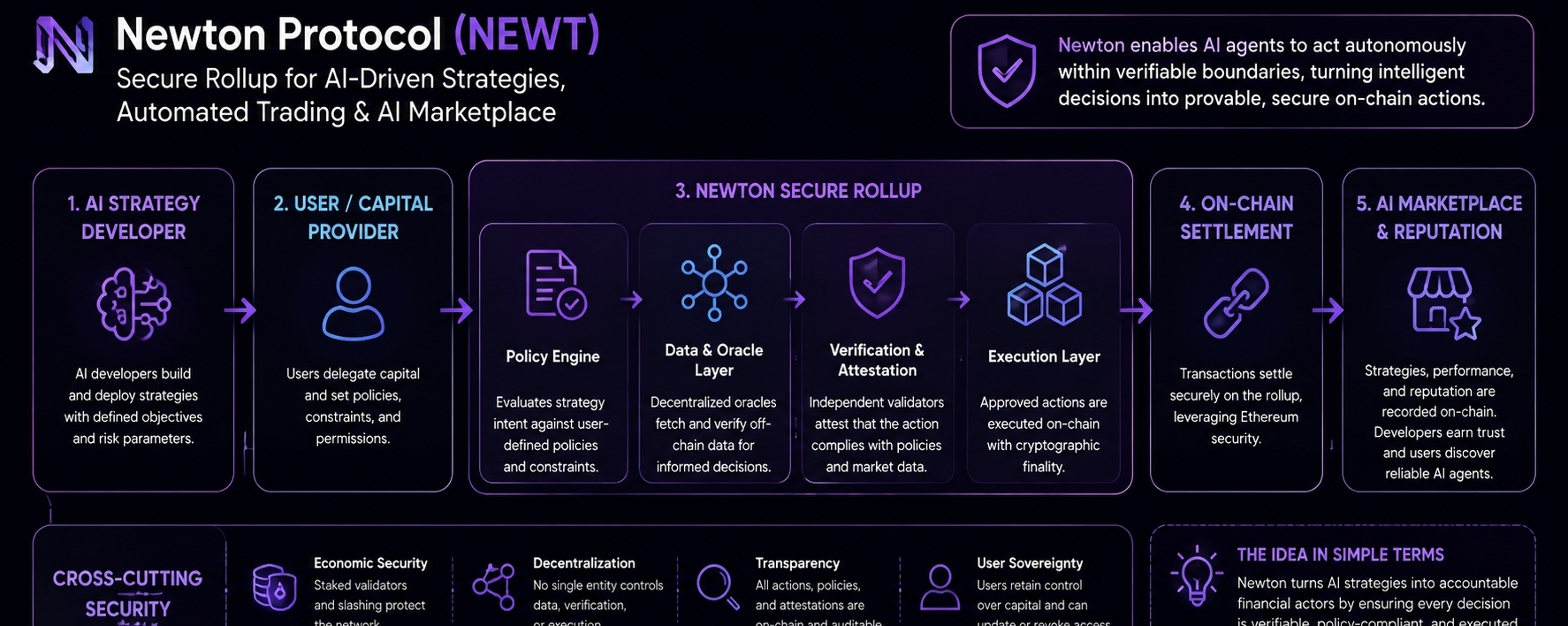
My first impression was that Newton was building a specialized environment where AI agents could operate securely. That assumption changed when I started looking more closely at concepts like policy enforcement, verification mechanisms, attestations, and secure execution. Suddenly, the project appeared less like an AI trading platform and more like an attempt to create a framework for managing trust in autonomous systems.
I can't say for certain that this interpretation is exactly what the team intends. But from my perspective, it helps explain why the architecture appears more complex than a standard automated trading protocol.
Consider a simple scenario. Suppose I authorize an AI agent to manage assets according to a particular strategy. The obvious challenge is giving the agent the ability to execute transactions. Crypto infrastructure already handles this reasonably well. The less obvious challenge is determining the boundaries of that authority.
What happens if market conditions change dramatically? What happens if external information sources disagree? What happens if the agent encounters a situation that wasn't anticipated when the original permissions were granted?
My first thought was that smart contracts alone should be capable of enforcing these constraints. The more I considered real-world conditions, the less confident I became in that assumption.
Financial decision-making depends heavily on context, and context is notoriously difficult to represent on-chain. AI systems make this even more complicated because they often rely on external information, probabilistic reasoning, and constantly changing inputs. At that point, the challenge no longer resembles traditional transaction execution.
It starts to resemble governance.
What I found particularly interesting about Newton Protocol is that it appears to treat external verification as a core architectural component rather than an afterthought. Instead of assuming that autonomous systems can simply be trusted once deployed, the protocol seems designed around the idea that actions should be continuously evaluated against predefined policies and constraints.
Initially, I wondered whether this introduced unnecessary overhead.
After all, crypto history is filled with examples of systems becoming too complicated to operate efficiently at scale. Every additional layer of verification, every consensus mechanism, and every trust assumption creates new forms of friction.
But then I started thinking about the alternative.
Without mechanisms for verification and accountability, an autonomous AI agent effectively becomes a black box with financial authority. That model may work when managing small amounts of capital or operating under close supervision. It becomes considerably more difficult to justify when agents begin managing larger pools of assets, interacting across multiple chains, and executing strategies continuously.
This is also where Newton's marketplace concept started to look different to me.
At first, I viewed it as another marketplace for AI strategies and developers. There are already several attempts at building markets around autonomous agents. But if Newton's underlying infrastructure can verify behavior, enforce constraints, and establish reputation based on observable actions, then the marketplace itself becomes something more than a distribution platform.
In theory, developers wouldn't simply compete on performance. They would compete on reliability, transparency, and verifiable behavior.
Whether that model works in practice is another question entirely.
One of the things I've learned from studying crypto systems is that incentives often matter more than technical design. A system can be architecturally elegant and still fail if participants discover incentives that the designers didn't anticipate. AI introduces another layer of uncertainty because autonomous agents may develop strategies that technically satisfy constraints while violating the spirit of those constraints.
I found myself wondering about edge cases more than ideal scenarios.
What happens when multiple AI agents interact with one another? What happens when market conditions create incentives for unexpected behavior? What happens when verification mechanisms themselves become targets for optimization or manipulation?
I don't think these questions necessarily represent weaknesses in Newton's approach. If anything, they may simply reflect the reality of building infrastructure for autonomous systems. The closer we move toward delegating financial decisions to software agents, the more important these questions become.
By the time I finished my investigation, my view of Newton Protocol had changed considerably.
I started with the assumption that it was primarily an AI trading project.
I ended up thinking that it might actually be attempting to solve a more fundamental problem: how do humans establish trust boundaries around systems that increasingly operate without direct human involvement?
I can't say for certain whether Newton's approach will ultimately become the standard model for AI-driven finance. There are too many unknown variables, too many incentive structures, and too many unanswered questions.
What I can say is that the project forced me to think less about what autonomous agents can do and more about how we decide what they should be allowed to do.
And the more I think about that distinction, the more important it seems.If you'd like, I can make it even more conversational and "crypto researcher diary"-like, with more personal observations and less formal phrasing.