
I kept coming back to a scenario that never actually happened.
Not a hack. Not a bad model release. Just a hypothetical.
An AI agent is given a wallet. It's told to manage a small allocation across a few vaults. It reasons well, most of the time. It reads yields, checks conditions, rebalances.
Then someone asks: what happens the one time it reasons its way to a wrong conclusion, and the wallet it's holding has real capital in it?
I used to think the answer was about model quality. Better reasoning, fewer mistakes, problem solved eventually.
I don't think that anymore.
A mistaken research summary is easy to correct. Someone reads it, notices something's off, fixes it. The cost of being wrong is a wasted hour.
A mistaken transaction settles anyway. The chain doesn't pause to ask whether the reasoning behind it made sense. It checks whether the signature is valid, and moves the funds.
Those aren't the same category of mistake, even though they can come from the exact same underlying model having an off day. One changes an opinion. The other changes ownership.
Once an agent holds a private key and decides to sign, there's no second decision point left. The judgment call already happened, upstream, invisibly, and the blockchain has no way to ask it to reconsider.
That's the part that actually worried me. Not that AI would be wrong sometimes — every system is wrong sometimes — but that the wrongness and the authority to act on it were bundled into the same moment, held by the same actor, with nothing in between.
**Where Newton fits into that gap**
I went looking at how Newton Protocol handles this, mostly because "agent authorization" is one of the use cases it's built around, and I wanted to know if it addressed the specific failure mode above or just talked around it.
The answer is narrower and more mechanical than I expected, which I think is a point in its favor.
Agents aren't designed to hold a raw private key with unrestricted signing power. Permissions run through something Newton calls the Keystore — a place where session keys and zkPermissions are defined ahead of time, by whoever is accountable for the capital, not decided in the moment by the agent itself. An agent operates inside a boundary that was set before it ever reasoned about anything.
On top of that, every transaction still gets evaluated against policy before it settles — spending caps, approved counterparties, mandate limits — by an independent network of operators, not the agent's own judgment. The policies are written in Rego, the same declarative language used by the Open Policy Agent project, and operators back their evaluations with restaked ETH through EigenLayer, so a wrong call has a cost attached to it, not just a shrug. The result is a signed authorization receipt, verifiable after the fact, showing whether a transaction was permitted and against what rule.
None of that makes the agent's reasoning better. I want to be clear about that, because it would be easy to oversell this as "solving AI reliability," and it isn't that.
What it changes is the size of the blast radius when reasoning goes wrong. A flawed conclusion inside a scoped, policy-checked boundary can be caught before it settles. A flawed conclusion inside an unscoped wallet with a live private key just becomes a transaction.
**What this doesn't answer**
I don't think this fully closes the original question. It relocates it.
The question stops being "can I trust this agent's judgment" and becomes "who defined the boundary the agent operates inside, and how well does that boundary match the risk actually being taken."
A boundary that's too loose recreates the original problem in a smaller container. A boundary that's too tight makes the agent useless — no automation is worth deploying if every meaningful action requires a human to widen the permission first, at which point you haven't really delegated anything.
Getting that calibration right isn't a cryptography problem. Newton can make the boundary enforceable and verifiable; it can't tell a curator or a developer where the boundary should actually sit. That's still a judgment call made by a person, upstream of all of this — just a narrower, more specific judgment call than "trust the whole system."
**Why I think this is still worth paying attention to**
I'm not fully convinced the smaller question is actually smaller. But I think it's a better question than the one it replaces, because it's answerable in a way "trust the AI" never really was. You can inspect a policy. You can audit an authorization receipt. You can't audit a private key that's already signed something.
Newton is in mainnet beta. The agent-authorization use case is part of the current feature set and roadmap, not something with years of production history behind it yet. That matters, and I'm not pretending otherwise.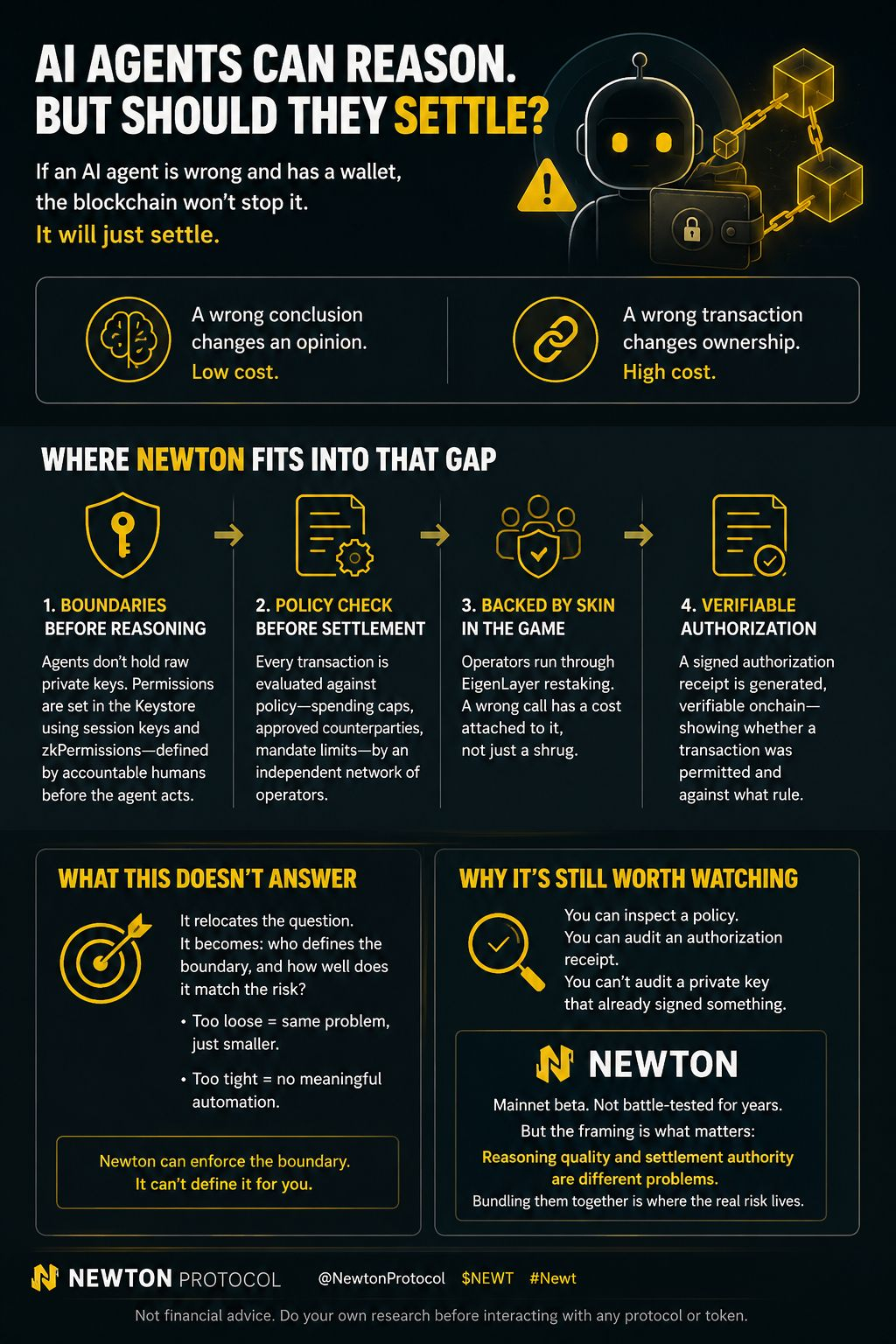
But the framing — reasoning quality and settlement authority are different problems, and bundling them together is where the real risk lives — is the part I keep coming back to, independent of how any one protocol executes on it.
@NewtonProtocol l $NEWT #Newt