
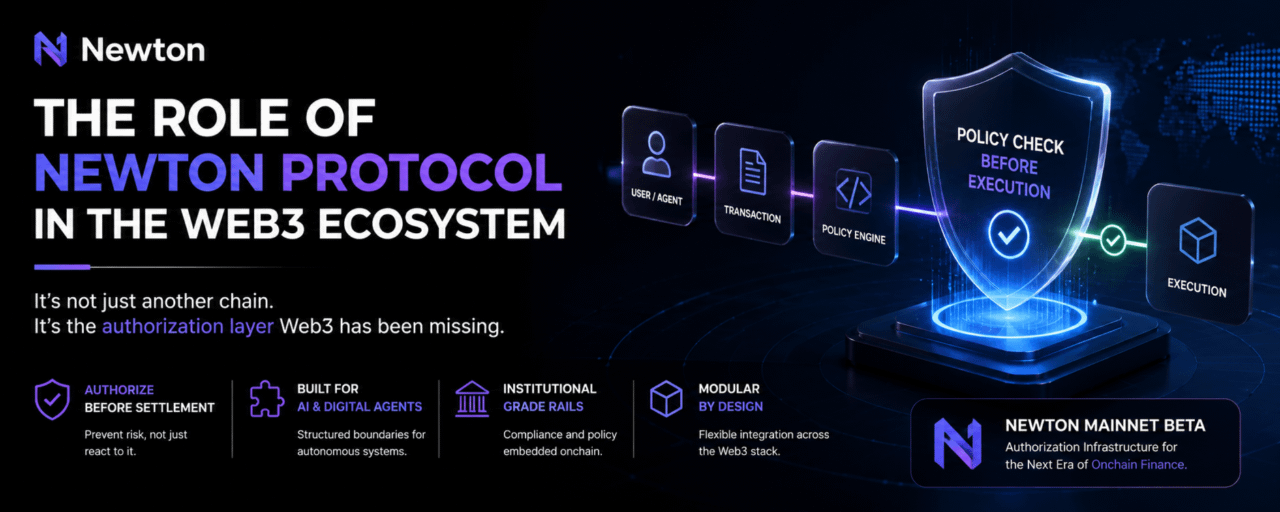
While reading Newton’s documentation, one small detail kept pulling my attention back. It was not the mention of AI agents, institutional onboarding, or even the recent #Newt Mainnet Beta discussion. It was a quieter design choice: policies are evaluated before a transaction settles, not after it executes. That sounds procedural at first glance, almost administrative. But the more I thought about it, the more it felt like one of those details that quietly changes the shape of an ecosystem.
I used to work around systems where risk management was always layered on top of activity rather than built into it. Traditional finance often settles transactions and then spends resources asking whether the transaction should have happened. Crypto inherited a similar habit. Smart contracts execute exactly as written, but they rarely understand context. A wallet does not know whether an #AI agent exceeded a spending limit. A DeFi vault does not naturally understand institutional restrictions. A protocol does not inherently know whether a transaction violates a risk policy.
Newton seems to approach this from a different direction. Instead of treating compliance or authorization as a separate process happening around a transaction, the protocol appears to move those checks into the transaction flow itself through programmable policies. These policies can evaluate information before execution occurs. The recent Newton Mainnet Beta discussion around authorization infrastructure and VaultKit made this point easier to notice because the emphasis was less about adding another application and more about inserting rules directly into transaction pathways.
That distinction matters because incentives change when authorization happens before settlement rather than after. In most systems, enforcement after an action creates a reactive culture. Someone breaks a rule, then systems investigate, reverse, punish, or compensate. But pre-transaction authorization creates a preventive structure.
I think this becomes increasingly relevant if #AI agents become meaningful participants in Web3. Humans tolerate uncertainty because we improvise. Machines scale uncertainty because they repeat it. A trading agent making one poor decision is a bug. Thousands of autonomous systems repeating the same poor decision becomes systemic risk.
The interesting investment question for me is not whether $NEWT gains attention. It is whether programmable authorization becomes invisible infrastructure that developers eventually assume should exist. Investors often focus on applications because applications are visible. Infrastructure rarely receives attention until the absence becomes painful.
Institutions might care because moving capital onchain becomes less about trust in counterparties and more about trust in process. Developers might care because they avoid rebuilding policy systems repeatedly. DAOs might care because governance increasingly becomes operational rather than ideological. But practical adoption usually moves slower than narratives suggest.
Crypto repeatedly solves one problem only to expose another. We removed centralized intermediaries and discovered coordination problems. We automated execution and discovered automation risk. We may eventually automate decision-making and discover that autonomous systems still require boundaries.
There are also obvious trade-offs here. Adding policy layers introduces complexity. Complexity always carries maintenance costs. The assumption that policies remain fair, adaptable, and resistant to capture deserves skepticism. Rules written in code can still reflect human judgment, and human judgment is rarely neutral forever.
There is also a subtler concern. Infrastructure designed to increase trust can accidentally concentrate influence if policy creation becomes dominated by a small group of actors. A protocol intended to preserve openness must constantly avoid becoming a gatekeeper itself.
That is why I keep returning to the original observation. The most important detail may not be that #Newt wants to authorize transactions. It may be that Newton is trying to redefine where trust enters the process.
Sometimes Web3 is less about removing rules and more about deciding where rules belong.
Following @NewtonProtocol and observing the evolution of Newton Mainnet Beta feels less like watching another application launch and more like watching an argument about infrastructure unfold in public. $NEWT #Newt