
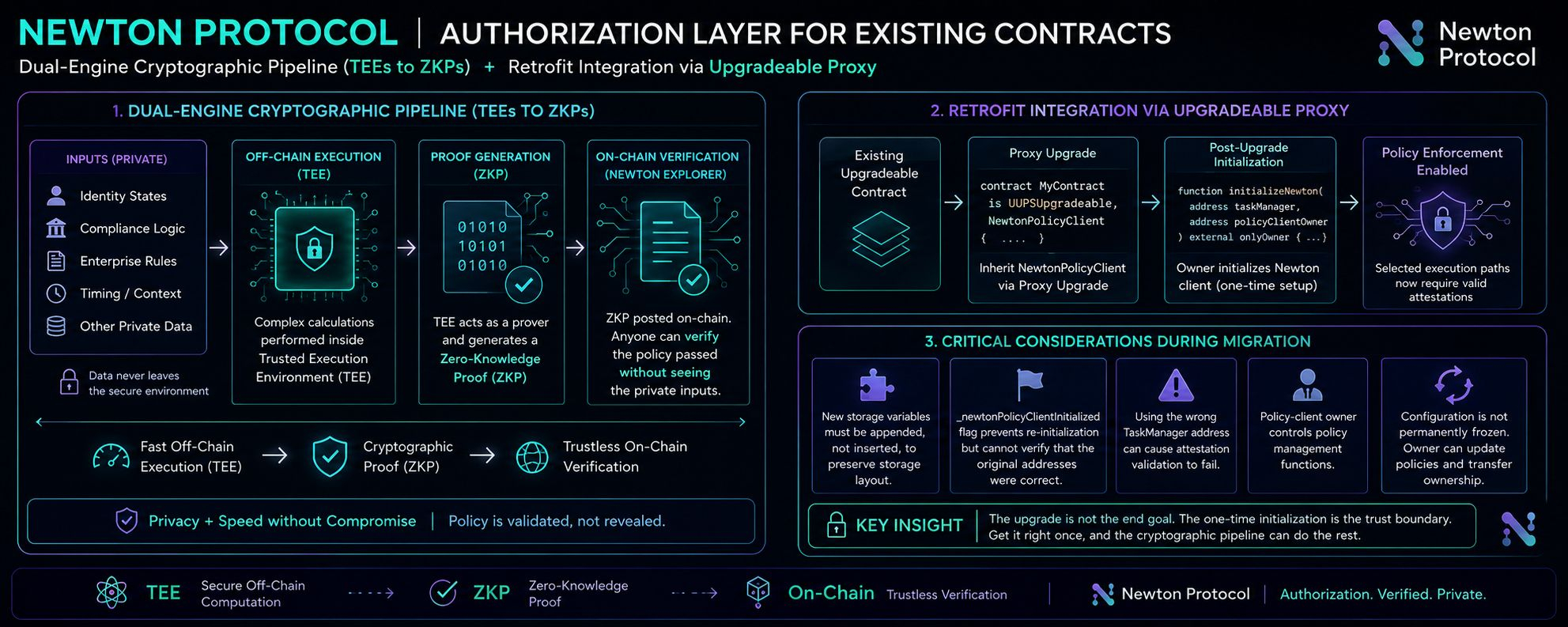

I spent time digging into the integration flow instead of only the architecture.
One detail changed how I looked at the protocol.
I assumed adding Newton's authorization layer to an existing contract would mainly be about inheriting NewtonPolicyClient and enabling policy checks.
Instead, the sensitive moment isn't the upgrade itself. It's the first initialization.
That single call decides which TaskManager verifies attestations and who controls future policy management.
The newtonPolicyClientInitialized flag prevents the function from running twice, but it cannot guarantee the original configuration was correct.
That made me rethink where trust actually concentrates.
The TEE to ZKP pipeline ensures private policy evaluation produces a verifiable proof without exposing sensitive inputs, but the cryptography only starts working after the contract is connected to the right components.
A clean proof cannot fix an incorrect initialization.
I came away paying less attention to the elegance of the verification pipeline and more attention to operational discipline.
The guide's recommendation to test upgrades on a fork and use a multisig or timelock for initialization suddenly felt less like best practice and more like the real security boundary.
