
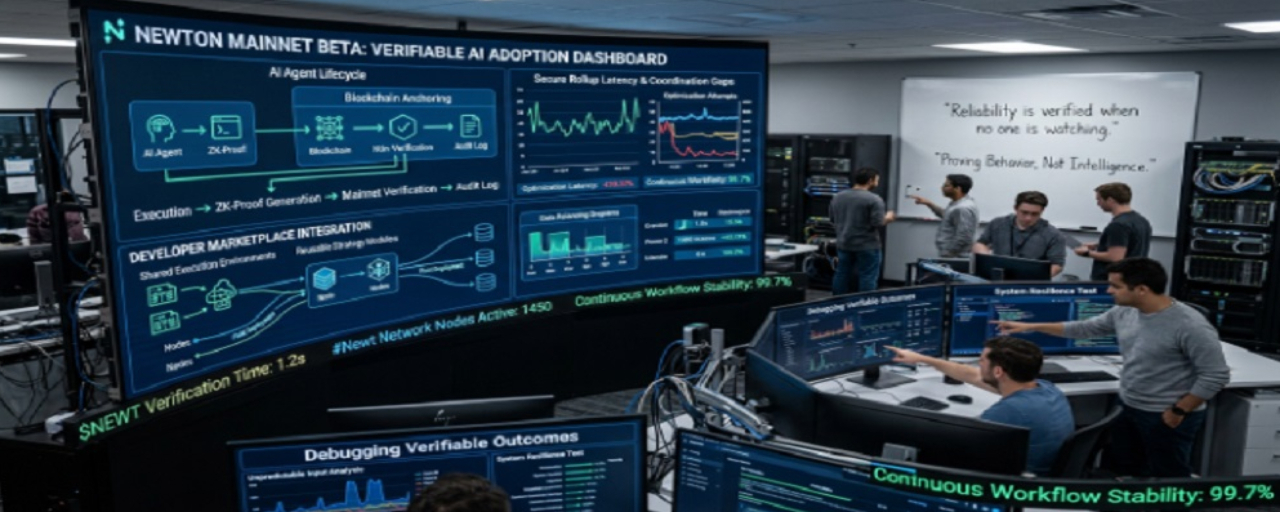

I keep noticing a subtle shift in how people talk about AI and crypto lately. It is no longer about speculation or isolated tools, but about whether these systems can actually behave reliably outside test environments.
While following Newton Protocol during its Mainnet Beta discussions, that question keeps coming back in a more grounded way, almost like something is slowly moving from theory into usage rather than promises.
What feels different now is how AI narratives are being tied to execution rather than prediction. In conversations around @NewtonProtocol , the emphasis seems less about what AI could do someday and more about how it behaves when paired with blockchain constraints.
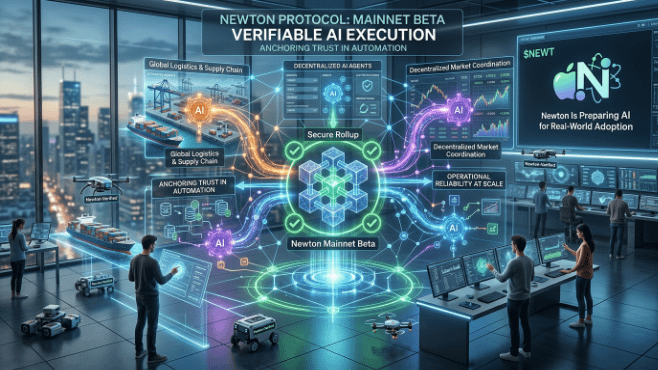
That intersection is where expectations start to get tested in real time, especially when systems are required to be verifiable instead of just intelligent.
Secure rollups have been discussed for years, but what stands out in Newton’s approach during its current Mainnet Beta phase is how security is not treated as a layer added later.
It feels more like a baseline assumption that everything else must align with. That shift changes how one thinks about scaling AI driven systems on-chain, because reliability becomes part of design instead of a final checkpoint.
In AI agent discussions, the real question is no longer whether agents can act, but whether their actions can be traced and verified after execution.
That is where blockchain infrastructure begins to matter in a practical sense. Instead of AI existing as a black box, the idea is to anchor its outputs in systems that can be audited without slowing them down too much.
The developer marketplace angle around AI infrastructure is also interesting because it shifts focus toward who builds and how reusable those components become.
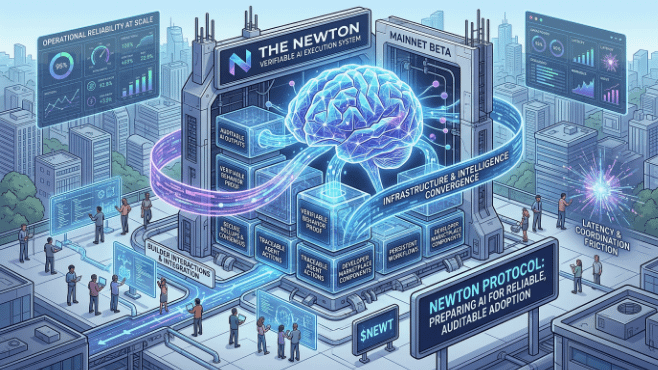
Instead of isolated models, there is a gradual move toward shared execution environments where strategies, agents, and logic can be deployed more fluidly.
But real-world adoption rarely moves as cleanly as technical design suggests. Latency, coordination, and trust gaps still create friction when AI systems interact with on-chain environments.
Even so, the push toward verifiable automation keeps growing because it answers a problem that centralized systems never fully solved.
That friction is often invisible in early discussions, but it becomes obvious when systems are deployed beyond controlled environments.
The difference between theoretical performance and real usage is where most AI blockchain experiments are actually tested.
The idea of verifiable AI is less about proving intelligence and more about proving behavior. In Newton’s current Mainnet Beta context, that distinction feels important because adoption depends on trust that can be checked rather than assumed.
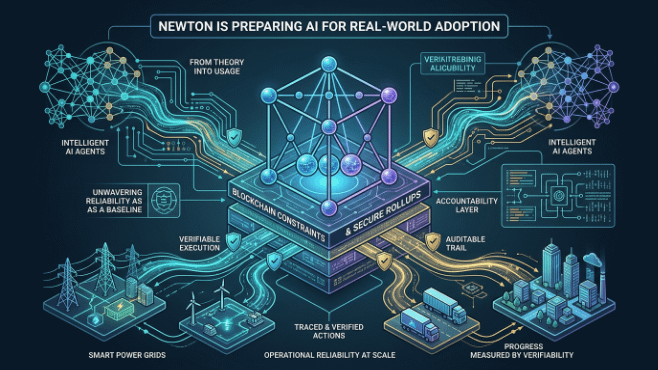
This is where blockchain becomes less of a buzzword and more of an accountability layer. That matters because systems only gain adoption when stakeholders can independently verify outcomes without relying on trust alone.
Over time, this could reshape how developers think about accountability in AI driven environments.
What stands out is how decentralized automation is slowly reframing AI applications from standalone tools into continuous systems that operate across environments.
Instead of one-off outputs, the expectation is shifting toward persistent, verifiable workflows that can run without constant human oversight.
This shift also changes expectations for uptime and consistency, since autonomous systems must behave predictably even when conditions vary. It is less about experimentation now and more about operational reliability at scale.
Watching these systems evolve creates a strange impression that infrastructure and intelligence are starting to converge.
It is not about replacing human decision making, but about designing environments where decisions can be executed with more transparency and fewer blind spots.
In many ways, this mirrors earlier shifts in computing where infrastructure quietly became more important than individual applications.
The same pattern seems to be emerging with AI systems connected to blockchain environments.
Another aspect that often gets overlooked is how builders actually interact with these systems day to day.
It is easy to talk about AI agents and verifiable execution at a conceptual level, but the real complexity shows up in integration, debugging, and coordination between components.
In the Newton ecosystem context, the Mainnet Beta phase feels like an early stress test for how developers will adapt their workflows to environments where computation, validation, and execution are tightly coupled.
There is also a quiet shift happening where developer value is not just in writing models, but in designing systems that can survive unpredictable inputs and still produce verifiable outcomes across distributed environments.
That shift is subtle but it changes how infrastructure decisions are prioritized from the start in practical development cycles.
Progress in AI will likely be measured less by capability and more by how reliably it can be verified when no one is watching. $NEWT #Newt #newt