A few months ago, I noticed something interesting while reading through discussions around AI-related crypto projects.
Everyone was talking about what AI agents could do.
Nobody seemed interested in talking about what happens when those agents make a bad decision.
That's a strange blind spot.
If an AI model gives you a bad movie recommendation, nobody cares. If it opens a leveraged position with real capital, bridges funds to the wrong chain, or interacts with a malicious protocol, the consequences are very different.
Yet most of the market is still focused on making AI agents more capable rather than making them safer.
That's the reason Newton Protocol caught my attention.
Not because it's promising some magical AI breakthrough. Not because it's trying to build the smartest trading bot in crypto.
What Newton is trying to solve is much simpler and, in my opinion, much more important.
How do you give an AI agent enough freedom to be useful without giving it enough freedom to become dangerous?
The Problem Most AI Projects Don't Want to Discuss
Crypto loves automation.
The logic is easy to understand. Markets trade 24/7. Opportunities appear and disappear within seconds. Humans get emotional, distracted, and tired. Machines don't.
That's why the idea of AI-powered trading has gained so much traction.
An AI agent can monitor markets around the clock, analyze huge amounts of data, and execute strategies faster than any human trader.
Sounds great.
Until you remember that speed doesn't automatically equal good decision-making.
Anyone who has spent time in crypto knows that even experienced traders make mistakes. They misread markets, chase narratives, and sometimes ignore obvious risks.
AI systems aren't immune to mistakes either. They just make different ones.
The difference is that an AI can make those mistakes at machine speed.
That's where things start getting interesting.
Newton Isn't Really Selling AI
One of the biggest misconceptions around Newton Protocol is that people view it as another AI token.
I don't think that's the right way to think about it.
The project isn't trying to compete with AI models.
It isn't trying to become the next ChatGPT for traders.
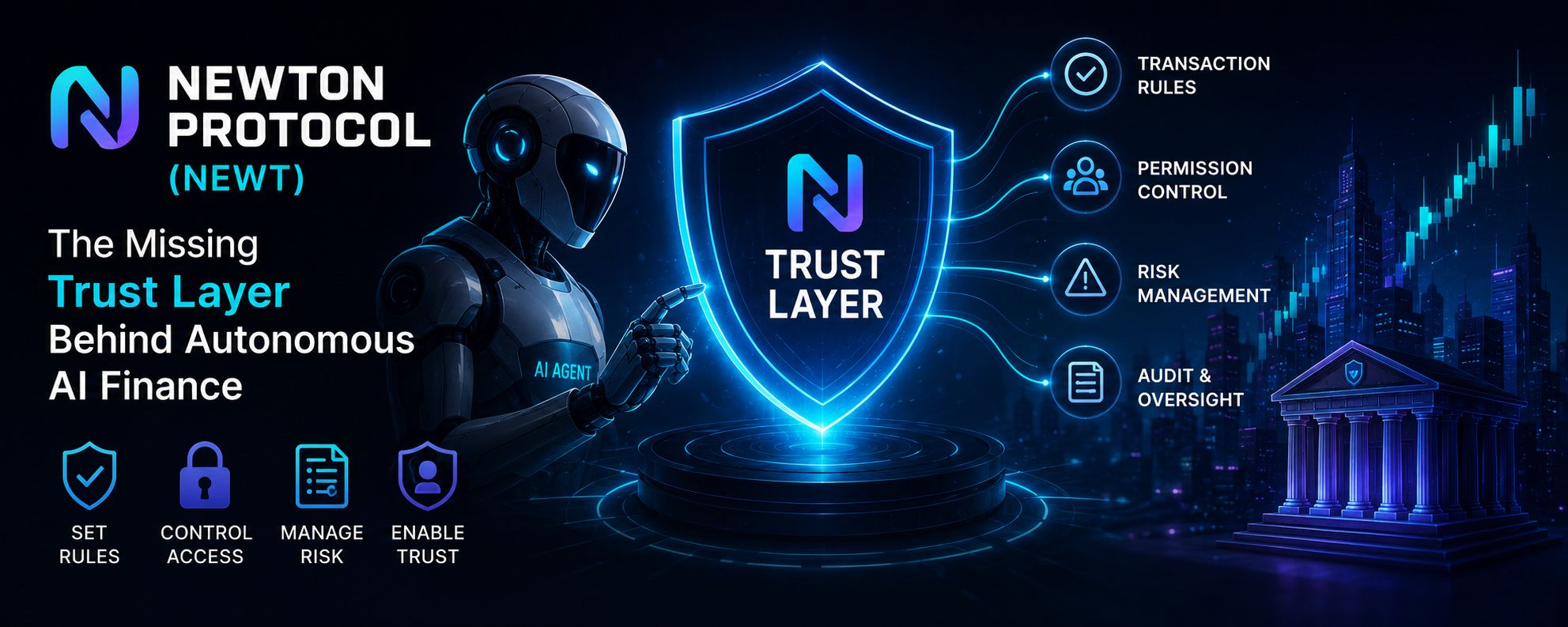
Instead, Newton is focused on creating rules around automated decision-making.
Think about it this way.
Imagine giving someone the keys to your car.
Most people wouldn't hand over the keys without setting some expectations.
Don't speed.
Don't drive recklessly.
Don't leave the city.
Bring it back tonight.
Those rules exist because trust isn't unlimited.
Newton applies a similar concept to AI agents.
Instead of asking whether an agent can execute a transaction, the protocol focuses on whether that transaction should be allowed in the first place.
That sounds less exciting than autonomous trading.
But in financial systems, boring problems often turn out to be the most important ones.
Why This Matters More Than It Did A Year Ago
A year ago, many AI-agent projects felt experimental.
Today, the landscape looks different.
AI tools are becoming more integrated into trading workflows. Research assistants are analyzing market data. Automated systems are helping manage portfolios. Developers are actively building products that reduce human involvement in routine decisions.
The direction of travel seems clear.
More automation is coming.
The question isn't whether AI will play a larger role in crypto.
The question is how much authority people are willing to hand over.
That's where Newton's thesis becomes interesting.
As more capital moves on-chain, trust becomes a bigger issue.
Managing a small wallet is one thing.
Managing millions of dollars is something else entirely.
The larger the amount of capital involved, the less comfortable investors become with blind automation.
At some point, somebody has to define the rules.
The Institutional Angle Is Probably More Important Than Retail
Most retail traders focus on narratives.
Institutions focus on risk.
That's an important distinction.
A retail trader might be comfortable experimenting with an AI strategy using a few thousand dollars.
A professional fund managing millions has a completely different mindset.
Before deploying capital, they want controls.
They want limits.
They want oversight.
They want systems that can prevent mistakes before those mistakes become expensive.
This is where Newton could potentially find its place.
Not because institutions suddenly love crypto.
Not because they suddenly trust AI.
But because they generally don't trust anything without safeguards.
If AI-driven finance continues growing, some form of authorization layer will probably become necessary.
The debate isn't whether controls will exist.
The debate is who ends up providing them.
The Risk Nobody Should Ignore
That doesn't automatically make NEWT a great investment.
There's a difference between identifying a real problem and building a successful business around solving it.
The biggest challenge for Newton isn't proving that the problem exists.
Most people already understand that uncontrolled AI systems can create risks.
The challenge is convincing enough users that they need Newton specifically.
That's a much harder task.
Crypto history is filled with projects that had solid ideas but struggled to achieve meaningful adoption.
Good technology doesn't guarantee demand.
Sometimes the market simply isn't ready.
Sometimes competitors arrive with stronger distribution.
Sometimes users choose convenience over security.
All of those risks apply here.
What I'm Watching
Honestly, I'm less interested in Newton's price chart than I am in its adoption.
Price can move for dozens of reasons.
Speculation.
Listings.
Market sentiment.
Narratives.
None of those tell you whether a protocol is actually becoming useful.
What I want to see is evidence that developers are integrating Newton into real products.
I want to see automated systems using its infrastructure.
I want to see organizations deciding that policy controls are important enough to implement.
That's where the real signal is.
Because if nobody uses the product, the investment case eventually falls apart no matter how interesting the concept sounds.
My Take
After looking at Newton Protocol, I don't see it as a bet on AI.
I see it as a bet on trust.
The crypto industry has spent years building systems that remove middlemen.
Now it's entering a phase where machines are starting to make decisions on behalf of humans.
That creates a completely new set of challenges.
The next wave of infrastructure may not be focused on making AI smarter.
It may be focused on making AI predictable.
That's what Newton is trying to build.
Whether it succeeds is still an open question.
The idea makes sense.
The timing could be right.
The need is real.
What remains uncertain is adoption.
And in crypto, adoption is ultimately what separates an interesting idea from a valuable network.
That's why NEWT is on my watchlist.
Not because of the AI narrative.
Because if autonomous finance becomes a meaningful part of this industry, the projects that define the rules could end up being just as important as the projects making the decisions.