
I once found myself refreshing a blockchain explorer far more times than I expected after submitting what should have been a simple onchain action. Nothing appeared broken, yet the outcome took longer than I anticipated. That small moment stayed with me because it reminded me that the biggest challenges in crypto are often invisible. We usually notice the result, but we rarely think about the systems quietly deciding how requests are processed, verified, and prioritized behind the scenes.
After seeing similar situations across different networks, I started paying less attention to who could build the smartest AI agent and more attention to the infrastructure responsible for keeping automated activity organized. The more I watched networks grow, the more I realized that intelligence alone does not create reliable systems. What matters is whether every action follows clear rules that remain dependable even when demand increases.
I often compare this to a busy logistics warehouse. Imagine hundreds of packages arriving every minute. Hiring more workers helps, but if there is no clear process for sorting, routing, and verifying every parcel, the warehouse quickly becomes disorganized. Delays begin to spread, mistakes become harder to trace, and efficiency slowly disappears. The real strength of the warehouse is not the speed of individual workers. It is the system that coordinates everyone without creating confusion.
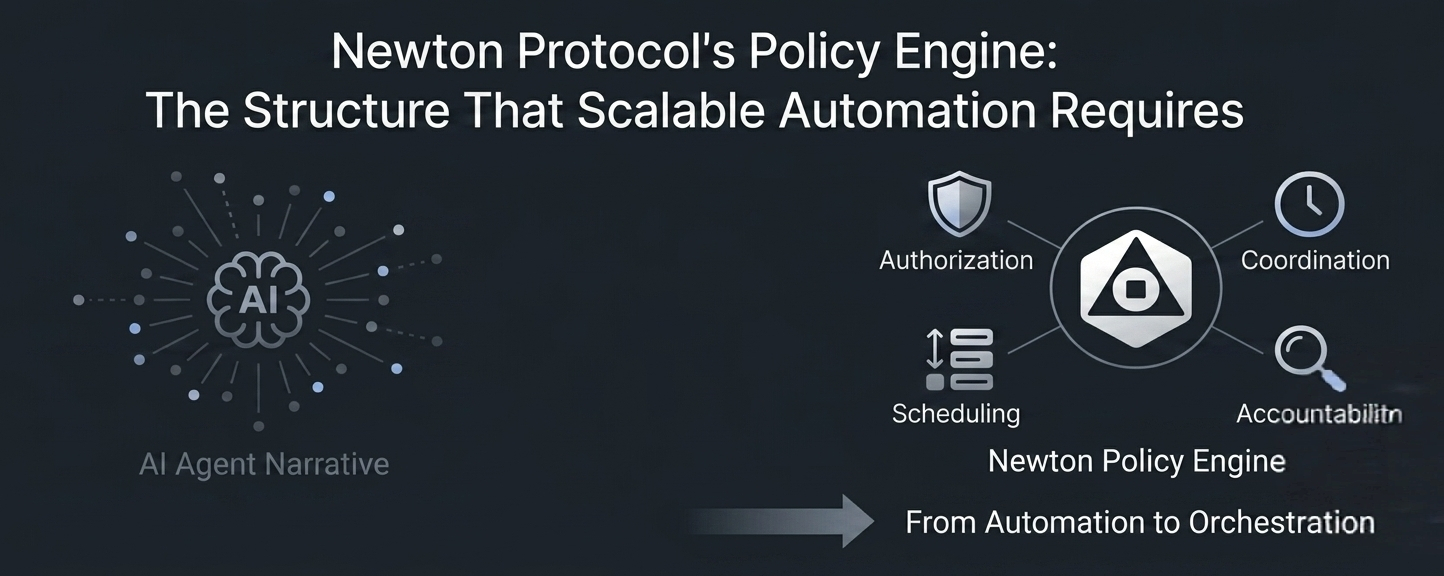
That comparison came back to me while learning more about @NewtonProtocol . Surprisingly, what interested me wasn't the discussion around AI agents. The part that kept drawing my attention was the Policy Engine because it focuses on something I believe deserves far more discussion: the rules that govern automation before actions are allowed to move through the system.
From my perspective, this is where infrastructure becomes genuinely interesting. A resilient network is not built simply by executing more tasks. It is built by deciding which tasks should move first, which ones can run independently, and which require additional verification before continuing. Those decisions influence scheduling, workload distribution, and overall system stability far more than many people realize.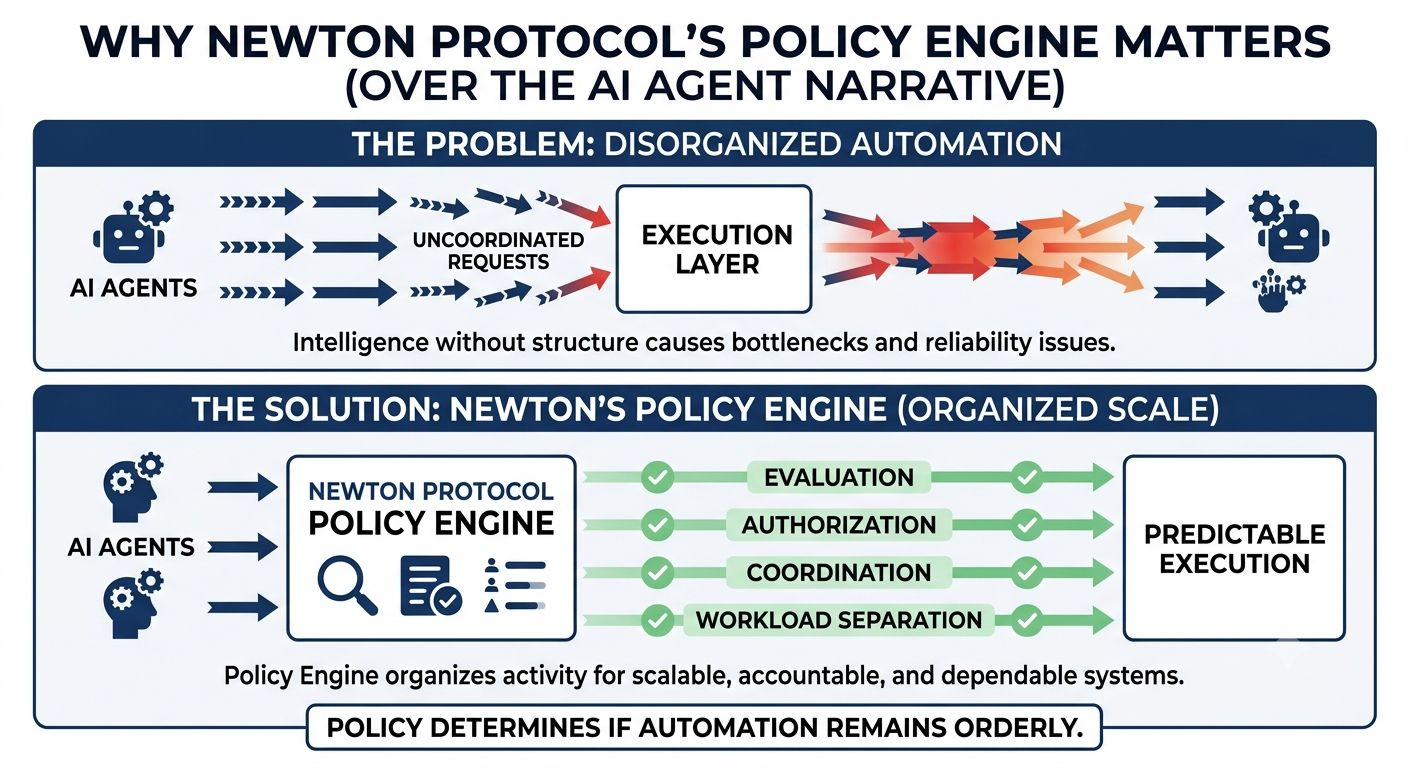
What I noticed is that the Policy Engine encourages me to think about automation differently. Instead of asking whether an AI agent can complete a task, I find myself asking whether the system has clear policies to evaluate, authorize, and coordinate that task responsibly. That feels like a much healthier way to think about long term infrastructure because automation without structure eventually creates complexity that becomes difficult to manage.
In my experience watching blockchain networks evolve, congestion rarely begins because technology suddenly stops working. More often, it appears when too many legitimate requests compete for the same resources without enough coordination. This is where careful workload separation, verification flows, and sensible scheduling become valuable. They help the network remain predictable instead of allowing temporary pressure to ripple through the entire system.
That is why I believe Newton Protocol's Policy Engine deserves more attention than the AI agent narrative itself. AI agents may generate activity, but policies determine whether that activity remains orderly, accountable, and scalable. From a system perspective, those quiet design choices are often far more important than the features that receive the most attention.
the longer I spend studying blockchain infrastructure, the more I appreciate systems that solve coordination problems instead 0f simply promising greater automation. Good infrastructure rarely asks to be noticed. It quietly keeps everything moving when complexity increases, and in the long run, that reliability is usually what people value most.