
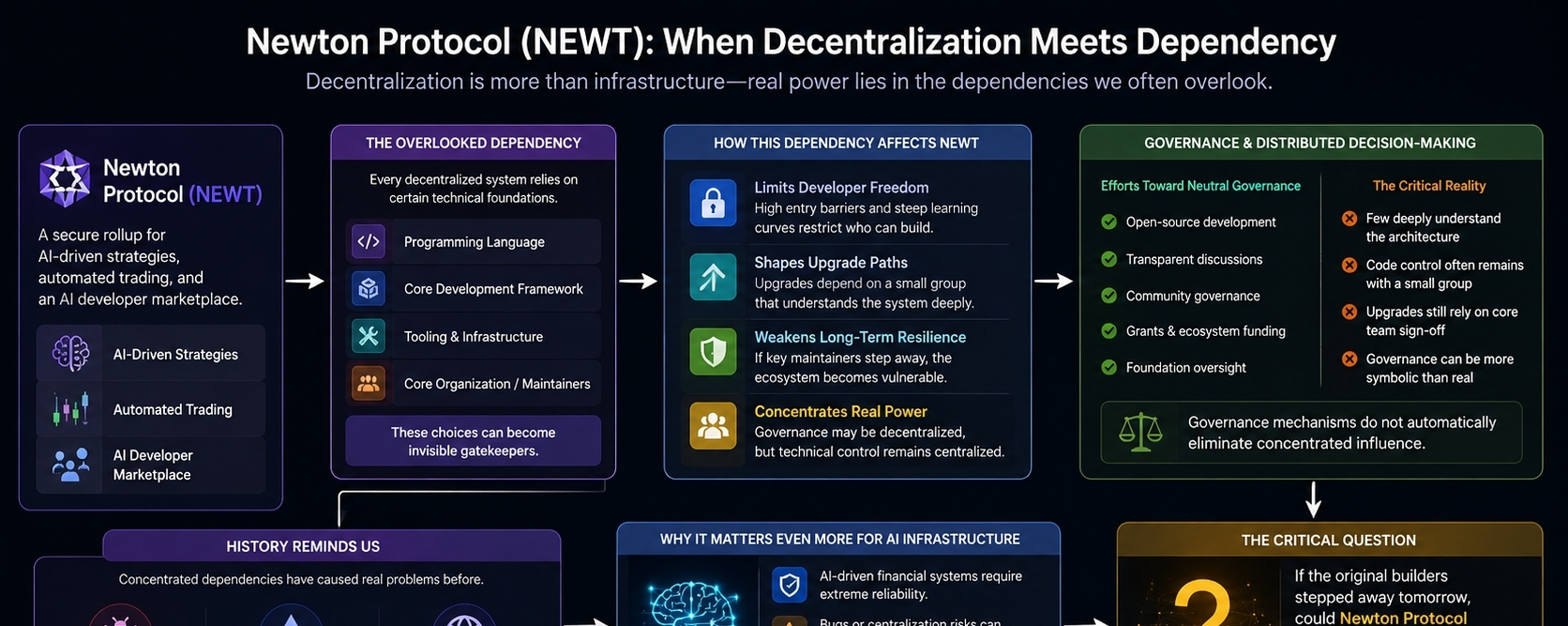
Decentralization has become one of the most celebrated ideas in blockchain, promising a future where no single person or organization holds too much power. But the reality is often more complicated. Behind every decentralized network is a technical foundation built by real people making real decisions, and that foundation can quietly become the project's greatest point of dependence. In the case of Newton Protocol (NEWT), which aims to create a secure rollup for AI-powered strategies, automated trading, and an AI developer marketplace, the most important question may not be how decentralized the network appears, but how much of it still depends on a small group shaping its core technology.
Most users pay attention to validators, token holders, or governance proposals. Far fewer ask who maintains the software that everyone relies on or who decides how the protocol evolves. A single programming language, a specialized development framework, or the organization leading the protocol's engineering can become an invisible center of influence. These choices may speed up innovation in the beginning, but they also determine who can contribute, who understands the system well enough to improve it, and who has the final say when difficult technical decisions arise.
This is where decentralization becomes more than a marketing slogan. If only a handful of developers can confidently work on the protocol's most important components, then the community may have ownership in theory while technical control remains concentrated in practice. New contributors face a steeper learning curve, independent implementations become less likely, and upgrades naturally revolve around the original builders because they possess the deepest knowledge of the system.
The technology industry has seen this pattern before. Some of the world's most widely used open-source libraries have depended on only a few maintainers, leaving essential infrastructure vulnerable when those individuals became overwhelmed or when security flaws appeared. Blockchain networks have also experienced controversial upgrades where technical leadership carried more influence than community discussions, reminding everyone that voting mechanisms do not always reflect where real authority exists. These moments show that concentration does not disappear simply because a project describes itself as decentralized.
To its credit, Newton Protocol encourages transparency through open development and community governance. These are meaningful steps toward building trust, and they create opportunities for broader participation. Yet transparency is not the same as decentralization. If the people reviewing code, designing upgrades, and maintaining the protocol remain largely the same small group, then governance can become more symbolic than transformative. A proposal may be open to everyone, but only a few people may truly understand its long-term consequences.
This matters even more for a project focused on AI. As artificial intelligence becomes increasingly involved in financial decisions and automated strategies, the infrastructure supporting those systems must remain resilient for years to come. That resilience depends not only on secure code but also on the ability of independent developers to contribute, challenge assumptions, and build alternatives without relying on a single organization.
Perhaps the biggest question is not whether Newton Protocol is decentralized today, but whether it could remain healthy if its original architects stepped away tomorrow. A decentralized future is measured by the community's ability to carry the project forward without depending on the same small circle of experts. Until that becomes possible, it is worth asking where power truly lives. Is it distributed across the network, or is it still quietly concentrated in the hands of those who shape the technology that everyone else depends on?