
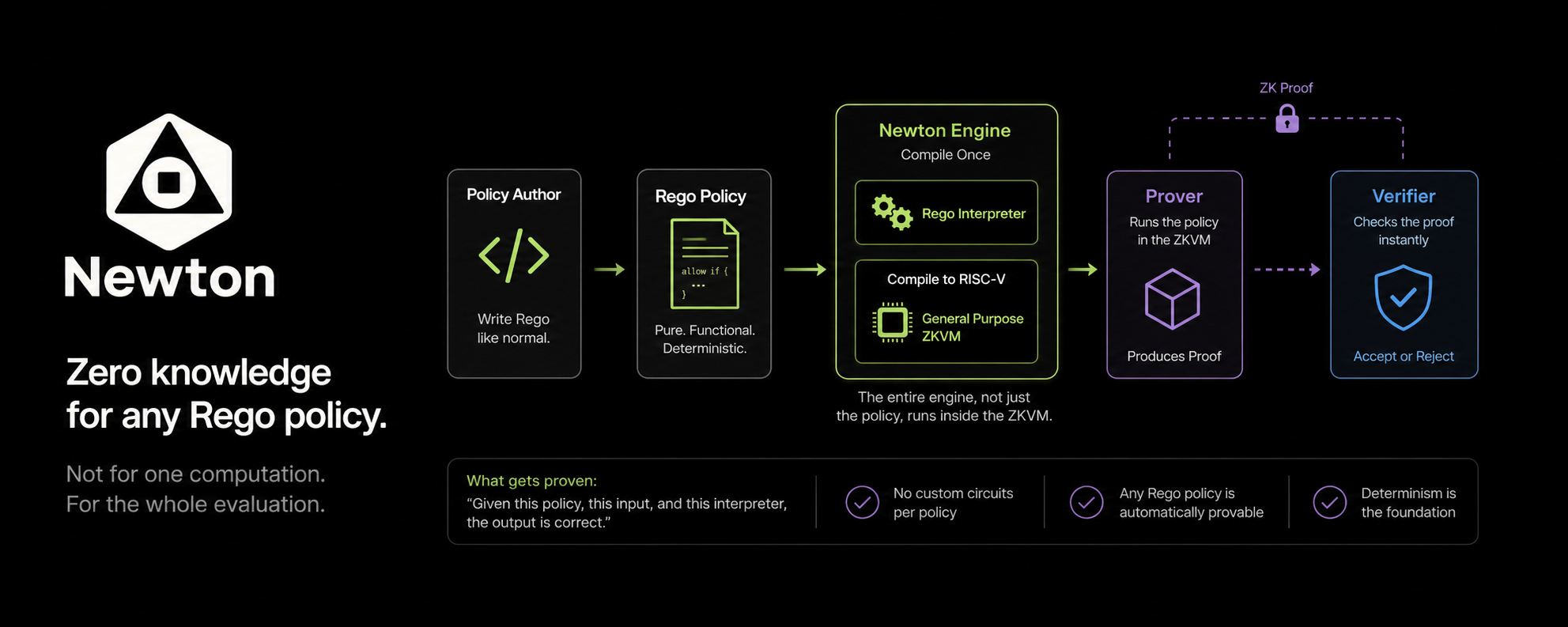
been sitting with newton's zk approach for a couple days now and the part that actually stands out is how sideways it is compared to how zero knowledge usually gets used.
heres the setup. most zk applications build a custom circuit for one specific computation, you design the constraint system around exactly what you're proving and nothing else. newton doesn't do that. it takes the entire rego policy engine, the whole interpreter, and compiles that to a risc-v target, then runs it inside a general purpose zkVM. the proof newton produces isn't "this one calculation was done right." it's "this policy, given this input, run through this interpreter, produced this output."
that's a different shape of claim entirely, and newton protocol seems to be the first system i've read that takes this route deliberately rather than as a shortcut.
what makes it work is something almost boring underneath all the cryptography. rego is a pure functional language. same policy, same input, always the same output, no side effects, no hidden state. that determinism is the actual hinge. without it you can't even ask the zk question cleanly, what would "prove this was evaluated correctly" even mean if the same policy could legitimately produce different answers on different runs.
so policy authors building on newton never touch any of this. they write rego the same way they'd write a kubernetes admission rule. the zk layer sits underneath, invisible to them.
what i find genuinely interesting here is what this buys structurally. because the whole engine is compiled once, any policy written in rego on newton becomes zk provable automatically. no per policy circuit work, no custom constraint design every time someone writes a new sanctions check or velocity rule. that's the part that scales in a way bespoke circuits don't.
i'm less sure how this holds up at scale though. general purpose zkVMs are slower than purpose built circuits, that's just the tradeoff for not hand designing each one. the whitepaper doesn't put a number on proving time for a realistic policy under load, and that gap matters more here than in a lot of zk writeups, because newton's whole challenge mechanism depends on a challenger being able to generate this proof inside a defined dispute window. if proving time runs long for a complex composed policy, does the window get sized around the slowest realistic case, or does that become a quiet constraint on how complex a newton policy can get before zk verifiability becomes impractical in practice rather than just in theory.
