WHO GOVERNS THE AGENT?
Everyone is obsessed with building smarter AI.
I think we are optimizing the wrong variable.
History shows that every powerful technology reaches a point where capability stops being the biggest challenge.
Control does.
The internet didn't become useful because computers became faster.
It became useful because we built rules around identity, authentication, and trust.
AI is approaching the same turning point.
Today, an AI agent can write code, analyze markets, search the web, and interact with blockchains.
Tomorrow, it will move stablecoins.
Manage treasuries.
Renew subscriptions.
Vote in DAOs.
Execute trades while you sleep.
That sounds like progress.
It is also the moment where intelligence becomes less important than permission.
A wrong answer from an AI wastes a few seconds.
A wrong transaction can destroy years of savings.
That is why I believe the biggest AI risk is being misunderstood.
People worry about whether AI can think.
They should worry about what AI is allowed to do.
There is a huge difference.
One is capability.
The other is authority.
Crypto has spent years solving decentralized ownership.
It has spent far less time solving delegated authority.
Imagine giving an AI one instruction.
"Invest $100 every Friday."
Simple.
Until the market crashes.
Or a malicious contract imitates a trusted protocol.
Or the agent discovers a higher yield somewhere you never approved.
Should it continue?
Should it stop?
Who decides?
If the answer depends on trust alone, the system is already fragile.
As autonomous agents become common, every wallet becomes a potential operating system.
Every permission becomes part of your security model.
That is the infrastructure challenge hiding in plain sight.
This is why Newton Protocol stands out.
Not because it promises a smarter AI.
Because it assumes smart AI already exists.
The real question is how that intelligence interacts with real assets without creating unacceptable risk.
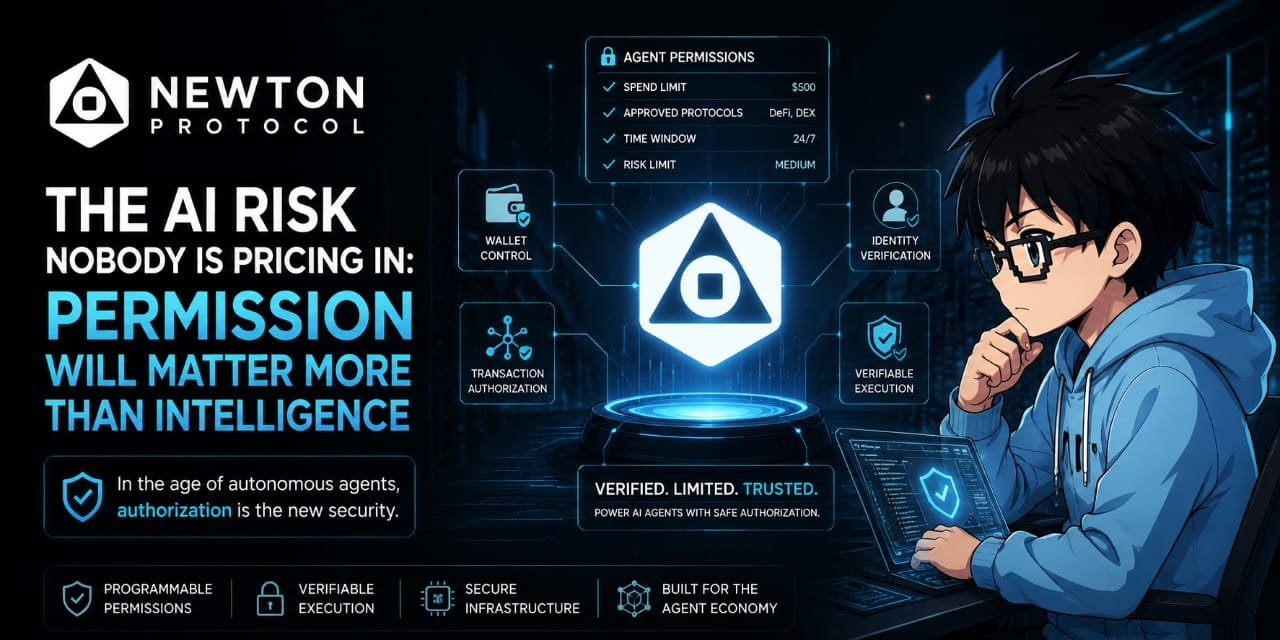
Newton Protocol introduces an authorization layer where permissions become programmable instead of assumed.
Users define what an agent can do.
How much it can spend.
Which protocols it can access.
When execution must stop.
Instead of unIimited authority, agents operate inside clearly defined boundaries.
The objective is simple.
Do not rely on good behavior.
Rely on verifiable rules.
That is a very different philosophy.
It shifts security away from trust and toward enforcement.
Early adoption suggests this problem is larger than many people realize.
Newton Protocol reported more than 1.1 million registered users, over 600,000 verified agent transactions, and approximately 350,000 activated AI agents during its early rollout.
Those numbers are important for one reason.
They show that autonomous onchain execution is no longer a theoretical discussion.
People are already experimenting with it.
The protocol is supported by a fixed supply of 1 billion NEWT, with 215 million tokens initially circulating.
That matters because the token is designed to secure network participation, staking, permission management, and protocol governance.
Its role is connected to operating the authorization layer itself rather than existing only as a speculative asset.
None of this guarantees success.
Newton Protocol still has difficult problems to solve.
Developers must embrace a new security model.
Users must understand programmable permissions without adding unnecessary complexity.
Competing authorization standards will inevitably emerge.
Infrastructure is never won by good ideas alone.
It is won through adoption.
Here is the prediction I believe most of the market is missing.
The first trillion dollar AI infrastructure company may not build the smartest model.
It may build the permission layer that every intelligent model is forced to use.
Intelligence will become abundant.
Trusted execution will remain scarce.
That changes where value accumulates.
We are entering an era where the most important AI question is no longer...
"Can it think?"
It is...
"Who gave it permission?" 🤔
Which will become more valuable over the next decade: smarter AI models or stronger authorization infrastructure?