
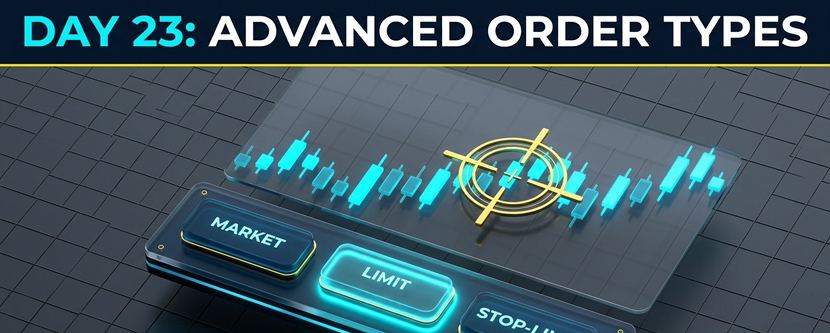

Welcome to the twenty-third day of our educational series. Yesterday, we peeked behind the curtain of price charts to understand how the electronic order book matches buyers and sellers in real time. Today, we are taking complete control of your execution mechanics by mastering Advanced Order Types. Relying solely on the basic buy and sell buttons is an easy way to lose money to unnecessary fees and market slippage. To trade like a professional analyst, you must know exactly when and how to deploy Market, Limit, and Stop-Limit orders to protect your entries and secure your capital.
Market Orders: Instant Execution with a Cost
A Market Order is the simplest and fastest way to buy or sell a digital asset. When you submit a market order, you are instructing the exchange to execute your trade instantly at the absolute best available price currently sitting in the order book.
* The Structural Mechanic: If you place a market buy order, the exchange matches you immediately with the lowest available seller in the ask book.
* The Major Risk: Market orders guarantee immediate execution, but they do not guarantee your price. If you try to use a market order during a violent market dump or in a thin, low-liquidity order book, you will experience severe price slippage, meaning your order will eat through the book and execute at a significantly worse price than you intended.
* The Fee Impact: Market orders make you a market taker because you are removing liquidity from the book, which usually incurs higher trading fees.
Limit Orders: Total Price Control
A Limit Order is an order to buy or sell an asset at a specific, predetermined price or better. Unlike market orders, limit orders give you absolute control over your entry and exit costs.
* The Structural Mechanic: If an asset is trading at one hundred dollars, but your technical analysis shows a major support floor at ninety-five dollars, you place a buy limit order at ninety-five dollars. Your order will sit patiently in the bid book as a green wall of liquidity. It will only execute if and when the market price drops down to match your exact target.
* The Major Benefit: You never suffer from slippage. If you set a limit to buy at ninety-five dollars, you will pay exactly ninety-five dollars or less. Furthermore, because you are adding pending orders to the book, you act as a market maker, which qualifies you for lower maker fees on most major exchanges.
* The Downside: Execution is not guaranteed. If the price drops to ninety-five dollars and one cent before skyrocketing upward, your order will remain unfilled, and you will miss the move.
Stop-Limit Orders: The Ultimate Risk Protection
A Stop-Limit Order is an advanced conditional order that remains completely invisible to the order book until a specific trigger price is reached. This is the ultimate tool used to automate your stop-losses and protect your trading account from sudden overnight market crashes. It requires you to set two distinct parameters: the Stop Price and the Limit Price.
* The Stop Price (The Trigger): This acts as the alarm clock. It tells the exchange, "If the market price drops down to this specific level, wake up and immediately place my order into the book."
* The Limit Price (The Execution): This is the actual price at which your order enters the book once triggered.
Let's look at a practical example: You buy an asset at one hundred dollars and identify a crucial structural support floor at ninety-five dollars. You want to exit immediately if that support breaks to avoid a massive loss. You set a stop-limit order with a stop price at ninety-four dollars and a limit price at ninety-three dollars and fifty cents. If a panic drop occurs and the price hits ninety-four dollars, your stop price triggers, and a sell limit order is instantly submitted to the book at ninety-three dollars and fifty cents. This ensures you cut your losses cleanly before the market can slide any lower.
Creator's Advice: Match the Order to the Market Environment
The most common mistake made by intermediate community members is using the wrong order type for the wrong situation. They use market orders during high-volatility news events, resulting in massive slippage losses, or they use basic limit orders as stop-losses, which can easily be skipped over entirely during a rapid price gap.
As a professional rule of thumb: use limit orders to patiently build your entry positions at key support zones during quiet market hours. Use stop-limit orders exclusively to secure your downside protection. Only reserve market orders for true emergencies where you must exit a failing position instantly, regardless of the fee cost.
Tomorrow, we will step into the mechanics of position management by mastering the difference between Spot Trading and Leverage Trading, teaching you how liquidations work and how to handle margin safely. For today, your practical task is to open your spot trading panel, locate the order type dropdown menu, and practice setting up a mock buy limit order at a support floor without hitting the final confirm button.