

By falling back below $60 000 in early June, Bitcoin didn't just put investors under pressure, it also impacted miners.
Miners were already facing operational challenges, leading to a decline in hashrate of roughly 28% since late October. This drop suggests that some miners decided to reduce or diversify their operations in order to lower costs, mechanically resulting in a difficulty adjustment of around 20% over the same period.
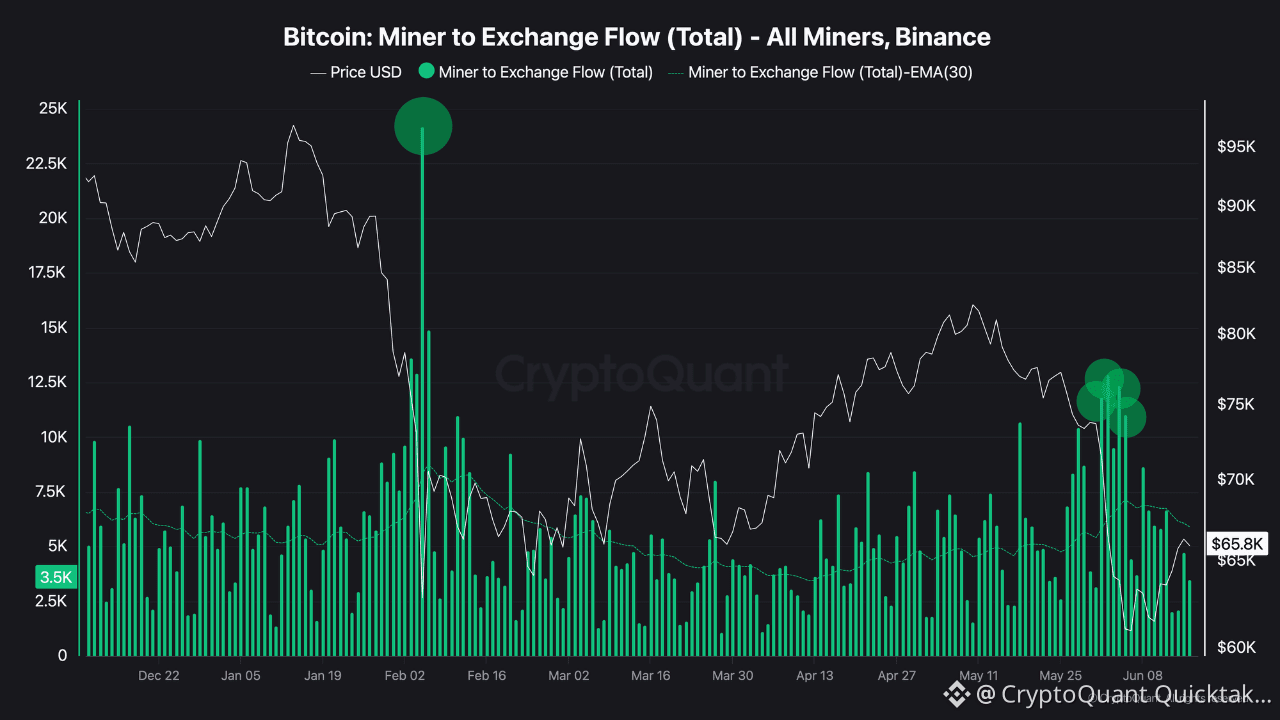
To deal with these challenges and cover their operating expenses, miners may be forced to sell BTC, not necessarily at the most favorable time, as illustrated by this chart showing their inflows to Binance.
We can see that in February, the dip below $60 000 pushed miners to sell more BTC than usual. On February 5 alone, more than 24 000 BTC were sent to Binance by miners, while the monthly average rose from around 5 000 BTC to more than 8 000 BTC.
The same pattern emerged again in early June as BTC revisited the $60 000 level. More than 4 days recorded miner inflows above 10 000 BTC per day on Binance, with a peak of 12 800 BTC. The monthly average increased from 4 700 BTC to 7 100 BTC.
It is worth noting that with an estimated production cost of around $76 000 and BTC trading near $65 000, the majority of miners are currently operating at a loss. As a result, many are forced to sell BTC to cover their expenses, and the amounts involved can become significant enough to influence Bitcoin's price.
Written by Darkfost