
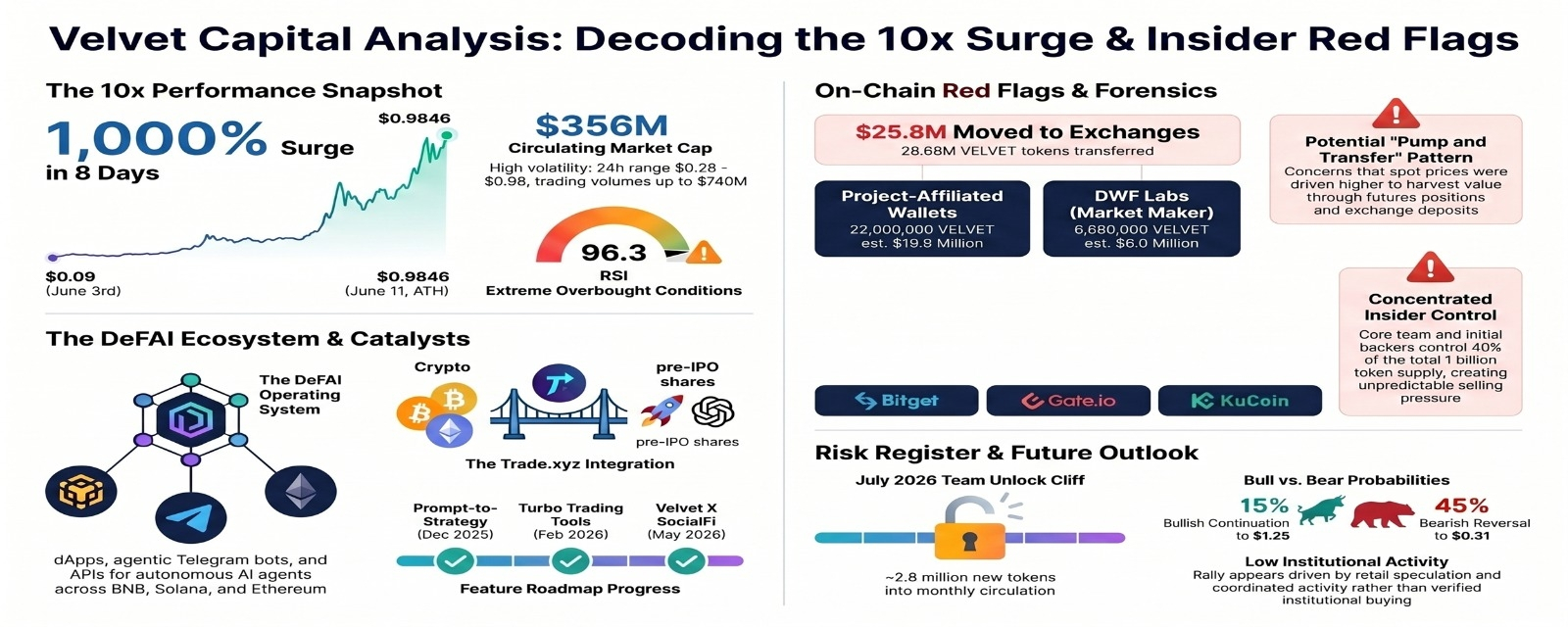
Between June 3 and June 11, 2026, the crypto markets witnessed a vertical move that defied standard volatility metrics: Velvet Capital (VELVET) skyrocketed from $0.09 to a peak of $0.9846. This staggering 1,000% increase in just eight days forces a difficult question for any serious analyst. Is this the definitive emergence of a new "DeFAI" (DeFi + AI) powerhouse, or are we witnessing a masterclass in market timing and institutional-scale exit liquidity?
Takeaway 1: The "Trade.xyz" Catalyst—Crypto Meets Pre-IPO Giants
The primary narrative driver was the June 3, 2026, announcement of Velvet’s integration with Trade.xyz. This partnership aims to bridge the chasm between decentralized finance and traditional high-value assets by promising "unified access" to crypto, equities, commodities, and indices. The integration purportedly allows users to trade pre-IPO shares of tech titans like SpaceX, OpenAI, and Anthropic alongside their on-chain holdings.
This "cross-asset" scope is a potent psychological trigger for investors, positioning the protocol as a one-stop-shop for the future of finance. However, as an analyst, one must separate marketing hype from technical milestones.
"The official announcement did not specify a launch timeline or detailed functionality for the Trade.xyz integration."
Until this moves beyond a narrative catalyst, the fundamental value remains speculative rather than functional.
Takeaway 2: The $25 Million "Red Flag"—Textbook Distributive Behavior
While retail investors chased the "SpaceX" headline, on-chain forensics revealed what appears to be institutional-scale exits masquerading as liquidity provision. Between June 8 and June 11, approximately 28.68 million VELVET tokens—valued at $25.8 million—were transferred to Bitget, Gate.io, and KuCoin.
The breakdown suggests a coordinated move:
Project-affiliated wallets: 22,000,000 VELVET ($19.8 million)
DWF Labs (Market Maker): 6,680,000 VELVET ($6 million)
The presence of DWF Labs here is particularly noteworthy and introduces a significant conflict of interest. DWF Ventures is an early investor in Velvet, while DWF Labs serves as the project's market maker. This "dual role" fuels the "spot price ramp-up + contract harvesting" theory: spot prices are driven higher to attract retail attention while affiliated entities potentially use exchange access to liquidate positions or harvest value via futures contracts. This is not the behavior of long-term conviction; it is textbook distribution.
Takeaway 3: The Rise of the DeFAI Operating System
Skepticism aside, one cannot ignore the technical "stack" Velvet is constructing. Operating across BNB Chain, Base, Solana, Ethereum, and Sonic, the project is positioning itself as a vertically integrated DeFAI Operating System. This architecture includes:
Native User Application (dApp): The primary hub for the reported 100,000 users.
Agentic Telegram Bot: Enabling mobile-first asset management.
APIs & DeFAI OS: A specialized environment for autonomous agents to execute complex strategies.
The project’s "agentic" capabilities reached a milestone in April 2026 with the deployment of the Unicorn AI Agent on x402. This follows the December 2025 "Prompt-to-Strategy" launch, allowing natural language commands to dictate DeFi maneuvers. The momentum was further sustained by the June 9 launch of Velvet X (SocialFi) and full Perpetual Futures Trading. This technical depth is the only reason a $350M market cap remains even remotely debatable.
Takeaway 4: The 40% Insider Concentration & The July 2026 Cliff
Velvet’s tokenomics present a looming structural risk. The Core Team and Initial Backers control 40% of the total 1-billion-token supply. However, the effective insider influence is likely higher, as the Ecosystem Fund (25%) is DAO-controlled but heavily influenced by the founding team.
Investors must mark July 2026 on their calendars. This date signals the end of the one-year cliff for team allocations. At that point, an estimated 6–7 million tokens will begin hitting the market monthly. In a market currently characterized by extreme volatility, this scheduled dilution creates a heavy, predictable source of selling pressure that could easily overwhelm organic demand.
Takeaway 5: Extreme Technical Overextension (RSI at 96)
From a technical perspective, the recent price action was a "blow-off top" in the making. During the peak of the surge, the Relative Strength Index (RSI) hit an astronomical 96.3. While the RSI has since cooled slightly to ~83, it remains firmly in overbought territory, suggesting the "reset" has not yet occurred.
The volatility has been staggering, with a 24-hour range on June 11 stretching from $0.28 to $0.98. Furthermore, a 40–50% daily turnover rate suggests heavy "distribution," where tokens are rapidly moving from early entrants to late-arriving retail speculators. This is confirmed by a classic MACD divergence: the price continued to print new highs while momentum began to decay, a standard warning sign of an impending reversal.
Conclusion: A Visionary Future or a Cautionary Tale?
Velvet Capital represents the ultimate DeFAI paradox. On one hand, it offers a sophisticated multi-chain OS and agentic tools like the Unicorn AI Agent that could genuinely revolutionize automated finance. On the other hand, the project’s current market behavior—characterized by massive exchange transfers from affiliated wallets and the DWF Labs "dual role" conflict—bears the hallmarks of a "Pump, Transfer, Dump" pattern.
As an analyst, I find the technology compelling but the market behavior concerning. The ultimate question for any potential investor is simple: Do you value the long-term potential of technical innovation enough to overlook non-transparent and aggressive market distribution?
Disclaimer: The information provided in this analysis is for educational and informational purposes only and does not constitute financial advice. Cryptocurrency investments carry substantial risk, and you should always conduct your own research and consult with qualified financial professionals before making any investment decisions. All price targets and scenarios are based on third-party analysis, technical indicators, and market observations—none of which guarantee future results.