
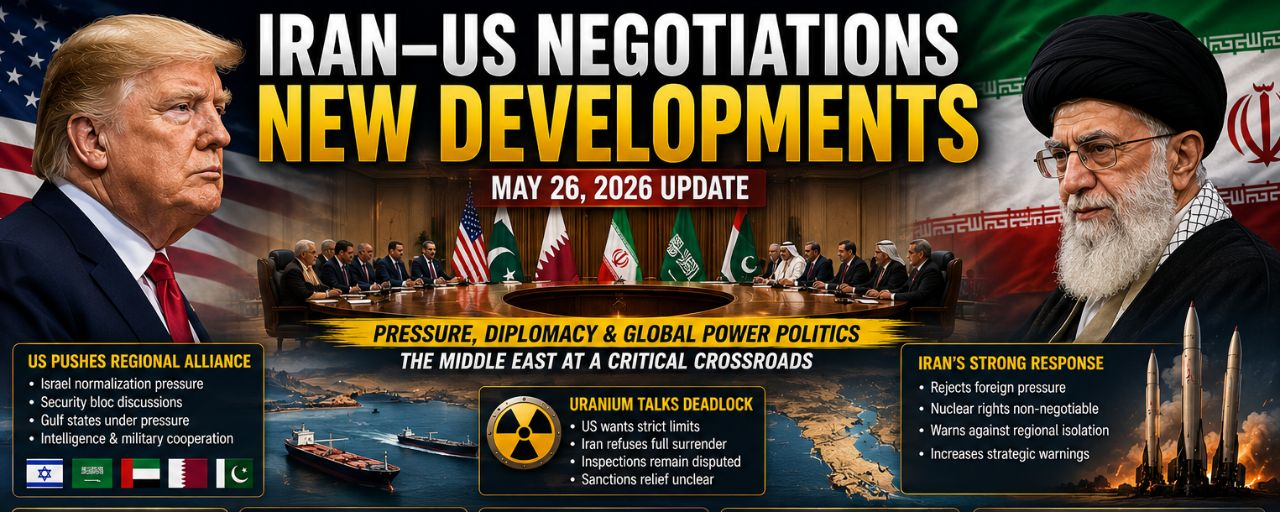
As of May 26, 2026, several new developments are now emerging around the Iran–US negotiations, and the situation is becoming more complicated than simple ceasefire talks.
The diplomatic atmosphere across the Middle East is now shifting toward a much larger geopolitical restructuring process involving: ▪️ Israel normalization ▪️ Gulf security alliances ▪️ Iran’s nuclear future ▪️ oil market stability ▪️ US military influence in the region
And according to multiple regional reports, the pressure behind closed doors is increasing rapidly.
🇺🇸 US Reportedly Expanding “Regional Security Bloc” Discussions
One major update circulating through diplomatic circles is that Washington is now trying to expand a broader Middle East security framework involving: ▪️ Gulf states ▪️ Israel ▪️ regional air defense cooperation ▪️ intelligence-sharing agreements
Analysts believe the US strategy is becoming clearer:
Instead of only containing Iran militarily, Washington may now be trying to build a long-term regional alliance system around Israel and Gulf partners simultaneously.
This is why discussions about normalization and diplomatic recognition are appearing more aggressively again.
🇸🇦 Saudi Arabia Still Moving Carefully
Despite heavy speculation online, Saudi Arabia still appears cautious.
Saudi leadership reportedly wants: ✅ stronger US security guarantees ✅ advanced military cooperation ✅ economic agreements ✅ stability before any final normalization steps
At the same time: ⚠️ domestic political sensitivity remains extremely high ⚠️ Palestinian issues continue creating pressure inside the Muslim world
Because of this, analysts believe Saudi Arabia is trying to balance: ▪️ Western partnerships ▪️ regional security ▪️ Islamic political optics ▪️ economic modernization goals
all at the same time.
🇮🇷 Iran Increasing Strategic Warnings
Iranian officials meanwhile are increasing public warnings against what they describe as: “foreign-controlled regional restructuring.”
Tehran reportedly believes: ▪️ Israel normalization efforts are partly aimed at isolating Iran ▪️ military alliances near Iranian borders are becoming a long-term threat ▪️ nuclear pressure is being used as geopolitical leverage
Iranian media has also intensified rhetoric around: ⚠️ sovereignty ⚠️ regional resistance ⚠️ anti-Western positioning
which signals Tehran is preparing both diplomatically and psychologically for difficult negotiations ahead.
☢️ Nuclear Negotiations Still Facing Major Deadlock
The uranium issue remains one of the biggest unresolved problems.
According to diplomatic leaks: ▪️ Western negotiators want stricter enrichment limitations ▪️ Iran refuses to fully surrender enrichment capability ▪️ inspection mechanisms remain disputed ▪️ sanctions relief timelines are still unclear
This creates a dangerous situation where: both sides want negotiations — but neither side wants to appear weak publicly.
And historically, that is where Middle East negotiations often become unstable.
🇶🇦 Qatar Quietly Becoming The “Emergency Communication Hub”
Another important development is Qatar’s growing behind-the-scenes role.
Political analysts now believe Doha is becoming: 🌍 one of the primary indirect communication channels 🌍 a crisis-management center for regional diplomacy 🌍 a bridge between hostile powers
This matters because Qatar maintains active relationships with: ▪️ Iran ▪️ the US ▪️ Hamas-linked channels ▪️ Gulf governments ▪️ Western intelligence networks
Very few countries currently have access to all sides simultaneously.
🇷🇺 Russia & 🇨🇳 China Watching Carefully
Another major hidden factor: Russia and China are now monitoring negotiations very closely.
Why?
Because: ▪️ China depends heavily on Gulf energy routes ▪️ Russia benefits strategically from Western instability ▪️ both countries want influence over future regional arrangements
If negotiations collapse: 🌍 Russia could gain geopolitical leverage 🌍 China could push for alternative regional agreements 🌍 global energy markets could face major shocks
So this crisis is no longer purely “Middle East politics.”
It is now part of a much larger global power competition.
📉 Oil Markets Remain Extremely Sensitive
Financial markets are reacting cautiously to every update.
Even small rumors around: ▪️ Hormuz reopening ▪️ ceasefire progress ▪️ tanker security ▪️ sanctions relief
are affecting: 🛢️ oil prices 📈 energy stocks 💰 global inflation expectations
This is why world powers are pushing aggressively to avoid direct military escalation.
Final Analysis
The biggest reality now is this:
The Iran–US negotiations are no longer isolated diplomacy.
They are becoming the center of a much larger struggle involving: ▪️ Middle East power balance ▪️ Israel’s regional role ▪️ Gulf alliances ▪️ nuclear leverage ▪️ global oil security ▪️ US influence ▪️ Russia-China positioning
And while headlines online are becoming increasingly dramatic, the real negotiations appear to be happening quietly through intermediaries like: 🇵🇰 Pakistan 🇶🇦 Qatar 🇴🇲 Oman and several Gulf diplomatic channels.
Right now, the region is standing between: ⚠️ fragile diplomacy or ⚠️ a much wider geopolitical confrontation.
The next few weeks could become one of the most important periods for Middle East stability in years.