
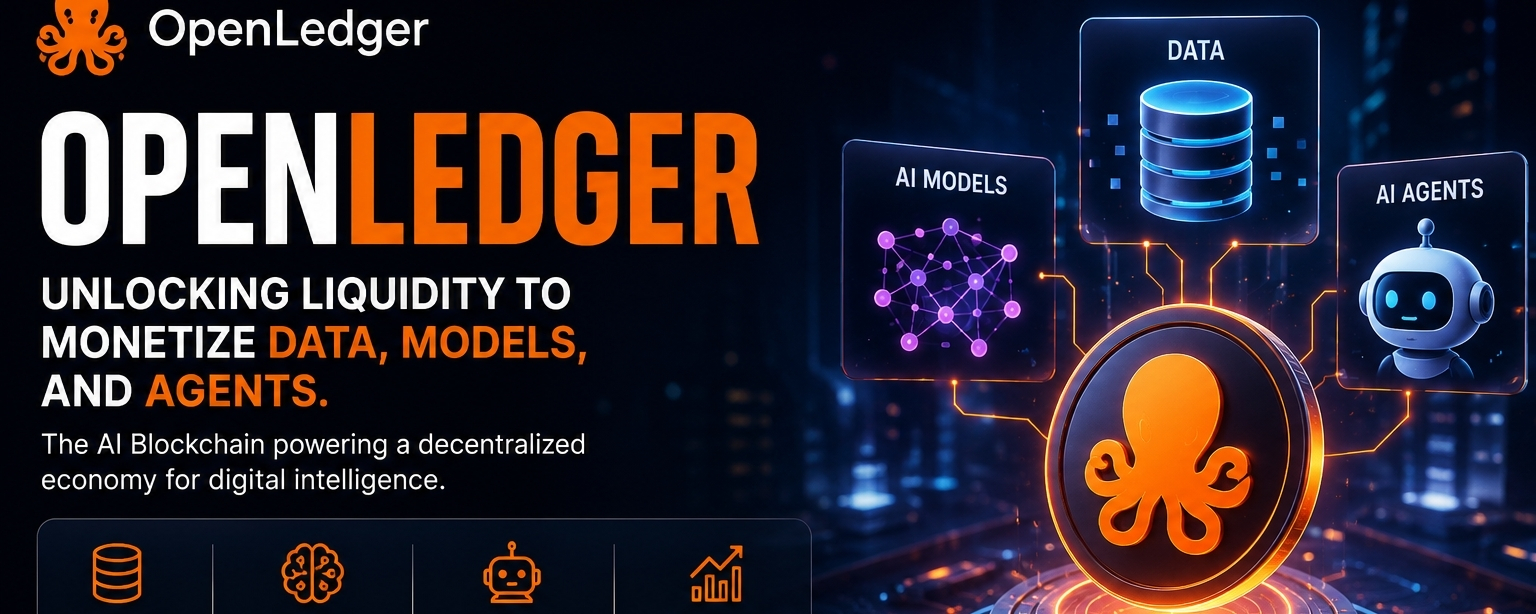
OpenLedger: Unlocking the Future of AI Blockchain Liquidity
Introduction
Artificial intelligence and blockchain are two of the most transformative technologies of our time. Individually, they are reshaping industries, economies, and digital experiences. Together, they have the potential to create an entirely new financial and technological ecosystem. This is where OpenLedger (OPEN) enters the picture.
OpenLedger is more than just another blockchain project. It is an AI-powered blockchain infrastructure designed to unlock liquidity for data, AI models, and autonomous agents, allowing users, developers, and businesses to monetize digital intelligence like never before. In a world where data has become one of the most valuable assets, OpenLedger is building the foundation for a marketplace where data and AI resources can be exchanged, valued, and rewarded transparently.
By combining decentralized finance, artificial intelligence, and blockchain technology, OpenLedger aims to solve one of the biggest challenges in the digital economy: how to transform underused data and AI assets into productive, liquid, and tradable value.
This article explores what OpenLedger is, how it works, its core features, recent developments, token utility, and why it could become a major player in the future of decentralized AI infrastructure.
What Is OpenLedger?
OpenLedger is an AI blockchain built to create liquidity around three essential digital assets:
Data
AI Models
Autonomous Agents
Its mission is simple but powerful: enable individuals and organizations to monetize their digital intelligence.
Today, enormous amounts of valuable data remain unused or locked inside private systems. AI models are expensive to build and difficult to monetize fairly. Intelligent agents capable of performing automated tasks often lack efficient economic infrastructure.
OpenLedger solves these problems by providing a decentralized blockchain ecosystem where these resources can be tokenized, shared, traded, and rewarded.
In simple terms, OpenLedger transforms digital intelligence into an economic asset.
Why OpenLedger Matters
The world is entering an AI-driven economy.
Businesses rely on data to train machine learning systems. Developers need access to quality AI models. Intelligent software agents are becoming increasingly important in automation.
However, current systems have major limitations:
Data owners often do not receive fair compensation.
AI developers struggle to monetize their models efficiently.
Access to premium AI tools remains centralized.
Autonomous agents lack trustless payment systems.
OpenLedger addresses these issues by building a blockchain specifically designed for AI liquidity.
This creates a decentralized marketplace where contributors can earn value for their data, developers can monetize models, and AI agents can operate within transparent financial systems.
Core Vision: Unlocking AI Liquidity
Liquidity is essential in finance. It allows assets to move freely and generate value.
OpenLedger applies this concept to artificial intelligence.
Instead of viewing data and AI models as static resources, OpenLedger treats them as liquid assets that can be exchanged and monetized.
This creates new economic opportunities such as:
Selling valuable datasets
Licensing trained AI models
Renting AI compute capabilities
Deploying autonomous AI agents
Rewarding contributors fairly
This shift could fundamentally change how digital intelligence is owned and distributed.
Key Features of OpenLedger
1. AI-Native Blockchain Infrastructure
OpenLedger is designed specifically for AI applications.
Unlike general-purpose blockchains, its infrastructure is optimized for handling data assets, model verification, and intelligent agent interactions.
This specialization gives it an advantage in supporting AI-focused decentralized applications.
2. Data Monetization Marketplace
Data is often called the new oil.
OpenLedger allows users and organizations to tokenize and monetize their datasets.
This can include:
Training datasets
Consumer behavior data
Research datasets
Enterprise analytics data
Machine-generated data
Contributors can receive rewards when their data is used for AI development.
This creates a fairer digital economy.
3. AI Model Marketplace
Developing advanced AI models requires significant investment.
OpenLedger allows developers to publish, license, and monetize their trained models on-chain.
Potential buyers can access verified AI tools while developers receive transparent compensation.
This helps create an open AI economy.
4. Autonomous Agent Economy
AI agents are becoming increasingly capable of handling tasks independently.
OpenLedger supports economic interactions for these agents.
Examples include:
Automated trading agents
Research assistants
Customer service bots
Data processing agents
Workflow automation systems
These agents can perform services and receive blockchain-based payments.
This opens the door to machine-to-machine economies.
5. Decentralized Ownership and Transparency
Blockchain ensures that ownership records, payments, and usage rights remain transparent and secure.
Users can verify:
Who owns specific data
How models are used
Where payments flow
How rewards are distributed
Transparency builds trust.
6. Scalable Ecosystem for Developers
OpenLedger provides developers with tools to build decentralized AI applications.
This includes smart contracts, integrations, and infrastructure designed for AI workflows.
A strong developer ecosystem can accelerate platform growth.
Recent Updates and Project Momentum
OpenLedger has been attracting increasing attention in the blockchain and AI sectors.
Several recent developments highlight its growing momentum.
Expanding Ecosystem Partnerships
Strategic partnerships are helping OpenLedger strengthen its network and attract developers, businesses, and infrastructure providers.
Partnership growth often signals confidence in a project's long-term potential.
Increased Community Engagement
The OpenLedger community has shown rising interest across social platforms and crypto discussions.
Community support can be a major growth catalyst.
Product Development Progress
Recent updates suggest continued technical development, including improvements in:
Blockchain performance
AI integration tools
Marketplace functionality
Developer support systems
Security infrastructure
Consistent product delivery builds investor confidence.
Growing AI Narrative
AI-related blockchain projects have become one of the strongest market narratives.
OpenLedger benefits directly from this trend by positioning itself at the intersection of blockchain and artificial intelligence.
Timing can be a major advantage.
OPEN Token Utility
The OPEN token plays a central role in the OpenLedger ecosystem.
Its utility helps power network activity and incentivize participation.
1. Transaction Fees
Users may use OPEN tokens to pay for network operations, marketplace activity, and service access.
This creates baseline demand.
2. Access to AI Services
Premium AI models, datasets, and agent services may require OPEN tokens for access.
This links token demand directly to ecosystem growth.
3. Staking and Security
Users may stake OPEN tokens to support network security and receive rewards.
Staking encourages long-term participation.
4. Governance Participation
OPEN holders may participate in decentralized governance.
They can vote on:
Protocol upgrades
Fee structures
Marketplace rules
Future development priorities
Community governance strengthens decentralization.
5. Incentive Distribution
Contributors providing valuable data, models, or agent services may receive OPEN token rewards.
This drives ecosystem activity.
Competitive Advantages of OpenLedger
First-Mover Advantage in AI Liquidity
Few blockchain projects focus specifically on AI liquidity.
OpenLedger’s specialized mission gives it a strong market identity.
Strong Market Narrative
AI and blockchain are both high-growth sectors.
Projects combining both can attract significant investor attention.
Real Utility
OpenLedger solves real economic problems rather than relying on speculation alone.
Practical utility often supports long-term sustainability.
Network Effects
As more users contribute data and models, the ecosystem becomes more valuable.
This creates a positive growth cycle.
Why Investors Are Watching OpenLedger
Investors are increasingly focused on projects with strong fundamentals and emerging narratives.
OpenLedger checks several important boxes:
Innovative technology
AI exposure
Blockchain infrastructure utility
Growing community interest
Scalable business model
Strong token utility
Projects that combine narrative strength with practical utility often perform well during major market cycles.
Future Potential of OpenLedger
The future of digital economies may depend heavily on how data and AI assets are managed.
OpenLedger is positioning itself to become foundational infrastructure for this future.
Possible long-term outcomes include:
Global decentralized AI marketplaces
Cross-platform AI model trading
Autonomous machine economies
Enterprise AI monetization tools
Tokenized intelligence networks
If adoption accelerates, OpenLedger could become a major infrastructure layer in the decentralized AI ecosystem.
Conclusion
OpenLedger is building something ambitious and highly relevant: an AI blockchain designed to unlock liquidity for data, models, and autonomous agents.
By combining blockchain transparency with AI-powered economic systems, it creates new ways for individuals and businesses to monetize digital intelligence.
Its focus on real utility, scalable infrastructure, and AI-driven innovation gives it strong long-term potential.
As the global economy moves toward decentralized artificial intelligence, platforms like OpenLedger may become essential foundations of the next technological era.
For investors, developers, and technology enthusiasts, OpenLedger is a project worth watching closely.
The future of AI may not only be intelligent—it may also be decentralized, liquid, and powered by OpenLedger.