

I’ve been around crypto long enough to know that markets usually get excited about the visible thing and ignore the layer quietly forming underneath.
A few years ago, everyone cared about tokens moving faster, yields looking bigger, and new chains promising cheaper transactions. Some of that mattered. Most of it was noise dressed as innovation. Now the same feeling is starting to build around AI.
And if I’m being careful with my attention, it’s because AI narratives are becoming crowded fast.
Still, every once in a while a project appears where the idea feels bigger than the marketing around it. OpenLedger gave me that feeling.
Not because I think AI and blockchain automatically belong together. Honestly, that assumption has burned traders before. But because there’s a real economic problem sitting underneath this conversation that people are finally starting to notice.
AI runs on data, models, and increasingly on agents that can perform work with limited human involvement. Yet ownership around those systems still feels strangely incomplete.
A model improves from thousands of interactions and data inputs, but who truly owns that improvement? A builder creates something valuable but relies on centralized platforms to distribute and monetize it. Valuable datasets exist everywhere, but their contribution to AI systems often disappears into closed ecosystems where value becomes difficult to track.
That imbalance feels familiar.
Crypto, at its best, has always been trying to answer ownership problems.
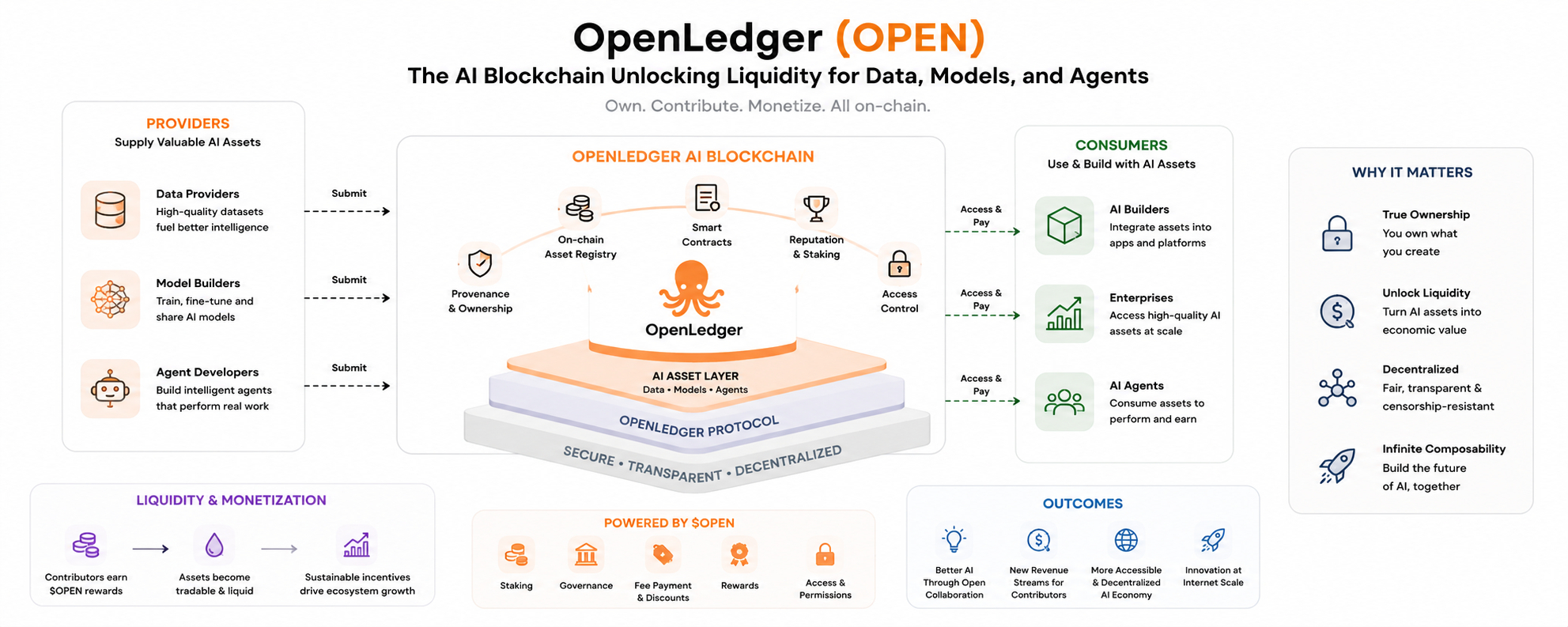
OpenLedger seems to be approaching this from that angle. An AI-focused blockchain designed to unlock liquidity around data, models, and agents sounds abstract at first, but the practical side is where it becomes more interesting.
Think about how workflows are changing already.
Traders use AI to process information faster. Researchers rely on models to filter signal from noise. Builders are experimenting with agents that can automate analysis, execution, and repetitive digital work. AI is no longer some distant concept sitting inside research labs. It’s entering everyday market behavior.
The question is no longer whether AI creates value.
The question is who captures it.
That distinction matters more than people realize.
If AI systems become productive digital assets, then ownership starts becoming a market question rather than just a technical one. Suddenly data is not merely information. A model is not simply software. An agent is not just automation.
They become economic units.
That shift changes incentives.
For builders, easier monetization can change what gets created. For developers, open infrastructure can lower dependency on closed ecosystems. For markets, it introduces entirely new forms of competition.
The edge may stop being purely about capital or execution speed.
It may become about owning better intelligence systems.
That’s partly why OpenLedger interests me. Not as a guaranteed winner, and definitely not as some instant solution, but as infrastructure attempting to align with where digital work may be heading.
And infrastructure tends to matter more than people appreciate during its early stages.
We saw versions of this in past cycles. The first waves of crypto were mostly speculative. Then the market slowly realized that better rails created stronger ecosystems. Wallets improved. Liquidity systems matured. Developer tooling became easier. Once infrastructure reached a certain threshold, entirely new behaviors emerged.
AI could follow a similar path.
But this is where experience forces me to stay skeptical.
A useful network does not automatically create a valuable token.
Crypto markets repeatedly blur that line.
There are countless examples where strong products attracted users while token economics remained weak or disconnected. OpenLedger, like any infrastructure play, eventually has to answer a difficult question that traders should never ignore.
Does the network capture value, or does the value escape toward applications built on top of it?
That answer matters more than narrative strength.
There is also the adoption problem.
Most AI builders today use centralized tools because they are efficient and familiar. Decentralized infrastructure cannot win through ideology alone. It has to offer better economics, smoother workflows, or stronger ownership guarantees. Otherwise convenience wins, and convenience usually wins fast.
So I don’t look at OpenLedger through a hype lens.
I look at it as part of a broader experiment.
AI is creating new forms of digital production while crypto keeps searching for durable economic coordination. Somewhere between those two forces, projects like OpenLedger are trying to build infrastructure for ownership itself.
Maybe that becomes foundational.
Maybe it stays niche.
Markets will decide that later.
For now, I find the idea worth watching because the loudest narratives often fade first, while the quieter infrastructure stories sometimes end up shaping what the next cycle actually looks like.
