

The AI industry has become obsessed with intelligence.
Smarter models.
More autonomous agents.
Faster inference.
Bigger ecosystems.
But beneath all the excitement, I think a much larger problem is quietly forming:
AI still has no reliable way to track contribution.
And that matters more than most people realize.
Because modern AI is no longer built by a single company sitting behind closed doors.
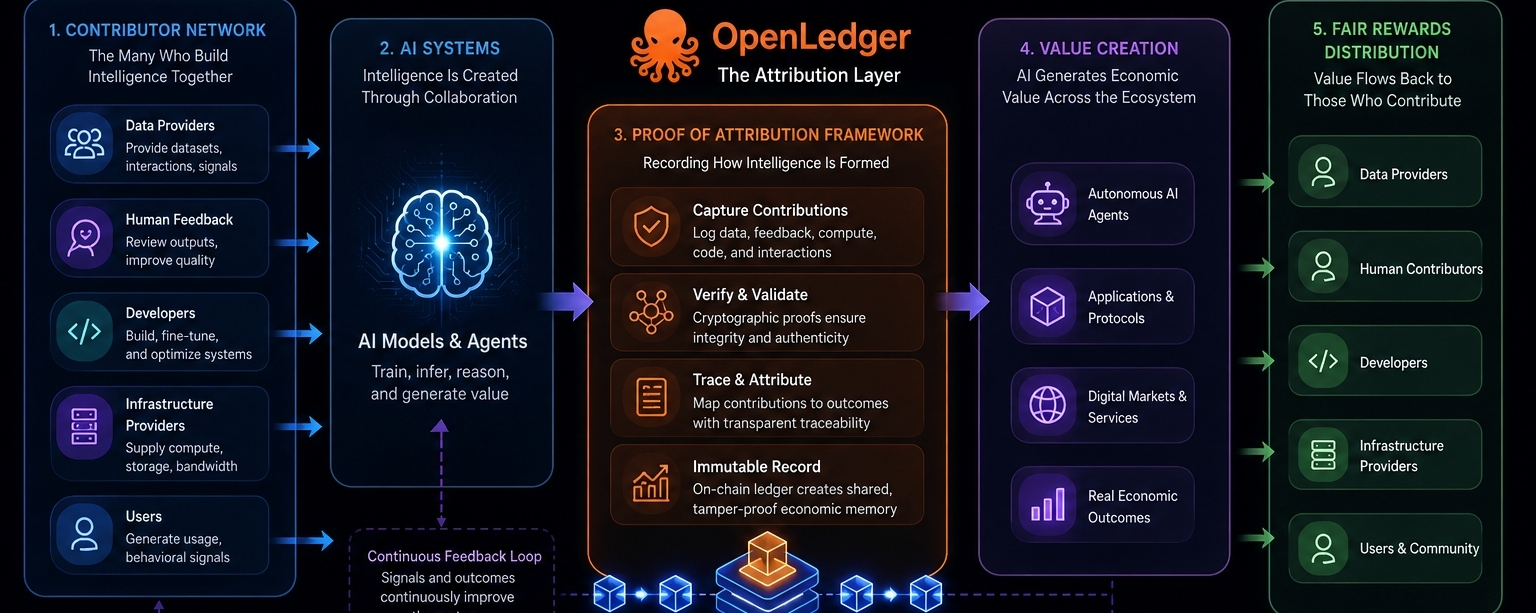
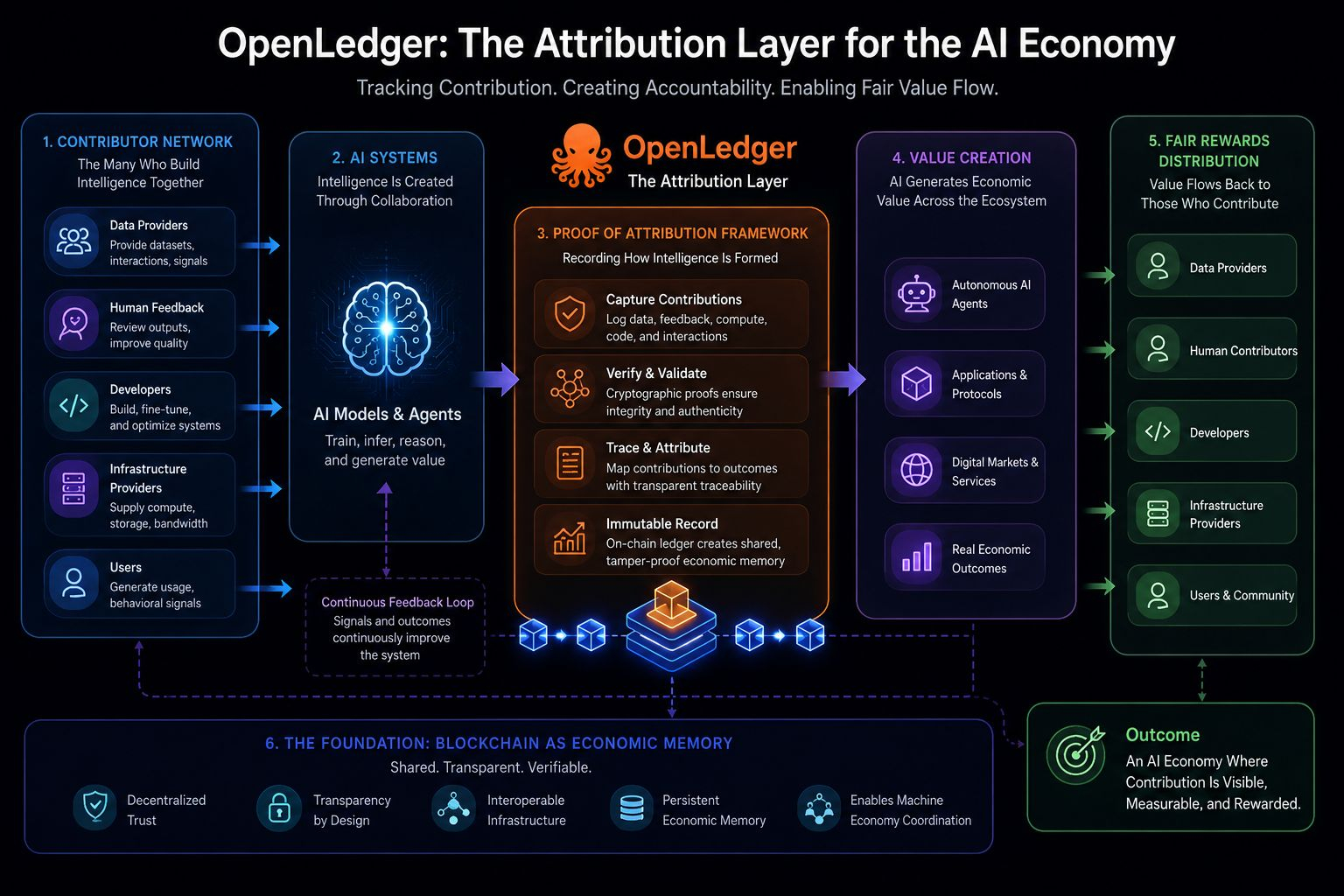
Every useful model today is shaped by a massive invisible network:
Datasets gathered from millions of interactions.
Human feedback refining outputs.
Developers optimizing systems.
Infrastructure providers supplying compute.
Users constantly feeding behavioral signals back into the models.
The intelligence may look centralized on the surface.
But underneath it is deeply collaborative.
The strange part is that once economic value gets created, most of those contributors disappear from the equation entirely.
The output remains visible.
The contribution trail disappears.
And honestly, I think that becomes one of the defining infrastructure problems of the AI era.
That is exactly why OpenLedger stands out.
Not because it promises “decentralized AI.”
That narrative already exists everywhere.
What makes OpenLedger different is that it approaches AI like an economy that needs accounting infrastructure.
Its core idea is surprisingly simple:
What if blockchain becomes the system that records how intelligence itself is created?
Not just who owns the platform.
Who contributed to the intelligence behind it.
That distinction changes everything.
Most blockchains today record transactions.
OpenLedger is exploring whether blockchains can record attribution.
And I think attribution becomes one of the most important primitives in the future AI economy.
Because once AI agents begin operating autonomously across applications, protocols, and digital markets, the internet suddenly needs systems capable of answering entirely new questions:
Who supplied valuable data?
Who improved model behavior?
Who contributed to outputs?
How should rewards flow when AI creates economic value?
Traditional databases can store information.
But blockchains create shared economic memory between independent participants.
That is why OpenLedger’s direction feels structurally important instead of purely narrative-driven.
It is not trying to replace AI.
It is trying to build accountability infrastructure around AI itself.
The project’s Proof of Attribution framework is where the thesis becomes especially interesting.
Instead of treating AI systems like black boxes, OpenLedger is attempting to create transparent economic traceability around how intelligence evolves over time.
That may sound technical on the surface, but the implications are enormous.
Because today’s AI systems are heavily extractive by design.
Users contribute data.
Models improve.
Platforms capture most of the upside.
Contribution powers the system, but contribution is rarely rewarded transparently.
OpenLedger hints at a completely different model:
An ecosystem where participation itself becomes economically measurable.
And honestly, I think that shift could reshape how AI economies function over the next decade.
Because the internet rewarded attention.
AI may eventually reward contribution.
Those are fundamentally different economic systems.
What also makes OpenLedger compelling is the timing.
The market is rapidly moving from AI tools toward autonomous AI agents capable of coordinating tasks, accessing liquidity, interacting with applications, and participating directly in digital economies.
That changes the infrastructure requirements of the internet completely.
At that stage, intelligence alone is not enough.
The ecosystem also needs:
Economic coordination.
Transparent reward systems.
Ownership tracking.
Shared financial memory.
And that is exactly where blockchain becomes useful in a way that actually feels native to AI.
Not as speculative infrastructure attached to the narrative…
…but as the ledger layer underneath machine economies themselves.
I also think the project’s infrastructure-first approach matters a lot.
Much of OpenLedger’s ecosystem growth revolves around interoperability, execution environments, data coordination, and AI agent infrastructure rather than short-term consumer hype.
That may not create the loudest headlines.
But historically, infrastructure becomes most valuable once activity starts depending on it.
The internet followed the same pattern.
At first, attention focused on applications.
Later, the deepest value accumulated around the protocols and systems coordinating everything underneath.
AI may evolve similarly.
And if it does, attribution infrastructure could become just as important as intelligence itself.
Of course, solving attribution at scale is incredibly difficult.
AI systems are probabilistic by nature. Outputs emerge from overlapping datasets, reinforcement systems, and millions of blended interactions. Measuring contribution fairly may become one of the hardest coordination problems in the industry.
But that is also why OpenLedger deserves serious attention.
Because it is not solving a temporary hype problem.
It is exploring whether intelligence itself can become economically accountable.
And I honestly think that question becomes much bigger over time than the market currently understands.
Because eventually AI will need more than smarter models.
It will need systems capable of tracking how intelligence was formed, who contributed to it, and how value should move around it.
And if OpenLedger succeeds in building that layer, blockchain may stop looking like speculative infrastructure for AI narratives…
…and start looking like the accounting system behind the machine economy itself.
