One thing I keep getting stuck on is how difficult AI accountability becomes once systems scale beyond human visibility.
Most people still assume model quality is the main thing that matters. If outputs look accurate, the system is considered trustworthy enough to deploy. But the more AI starts moving into finance, healthcare, legal infrastructure, and enterprise automation, the less sufficient that assumption feels.
The real issue may not be whether a model produces impressive answers.It may be whether anyone can verify how those answers were produced in the first place.
That is where OpenLedger appears to position its argument differently from many other AI infrastructure projects in crypto.Instead of treating AI outputs as isolated predictions, OpenLedger focuses on making the development process itself auditable.
The premise sounds simple on paper: if AI systems increasingly influence decisions with economic or operational consequences, then the history behind those systems should probably remain inspectable. That means tracking who contributed data, when models changed, what updates occurred, and which inputs materially influenced performance over time.$OPEN #OpenLedger @OpenLedger
In traditional AI pipelines, much of that history becomes fragmented quickly.Datasets move across teams. Fine-tuning layers change repeatedly. External contributors provide specialized data without long-term visibility into how their information gets used. Once models are deployed, tracing the lineage of a specific behavior or capability often becomes extremely difficult.
That fragmentation creates a trust problem.An enterprise may know a model performs well statistically while still having very little visibility into why it behaves a certain way under edge conditions. In highly regulated industries, that uncertainty becomes harder to ignore because accountability requirements do not disappear simply because a neural network is involved.
OpenLedger’s proposed solution is essentially a verifiable history layer for AI development.The system attempts to record model updates, dataset provenance, attribution flows, and contribution records on-chain so the lifecycle of an AI model becomes more transparent over time. Instead of relying entirely on centralized internal documentation, parts of the development history become cryptographically verifiable.
Conceptually, the architecture resembles what blockchains originally introduced for financial systems: immutable transaction histories that can be independently audited rather than trusted blindly.Applied to AI, the idea becomes more interesting.
If contributors provide domain-specific datasets that materially improve a model, OpenLedger attempts to attach attribution metadata to those improvements. If a model undergoes tuning adjustments or optimization updates, those changes can theoretically become traceable across a recorded lifecycle rather than hidden behind opaque internal revisions.
That does not automatically solve AI trust.But it changes the discussion from “trust the company” toward “inspect the process.”The distinction matters more than it initially sounds.
One of the largest structural problems in current AI infrastructure is that verification often happens indirectly. Users infer reliability from reputation, benchmark scores, or output quality because they lack direct visibility into the underlying development chain.
OpenLedger seems to argue that AI systems may eventually require something closer to supply-chain traceability.Not just who built the final model, but how the model evolved, what data influenced it, and whether contributors can prove their role inside that process.
The crypto component becomes relevant because blockchains are naturally optimized for timestamped verification systems. AI development, meanwhile, increasingly suffers from coordination and provenance problems.
OpenLedger is effectively trying to connect those two pressures together.One practical scenario helps explain why the concept matters.
Imagine an enterprise deploying a specialized compliance model trained on financial regulatory data. The system suddenly produces an unexpected recommendation that affects a reporting decision. The company now wants to understand whether the issue came from recent fine-tuning, corrupted datasets, outdated source material, or a third-party contribution layer.In most closed AI systems, that investigation becomes difficult quickly.
With OpenLedger’s model, the assumption is that portions of the development lifecycle remain auditable enough to reconstruct what changed and when. Metadata trails, attribution systems, and update histories could theoretically reduce the opacity surrounding model behavior.
At minimum, that creates a more inspectable environment than current black-box deployment models.Still, the tradeoffs here are substantial.
Auditability only matters if the recorded information is accurate, meaningful, and operationally usable. Simply placing metadata on-chain does not automatically create trust if the underlying data inputs remain low quality or manipulable.There is also the scalability problem.
AI systems evolve rapidly. Recording meaningful lifecycle events without introducing excessive latency, operational complexity, or storage inefficiencies is much harder than it sounds. Enterprises may support transparency conceptually while resisting workflows that slow deployment velocity or increase infrastructure overhead.
That tension may ultimately define whether systems like OpenLedger gain adoption.Because the AI industry currently optimizes heavily for performance speed, not procedural transparency.
And historically, markets tend to prioritize convenience until regulation, risk exposure, or economic failure forces accountability standards upward.The interesting part is that OpenLedger does not necessarily require perfect transparency to become useful.
Even partial provenance may represent a significant improvement compared to today’s standard operating model, where most users interact with AI systems that provide almost no verifiable lineage at all.That may be the broader crypto thesis underneath projects like this.
Not that blockchains magically solve AI alignment or reliability, but that decentralized verification systems may become increasingly valuable once AI systems begin operating in environments where auditability carries real financial or legal weight.
So the real question is not whether AI can become more transparent.It is whether OpenLedger can make AI development easier to inspect without creating enough operational friction to slow the systems people actually want to use.$OPEN #OpenLedger @OpenLedger 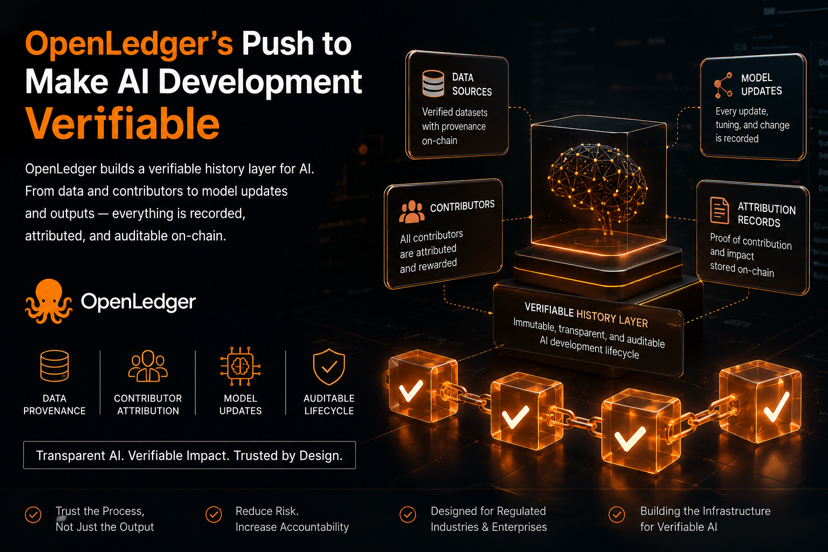

Artikel
OpenLedger’s Push to Make AI Development Verifiable
--
Haftungsausschluss: Die hier bereitgestellten Informationen enthalten Meinungen Dritter und/oder gesponserte Inhalte und stellen keine Finanzberatung dar. Siehe AGB.