
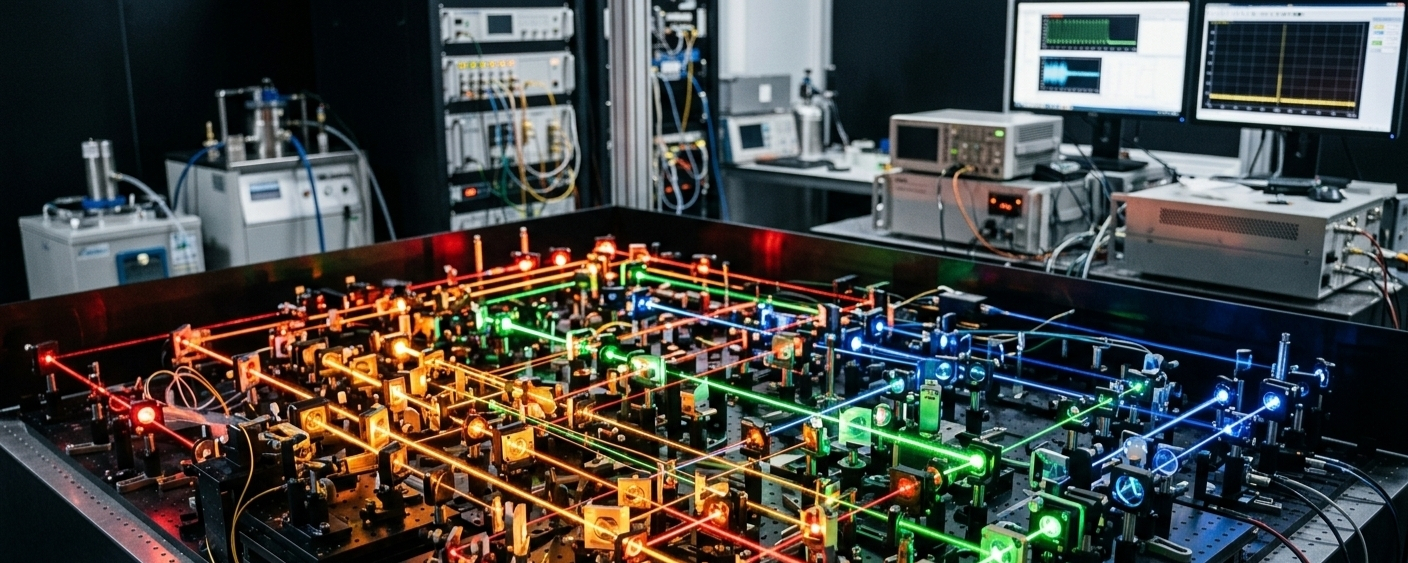
In May 2026, a research team from the University of Science and Technology of China (USTC), led by renowned physicist Pan Jianwei, announced a monumental milestone in quantum computing with the unveiling of Jiuzhang 4.0.
This latest-generation photonic quantum computer has shattered previous records, demonstrating an unimaginable level of "quantum advantage" over the world's most powerful classical supercomputers.
Solving Gaussian Boson Sampling (GBS) Jiuzhang 4.0: Achieving an Unprecedented Quantum Leap in Computing
In May 2026, a research team from the University of Science and Technology of #China (USTC), led by renowned physicist Pan Jianwei, announced a monumental milestone in quantum computing with the unveiling of Jiuzhang 4.0.
This latest-generation photonic quantum computer has shattered previous records, demonstrating an unimaginable level of "quantum advantage" over the world's most powerful classical supercomputers.
Solving Gaussian Boson Sampling (GBS)
The true measure of Jiuzhang 4.0’s dominance lies in its performance on a highly complex mathematical problem known as Gaussian Boson Sampling (GBS).
This problem simulates the behavior of non-classical light particles (photons) as they pass through a dense, intricate network of beamsplitters and mirrors. While classical computers must calculate an exponentially growing number of probabilities to track these particles, a photonic quantum computer naturally solves the problem simply by letting the light flow through its circuit.
Jiuzhang 4.0 achieved an astronomical breakthrough by manipulating up to 3,050 photons. It successfully completed the GBS task in just 25.6 microseconds.
To put this into perspective, if we were to task the world's fastest conventional supercomputer with solving the exact same problem, it would require approximately 10^{54} times longer than Jiuzhang 4.0 to finish. This represents a computational speedup so vast that it firmly establishes China's lead in the optical quantum computing sector.
Technical Innovations Behind the Speed
The immense jump in processing power from the previous model (Jiuzhang 3.0) to version 4.0 was made possible by overcoming severe physical bottlenecks in photonics:
Spatial-Temporal Hybrid Encoding: Earlier quantum photonic prototypes were rigid and could only execute a single, hardwired task. Jiuzhang 4.0 integrates a newly designed spatial-temporal hybrid encoding mechanism, drastically increasing the system's reconfigurability and programmability.
Mitigating Photon Loss: In light-based computing, losing photons as they travel through a circuit destroys the calculation. The USTC team raised the efficiency of the quantum light source to 92%, bringing the total system collection efficiency to a groundbreaking 51%.
Future Implications
While Jiuzhang 4.0 is a specialized (rather than universal) quantum processor, its ability to process complex probabilistic distributions at a factor of 10^{54} faster than classical systems has massive real-world potential.
The algorithmic principles tested by this machine are directly applicable to optimizing graph theory, enhancing machine learning models, accelerating quantum chemistry simulations, and developing next-generation cryptographic systems capable of securing data in the upcoming quantum era.