

I’m going to say something slightly uncomfortable.
A lot of AI infrastructure projects in crypto still feel like wrappers around demand they don’t actually control.
That’s the part I keep thinking about with $OPEN.
Because OpenLedger doesn’t just position itself as another AI narrative token. It’s trying to sit inside the data and model coordination layer itself — the place where contribution, inference, and ownership supposedly become decentralized.
Conceptually, that’s powerful.
But conceptually powerful systems are common in crypto.
What’s rare is real dependency.
$OPEN doesn’t feel like a normal infrastructure bet to me. It feels more like a wager on whether decentralized AI coordination becomes economically necessary instead of ideologically interesting.
And I’m not fully sure we’re there yet.
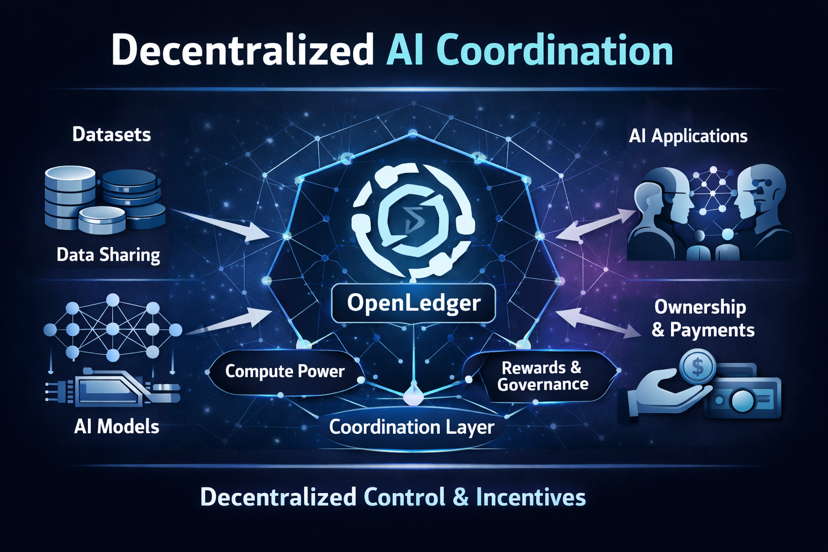
There’s something subtle happening beneath the surface though. OpenLedger isn’t only talking about compute or models. It’s trying to structure incentives around data contribution and intelligence production itself.
That changes the conversation slightly.
Because data in AI is strange. Everyone says it’s valuable, but very few systems know how to price contribution fairly. Most users generate value passively while centralized platforms capture almost everything upstream.
OpenLedger seems to be questioning that structure.
But here’s the tension.
Questioning a structure is easier than replacing it.
Right now, centralized AI still wins on convenience, speed, and distribution. Developers gravitate toward what already works. Enterprises trust systems with reliability and scale. That creates gravity around incumbents very quickly.
So for OpenLedger to matter long term, it probably needs more than good architecture.
It needs behavioral migration.
And migration is hard.
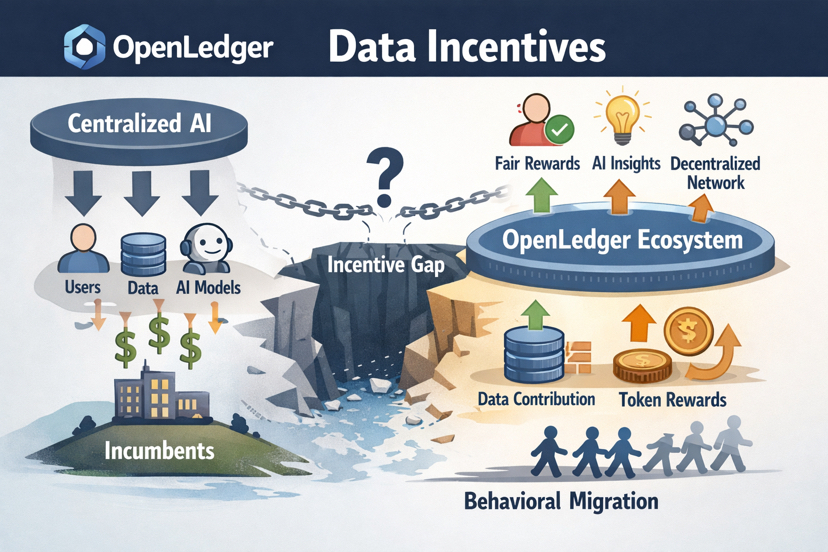
I’ve noticed this pattern with emerging AI x crypto systems: the technology sounds inevitable, but the user behavior underneath it still feels transitional. People experiment with decentralization while continuing to rely on centralized infrastructure for actual production.
That gap matters more than most token discussions admit.
Still, there are signals I can’t ignore.
OpenLedger’s positioning feels more structural than speculative. It’s less focused on consumer hype and more focused on ownership flows around intelligence itself. If AI becomes the dominant production layer of the internet, then systems coordinating who owns, trains, contributes, and benefits from models become strategically important.
That’s the real thesis here.
Not “AI coin.”
Not “next narrative.”
Infrastructure around intelligence markets.
And yet, I’m still uneasy.
Because AI moves incredibly fast. Faster than crypto infrastructure cycles usually do. There’s a real possibility centralized systems evolve quicker than decentralized coordination layers can mature.
If that happens, projects like OpenLedger risk becoming philosophically correct but economically secondary.
That’s the uncomfortable scenario nobody really wants to discuss.
I don’t see $OPEN as obviously undervalued.
I see it as a system trying to form around a future that hasn’t fully stabilized yet.
Maybe decentralized ownership of AI becomes necessary.
Maybe convenience wins again.
Right now, both outcomes still feel plausible.
So I’m watching closely.
Not for hype spikes or exchange narratives.
For signs that developers and data contributors are starting to behave differently around AI ownership itself.
And I’m not entirely sure that transition has started at scale yet.
