

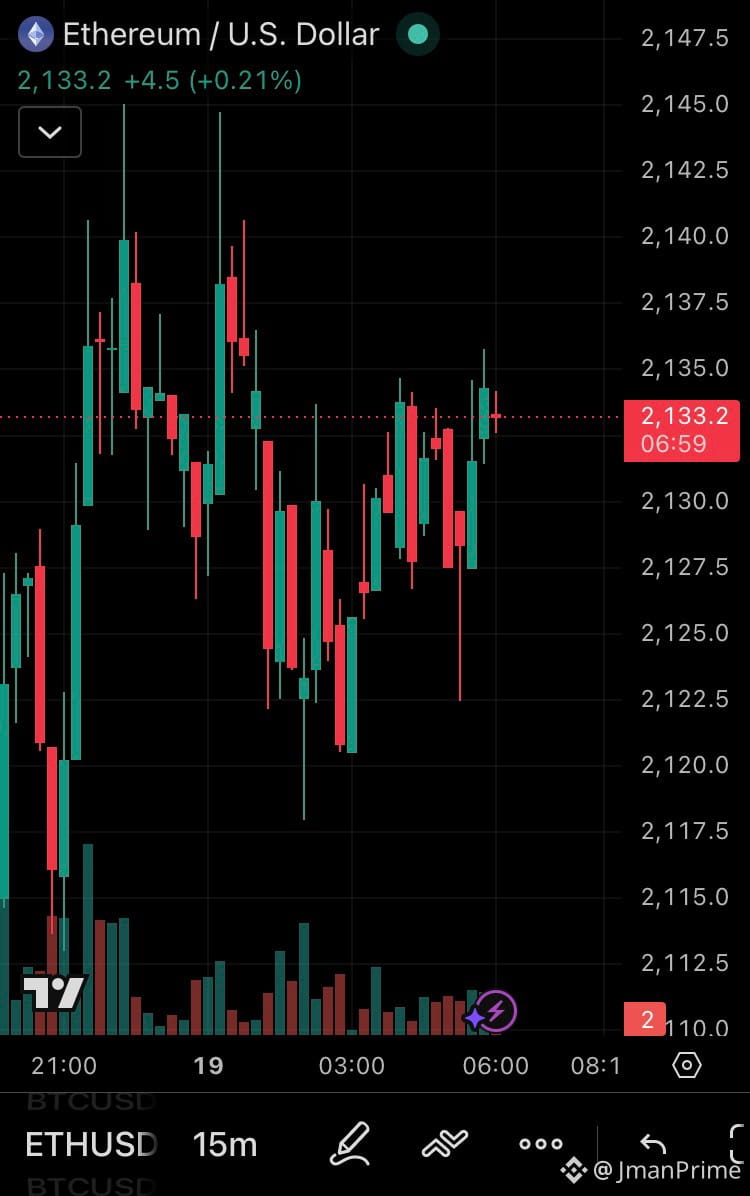
Most traders are still arguing about price targets.
Meanwhile, some of the biggest wallets in crypto are moving quietly behind the scenes — and Ethereum developers are building something the market hasn’t fully priced in yet.
Privacy.
Not meme-coin hype.
Not another “ETH to $10K” prediction.
Actual infrastructure changes.
And that matters more than people think.
Because the moment serious institutional money starts operating on-chain at scale, one uncomfortable problem becomes impossible to ignore:
No large financial player wants every move publicly tracked forever.
Right now, Ethereum is trying to solve that problem while whales continue accumulating ETH in patterns that look far more deliberate than emotional.
That combination is worth paying attention to.
Historically, markets notice structural changes late.
By the time retail traders fully understand the narrative, positioning is usually already happening underneath the surface.
And honestly, that may be exactly what’s happening now.
01 — Why Privacy Is Becoming a Bigger Conversation on Ethereum
Ethereum was built around transparency.
Every transaction is public.
Every wallet balance is visible.
Every major transfer can be tracked in real time.
That transparency helped build trust in decentralized systems. It allowed DeFi to function openly. It created an ecosystem where anyone could verify activity on-chain.
But there’s an obvious tension starting to appear:
Mass institutional adoption and total transparency don’t naturally fit together forever.
Think about traditional finance.
Hedge funds don’t publicly broadcast every trade they make. Corporate treasuries don’t reveal every capital allocation decision in real time. Large financial institutions operate with layers of confidentiality because strategic positioning matters.
Yet on Ethereum today, large wallets can be tracked within minutes.
The bigger the money gets, the less comfortable it becomes operating in public.
And this is where things get interesting.
As Ethereum grows into real financial infrastructure, privacy stops being a philosophical discussion and starts becoming an operational requirement.
Competitor chains are already focusing heavily on privacy features. Institutional players increasingly care about surveillance risks, front-running, and public exposure of trading activity.
Right now, Ethereum still struggles with that problem.
And developers know it.
02 — What Ethereum Privacy Upgrades Actually Are
When people hear the word “privacy” in crypto, they immediately think of fully anonymous coins like Monero.
That’s not what Ethereum is trying to become.
Ethereum’s direction is more nuanced.
The goal isn’t complete anonymity. The goal is selective privacy — giving users and institutions more control over what information becomes publicly visible while still maintaining compatibility with regulations and compliance frameworks.
The core technology behind this is zero-knowledge proofs, often called ZK proofs.
The concept sounds complicated but is actually simple:
You can prove something is true without revealing all the underlying information.
For example:
A user could prove they have sufficient funds for a transaction without exposing their entire wallet balance.
Or prove funds are legitimate without revealing complete transaction history.
That’s a major shift from how Ethereum currently operates.
Several important areas are now being developed around this idea:
🔒 Layer-2 Privacy Solutions
Privacy-focused Layer-2 systems aim to process transactions more confidentially while still using Ethereum for security and settlement.
👛 Wallet Privacy Improvements
Developers are exploring ways to reduce how easily wallets can be linked together and profiled publicly.
🧠 Privacy Pools
One of the most interesting concepts.
Privacy pools aim to allow users to protect financial privacy while still proving funds are not linked to illicit activity.
That balance between privacy and compliance may become one of the defining battles of Ethereum’s future.
Because regulators want transparency.
Institutions want confidentiality.
And Ethereum is trying to exist somewhere between those two realities.
03 — Why Whales Actually Care About This
Imagine managing hundreds of millions of dollars on-chain.
Every time you move funds, on-chain tracker accounts immediately post screenshots to social media.
Traders start speculating.
Bots attempt front-running.
Competitors analyze your positioning in real time.
That’s not theory.
That’s already happening.
And it creates genuine operational problems for large holders.
Front-running is one of the clearest examples. Sophisticated bots monitor pending transactions and attempt to position ahead of large trades before they finalize.
For whales and institutions, this becomes expensive very quickly.
Strategic accumulation also becomes difficult when the market can literally watch your positioning happen live.
And honestly, no serious institution wants its treasury operations functioning like a public livestream.
This is why privacy infrastructure matters more as larger capital enters crypto.
Not because institutions want illegal anonymity.
Because they want operational efficiency and strategic confidentiality.
That’s a very different conversation.
Crypto purists may dislike this reality, but institutional capital thinks differently from retail traders.
And if Ethereum wants to become global financial infrastructure, it eventually has to accommodate that reality.
04 — Whale Movements and What They Often Signal
Smart money rarely waits for headlines.
It positions before the narrative becomes obvious.
That pattern has repeated across nearly every major crypto cycle.
Whales are not always right. They make mistakes too.
But historically, large wallet accumulation during quiet periods has often preceded major market moves.
This is why on-chain analysts track whale activity so aggressively.
📤 Exchange Outflows
When large amounts of ETH leave exchanges and move into cold wallets, it usually signals reduced intent to sell.
Coins sitting off exchanges are less liquid.
That matters.
📥 Accumulation Wallets
Some wallets consistently buy and rarely distribute.
When these wallets grow during uncertain market conditions, analysts pay attention.
💵 Stablecoin Positioning
Large stablecoin inflows to exchanges can indicate preparation for major buying activity.
⏳ Long-Term Holder Behavior
Metrics like Coin Days Destroyed help analysts track whether older wallets are holding or distributing.
Strong long-term conviction during volatility is often more important than short-term price action.
Right now, several of these metrics suggest quiet accumulation behavior rather than emotional speculation.
And historically, markets tend to notice these structural shifts late.
By the time the crowd starts calling something “the future,” whales are usually already positioned.
05 — Ethereum’s Institutional Evolution
Ethereum is no longer just a speculative blockchain network.
It’s increasingly becoming financial infrastructure.
That’s not a small shift.
Spot Ethereum ETFs are opening institutional capital pipelines similar to what happened with Bitcoin in 2024.
At the same time, major firms are building tokenized financial products directly on Ethereum rails.
Treasury products.
Stablecoins.
Money market systems.
Real-world asset tokenization.
The infrastructure being built today is designed for serious capital.
And whether people like it or not, institutions think differently from retail traders.
They care about:
compliance
scalability
operational privacy
settlement reliability
liquidity efficiency
Ethereum’s Layer-2 ecosystem is also rapidly expanding.
Networks like Arbitrum, Optimism, and Base are making Ethereum cheaper and more scalable for real financial activity.
This is where privacy becomes incredibly important.
Because institutions will not comfortably operate at scale on fully transparent rails forever.
Not without demanding better privacy layers.
Personally, I think many traders are still underestimating how important this shift may become over the next few years.
06 — The Regulatory Tightrope
This is where the conversation becomes difficult.
Because crypto privacy exists in highly sensitive regulatory territory.
The Tornado Cash controversy made that very clear.
Regulators showed they are willing to aggressively target privacy infrastructure if they believe it enables illicit activity or sanctions evasion.
That created a major warning sign for the entire Ethereum ecosystem.
And it also explains why Ethereum developers are approaching privacy very differently now.
The focus is shifting toward selective privacy rather than full anonymity.
The challenge is obvious:
Too much privacy creates regulatory risk.
Too little privacy makes Ethereum uncomfortable for large-scale institutional activity.
That balance may end up defining Ethereum’s next phase more than most people realize.
And honestly, there’s still no perfect answer yet.
07 — What Traders Should Actually Watch
Price alone doesn’t explain market structure.
If you want to understand where Ethereum may be heading long term, these metrics matter far more than daily emotional price reactions.
📊 Whale Wallet Accumulation
Large non-exchange wallets growing during consolidation phases often matter more than retail hype.
🏦 Exchange Reserves
Declining ETH balances on exchanges can indicate supply tightening.
🔒 ETH Staking Growth
Staked ETH reduces liquid supply available for trading.
⚡ Layer-2 Adoption
Real usage growth matters more than speculative narratives.
🧠 Developer Activity
Privacy-related proposals and technical development often become important long before mainstream attention arrives.
💰 Institutional ETF Flows
Sustained institutional inflows create structural demand that retail traders alone cannot replicate.
📉 ETH/BTC Ratio
This reveals whether capital is rotating toward Ethereum specifically or remaining concentrated in Bitcoin.
The mistake many traders make is analyzing these metrics separately instead of together.
The real signals appear when multiple structural indicators start aligning simultaneously.
08 — The Bigger Picture
Step back from the charts for a moment.
Ethereum is simultaneously:
scaling through Layer-2 networks
attracting institutional ETF exposure
building tokenized financial infrastructure
expanding stablecoin dominance
developing privacy-focused technologies
That combination feels very different from previous cycles.
Less speculative.
More infrastructure-driven.
More long term.
And that may explain why whale positioning during quieter periods matters so much right now.
Institutions and sophisticated capital rarely wait for public confirmation.
They position before the narrative becomes obvious.
The market structure today already feels different from earlier crypto cycles.
And honestly, many traders still haven’t fully adjusted to that reality yet.
09 — The Bottom Line
Ethereum privacy upgrades are no longer just a niche developer discussion.
They’re becoming directly connected to how serious capital may operate on-chain in the future.
That’s the important shift.
Because if Ethereum continues evolving into institutional-grade infrastructure — through ETFs, tokenized assets, stablecoins, and Layer-2 scaling — privacy stops being an optional feature.
It becomes operationally necessary.
And at the same time, whale wallets continue showing signs of quiet accumulation during periods where retail attention is scattered elsewhere.
That combination shouldn’t be ignored.
Does it guarantee a massive move?
Of course not.
Markets are never that simple.
But the bigger picture developing underneath Ethereum right now feels different from the purely speculative cycles crypto became known for in the past.
This feels more structural.
More deliberate.
More infrastructure-driven.
So here’s the real question:
Are Ethereum whales positioning early for the next phase of institutional crypto infrastructure…
Or are we watching the early stages of Ethereum slowly becoming another Wall Street-integrated financial system?
Because those two futures lead to very different versions of crypto.
And the battle between privacy, regulation, and institutional adoption may end up defining Ethereum’s next decade more than price action alone ever could.
Now I want your opinion 👇
Do you think true financial privacy is necessary for crypto to reach full institutional adoption…
Or will governments eventually force blockchains to remain fully transparent?
And another question:
If Ethereum successfully solves privacy at scale, does that strengthen decentralization…
Or simply make the network more attractive to large institutional capital?
Drop your thoughts below. This debate is only getting started.
#Ethereum #ETH #Crypto #Blockchain #Web3 #DeFi #EthereumETF #OnChainAnalysis #BinanceSquare

