
There is a strange moment in every serious crypto game where the conversation stops being about gameplay.
At first, people talk about farming, rewards, items, land, quests, onboarding, token utility, and community growth.
Then one day, the language changes.
People start talking about voting.
Treasury control.
Proposals.
Influence.
And suddenly the game is no longer just a game.
It becomes a political surface.
That is where Pixels gets interesting to me.
Not because $PIXEL governance sounds exciting on paper. Governance always sounds clean on paper. Communities voting. Players having a voice. Token holders helping shape the future. It reads well. It feels decentralized. It gives the project a more mature frame.
But the harder question is not who gets to vote.
The harder question is whether the game can survive once control becomes political.
Because game design and governance do not naturally want the same thing.
Game design needs balance.
Politics wants influence.
Game design needs invisible discipline.
Politics wants visible power.
Game design asks, “What keeps the economy healthy?”
Governance asks, “Who gets to decide what healthy means?”
That gap is where the real risk lives.
Pixels works because the world has structure. The loops are not random. The economy is not supposed to be pure freedom. Rewards, sinks, pacing, access, friction, and progression all need to be tuned with care.
A good game economy is not a democracy in the emotional sense.
It is closer to a machine room.
Pressure here. Release there. Too much reward and the system bloats. Too much friction and players leave. Too much scarcity and whales dominate. Too much generosity and the token becomes a faucet with nicer art.
That is why governance is dangerous.
Not because voting is bad.
Because voting can turn design constraints into political bargaining chips.
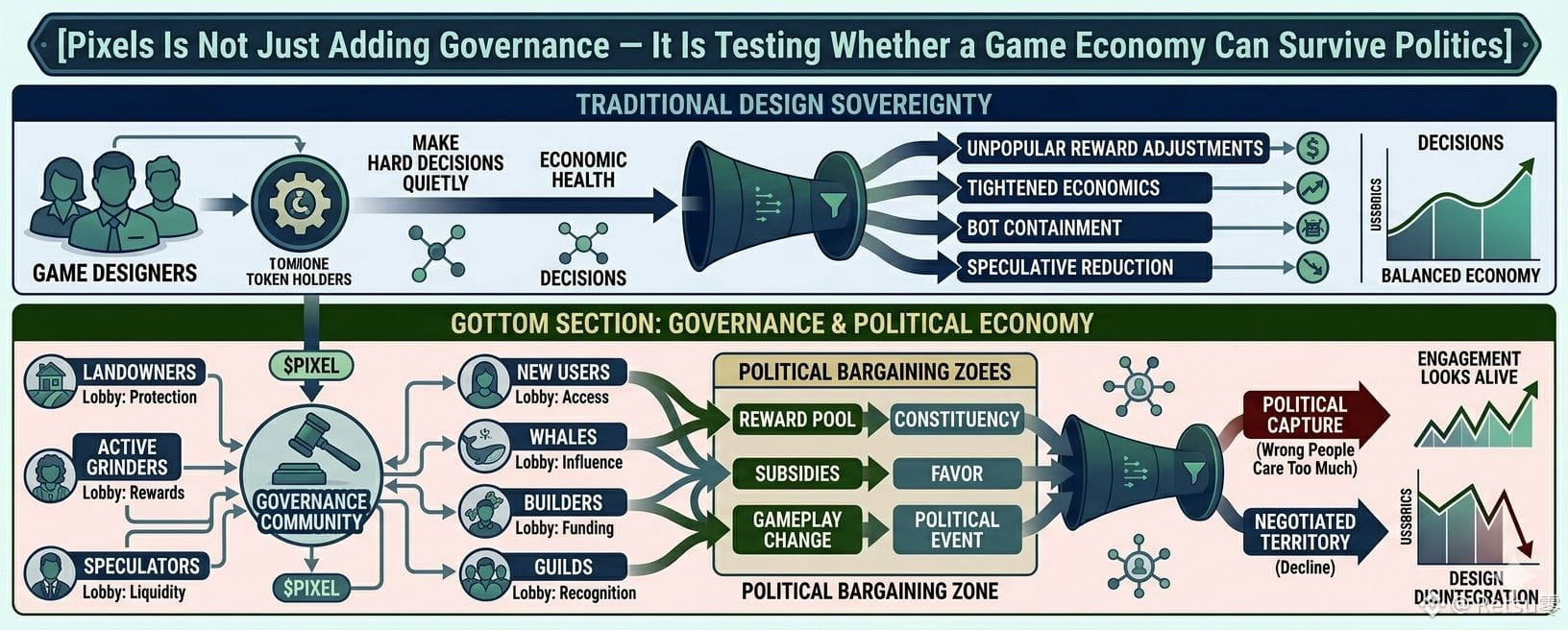
The moment a treasury becomes governable, every economic decision gains a second meaning.
A reward pool is no longer just a balancing tool.
It becomes a constituency.
A subsidy is no longer just an incentive.
It becomes a favor.
A gameplay change is no longer just a patch.
It becomes a political event.
This is the part most people avoid saying out loud.
Player governance can empower a community, but it can also teach every group inside the economy to lobby for itself.
Landowners want protection.
Active grinders want rewards.
Speculators want liquidity.
New users want access.
Whales want influence.
Builders want funding.
Guilds want recognition.
The game designer sees one economy.
Governance sees competing tribes.
That is where Pixels’ long-term test begins.
The project does not only need to build a fun world. It needs to stop that world from becoming a battlefield of narrow interests.
Because once token governance enters the room, the clean fantasy of “community control” starts looking much dirtier.
Who is the community?
The player who logs in daily?
The wallet holding enough Pixel to swing a vote?
The landholder with capital already inside the system?
The guild coordinating off-chain?
The silent user who plays but never joins governance discussions?
Everyone says “community” because it sounds warm.
But governance forces the ugly translation.
Community means voting blocs.
And voting blocs do not always protect the game.
Sometimes they protect their position inside the game.
That is the political capture problem.
A crypto game can die in two ways.
It can fail because nobody cares.
Or it can fail because the wrong people care too much.
The second one is more dangerous because it looks like engagement.
People are active. Proposals are moving. Debates are happening. Token holders are involved. On the surface, it looks alive.
But underneath, the design layer starts getting pulled apart.
Every group pushes for its own advantage.
More emissions here.
Lower costs there.
Better access for this class of users.
Special treatment for that pool of capital.
And slowly the game stops being designed as a coherent world.
It becomes negotiated territory.
That is not decentralization.
That is slow-motion capture wearing a community badge.
Pixels has to be careful here because its strongest asset is not only the farming loop or the social layer. Its strongest asset is coordination.
It has managed to make people behave inside a structured economy without making the structure feel too aggressive. That is rare. Most GameFi projects either over-financialize the user or fail to make the loop matter economically.
Pixels sits in the middle.
Soft enough to enter.
Structured enough to measure.
Casual enough to feel human.
Economic enough to matter.
Governance can either protect that balance or poison it.
The danger is that token voting may not respect the subtle parts of game design.
Good game economies often require unpopular decisions.
Rewards need to be reduced.
Loops need to be tightened.
Bots need to be punished.
Speculative behavior needs to be contained.
Certain user groups need to lose comfort so the whole system survives.
But politics hates being told no.
Especially when capital is involved.
If a large enough group benefits from a broken incentive, will governance have the courage to remove it?
If whales benefit from a treasury direction that weakens ordinary gameplay, who stops them?
If active voters represent capital better than actual players, does the game still belong to its world, or does it belong to its balance sheet?
That is why “who votes” is the surface-level question.
The deeper question is what governance is allowed to touch.
Some systems should be governable.
Some systems should be protected.
The treasury can be community-directed, but the core economy may still need design sovereignty. Otherwise, every balancing decision becomes a referendum, and every referendum becomes a pressure point for capture.
This is the contradiction Pixels cannot escape.
If governance is too weak, people will call it performative.
If governance is too strong, the game may become politically unstable.
If the team keeps too much control, decentralization becomes theater.
If the team gives away too much control, the economy may get carved up by whoever organizes best.
There is no clean answer here.
Only tradeoffs.
And that is what makes the angle serious.
Pixels is not just preparing governance. It is preparing to expose its game economy to political demand.
That changes everything.
A closed design team can make hard decisions quietly. A governed ecosystem has to survive public conflict. It has to survive coordinated voters, treasury narratives, short-term greed, and the constant temptation to turn shared resources into private advantage.
That is where a lot of crypto projects collapse.
Not at launch.
Not during hype.
But after power becomes distributed enough to be fought over.
The romantic version says governance makes users owners.
The colder version says governance creates a new battlefield over who gets to extract from the system with legitimacy.
Pixels will have to prove that $PIXEL governance can do more than create political theater. It has to prove that community power can protect the game instead of bending it toward the loudest wallets.
That is a much harder problem than onboarding.
Harder than token utility.
Harder than making the world feel alive.
Because once control becomes political, every design choice becomes suspicious.
Every reward decision becomes a signal.
Every treasury allocation becomes a map of power.
Every proposal asks the same hidden question.
Is this good for Pixels as a living economy, or is it good for the group smart enough to capture the vote?
That is the real governance test.
Not participation.
Not turnout.
Not how many people feel heard.
The real test is whether Pixels can keep its game design intact once the treasury becomes a political weapon.
Because if it cannot, then governance will not decentralize the world.
It will skin it alive slowly, proposal by proposal, until the game becomes just another economy where the best-organized capital wins.
And at that point, the question will not be who voted.
The question will be who was left playing after politics finished eating the game.