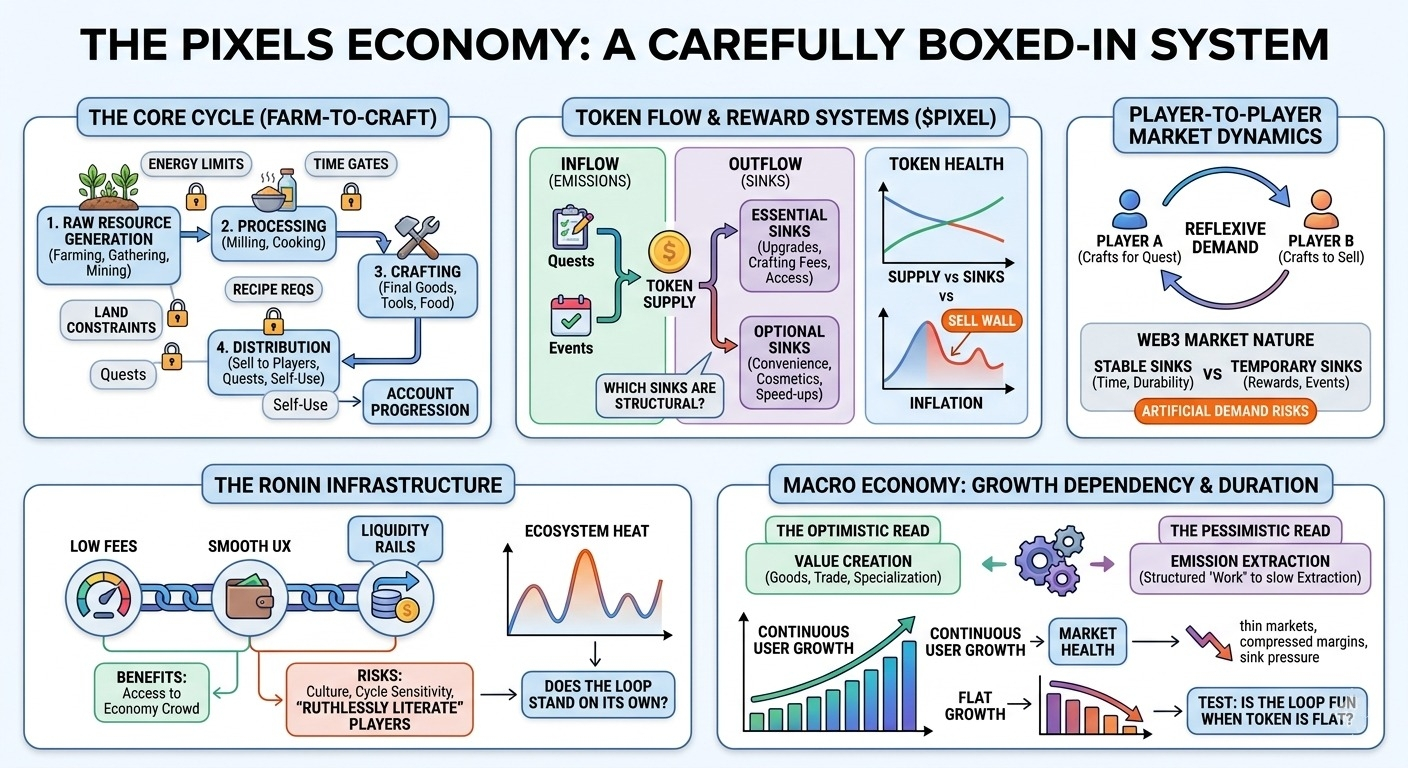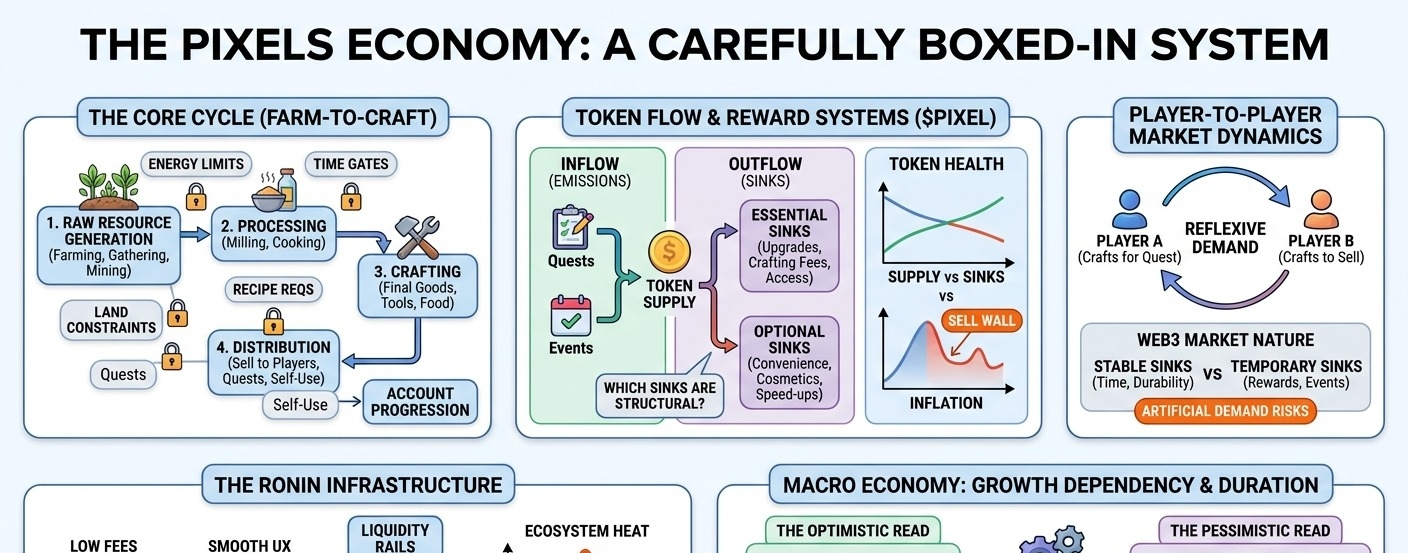
Most people think pixels is just a farming game with a token stapled on. plant crops, do some quests, earn $pixels, maybe flip an nft. that story isn’t wrong, it’s just kind of shallow. what stands out once you poke at it is how much the design leans on controlled loops: not just “produce stuff,” but “produce stuff inside a system that decides how fast you’re allowed to produce, and who you’re allowed to sell to.”
resource generation is the cleanest part to reason about. you’ve got the basic loop of farming/gathering → processing → crafting, and then some mix of selling, fulfilling quests, or using items to unlock further progression. an example i keep coming back to: you grow a batch of crops, harvest, convert into intermediate ingredients, craft a higher-tier item (food, tools, whatever), then either sell it or use it to complete something that pushes your account forward. it’s standard, but the important bit is that pixels can tweak a bunch of dials: energy limits, recipe requirements, time gates, and location/land constraints. honestly, those gates are doing more economic work than the “fun” sometimes. they prevent the obvious outcome where everyone prints the same profitable item until the market is dust.
then the token flow: $pixels feels like both lubricant and pressure point. emissions (rewards for play/quests) create baseline demand for participation, but they also create a permanent question: where does it go after distribution? if players earn $pixels and the primary move is to cash out, the game needs serious sinks or else you just get a slow-motion sell wall. i’m not totally sure yet which sinks are truly structural versus just “nice-to-have.” spending $pixels on crafting, upgrades, access, convenience, etc. can work, but it only holds if the spending is tied to retention loops that people actually care about when the token isn’t exciting. and here’s the part i’m thinking about: optional sinks are fragile. the minute people stop believing progression has resale value, they stop paying to optimize it.
also, player-to-player markets complicate the story in a way that’s easy to miss. if most of the “real demand” for crafted goods comes from other players chasing the same reward loops, the economy becomes reflexive: players craft because others need it to craft. that can be stable in normal games because the sink is time and permanent consumption (items get used up, durability, etc.). in web3 games, the sink tends to be mixed with token incentives, so you get these periods where demand is real but also slightly artificial, driven by reward schedules and events.
infrastructure-wise, ronin is doing quiet heavy lifting. low fees and smoother wallet UX matter a lot for a game that expects frequent transactions and asset movement without making players feel like they’re filing taxes. ronin also gives pixels access to an existing “game economy” crowd and liquidity rails that are already there. but it’s a trade: you inherit ronin’s culture (players are more economically literate, sometimes ruthlessly so) and its cycle sensitivity. when the ecosystem cools down, you find out whether the game loop can stand on its own or if it was riding ambient liquidity.
zooming out, i’m trying to figure out if pixels is creating value or mostly redistributing it. the optimistic read is: players generate useful in-game goods, trade them, specialize, and the token is just the accounting layer for coordinating time and scarcity. the pessimistic read is: players are mainly extracting emissions, and the “economy” is a structured way to slow extraction and keep people busy long enough to feel justified.
how much depends on continuous user growth? probably more than anyone wants to admit. new players absorb early oversupply (items, land access, even just market liquidity). if growth flattens, markets get thinner, crafting margins compress, and suddenly the sinks have to do real work. that’s where the gameplay vs financialization balance gets tense: tighten sinks and you risk making it feel like chores; loosen them and inflation shows up in the token or in item oversupply.
no clean conclusion yet. pixels feels competent, maybe even cautious, but i can’t tell if it’s durable or just well-managed tempo.
watching:
- do token sinks stay attractive when rewards cool off, or do they get ignored?
- retention after event spikes (who sticks around when it’s boring?)
- market health: do crafted goods keep meaningful spreads without constant new demand injections?
- how often the team tweaks emission rates and gating (and whether that feels like “balancing” or firefighting)
if a month from now the token is flat and the player count is flat, is the loop still fun enough that people keep producing and trading anyway? that’s the test i keep circling back to.