
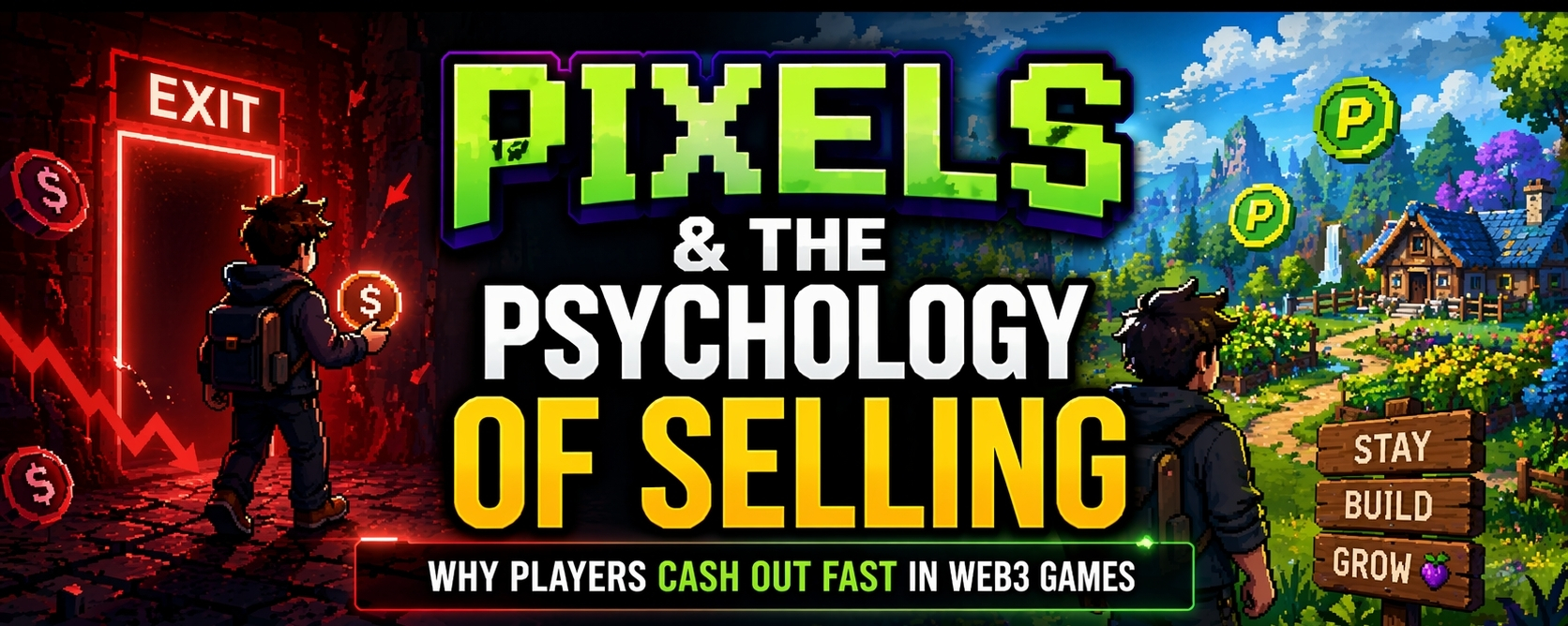
Let’s try to understand what the real story is.
One thing I keep coming back to in tokenized systems is this: people almost never treat rewards the way builders want them to.
On paper, a reward token is supposed to pull people deeper into the ecosystem. It is supposed to make players feel connected, involved, maybe even personally invested in what the project becomes over time. But that is not usually how it feels on the user side. For a lot of people, a reward does not feel like ownership. It feels like something temporary. Something they can separate from the experience and turn into something safer before the uncertainty gets worse. Pixels itself has admitted that, in 2024, a lot of players were taking value out without putting much back in, and that this created pressure on the token economy. What matters to me there is not just the economic point. It is the human one.
I think one big reason people sell so fast is that they do not really experience the token as something they belong to. They experience it as a way out. And those are two very different feelings. Ownership asks for patience. It asks for trust. Sometimes it even asks for a little emotional attachment. An exit does not ask for much at all. In a lot of Web3 games, people show up with mixed intentions from day one. Maybe they like the game a bit. Maybe they like the vibe. But at the same time, they are also thinking about timing, risk, and whether it makes more sense to take the reward now rather than wait. If the token feels more concrete than the game itself, then selling it starts to feel like the most understandable thing in the world. Pixels seems aware of that tension. Its materials make it pretty clear that the game has to be genuinely enjoyable first, because without that, the economic layer does not really have anything stable to sit on.
Trust matters more here than a lot of token systems want to admit. If people are not confident that an ecosystem will stay healthy, they become much less willing to hold onto the thing that represents belief in that ecosystem. At that point, short-term thinking does not even look selfish. It looks sensible. Financial pressure matters too. Not everyone enters these systems with the mindset of a long-term believer. Some people come in thinking like speculators. Some come in thinking like survivors. Some are simply thinking, “If there is value here now, I should probably take it while I can.” From the builder’s side, that may look like extraction. From the user’s side, it can feel a lot more like caution.
Another thing I think people often get wrong is the assumption that loyalty to a game automatically turns into loyalty to its token. I do not think that is true at all. Someone can enjoy the gameplay loop, like the world, spend time with friends there, and still have no real desire to hold the token. Enjoyment and conviction are not the same thing. And that gap gets even wider when the reward arrives without much emotional weight behind it. If a token comes from routine behavior rather than from something that feels meaningful, personal, or earned in a deeper sense, it is much easier to treat it like clutter than like something worth keeping. In that kind of setup, the system can accidentally train the exact behavior it says it wants to avoid.
That is also why rewards tied to weak gameplay usually get sold faster. If the game itself is not strong enough to hold people, then the reward becomes the main reason they showed up in the first place. And if the reward is the main reason they came, then cashing out becomes the cleanest and most logical end to that interaction. This is part of what makes Pixels interesting to me. It talks about “Fun First,” and honestly, I do not read that as branding language as much as a correction. It feels like an admission that no token model can replace actual attachment. If people would not want to be there without the reward, then the reward is not building loyalty. It is just renting attention for a little while.
What I find most interesting about Pixels, at least in theory, is that it does not seem to treat this problem as something that can be fixed by simply paying people more. It seems to be trying to redesign the path rewards take through the ecosystem. The project talks about smarter targeting, data-backed incentives, and a spend-only companion token, vPIXEL, that is meant to reduce selling pressure and keep more value circulating inside the system. It also points to withdrawal fees as a way to discourage pure extraction and route value back toward stakers. Whether all of that works perfectly is a separate question. But the thinking behind it is important. If people keep treating tokens like exits, then the answer probably is not more distribution. The answer is building a system that gives them fewer reasons to leave so quickly.
To me, that is the real lesson here. Technology does not only fail when the code is weak. It also fails when it reads human behavior badly. People do not always need a better token. Sometimes they just need a better reason to stay. And maybe that is the bigger point behind Pixels. A reward economy gets healthier only when it stops trying to fight human nature and starts building around it.
