
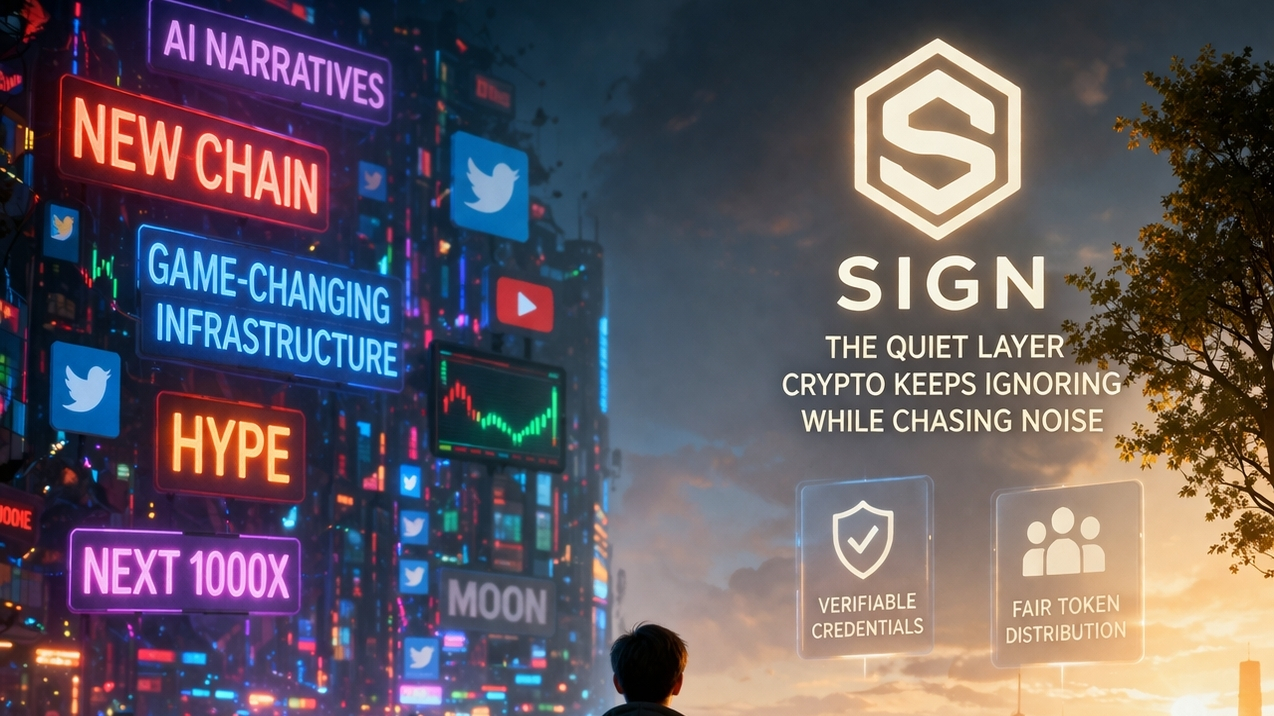

I wasn’t even looking for anything serious. Just scrolling, half-awake, watching the same kind of posts fly by—AI this, new chain that, “game-changing infrastructure” every other tweet. It’s like everyone’s trying to out-hype each other, and somehow it all starts sounding the same after a while.
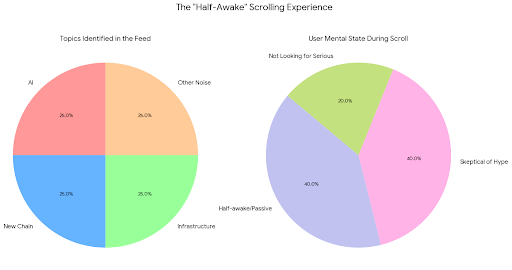
That’s kind of where my head is lately. Not excited, not negative… just tired of the repetition.
And in the middle of all that noise, I came across SIGN again. No big announcement. No aggressive marketing. Just… there. Quietly doing its thing.
Which honestly made me pause more than any loud launch ever does.
Because if you’ve been around crypto long enough, you start noticing a pattern. The loudest projects aren’t always the ones that last. And the ones actually working on something real usually don’t scream about it every five minutes.
Right now, everyone’s talking about “infrastructure” again. But we’ve been here before. We just keep changing the label. First it was Layer 1 wars, then Layer 2 scaling, then modular chains… now it’s AI mixed into everything.
But underneath all of that, the real problems haven’t really changed.
We still don’t have a clean way to prove who did what on-chain. Identity is messy. Verification is scattered. And token distribution? Still mostly controlled by capital, not actual participation.
It works fine when the market is just about speculation. You don’t need identity to trade coins. You don’t need verification to chase hype.
But the moment you try to bring real users into the system… things start breaking.
Not because the tech is bad. But because people show up.
That’s the part nobody talks about enough. Systems don’t fail in theory—they fail in reality. When thousands or millions of actual users try to use them at the same time.
Fees spike. Platforms lag. Incentives get abused. And suddenly all that “perfect infrastructure” doesn’t feel so perfect anymore.
That’s where SIGN started making more sense to me.
Not in a flashy way. Not like “this is the future of everything.” More like… it’s trying to fix a problem that’s been ignored for too long.
At its core, it’s about two things: verifying credentials and distributing tokens properly.
Sounds simple. Kind of boring, honestly.
But when you think about it, that’s where a lot of crypto struggles.
Right now, your on-chain identity is basically just a wallet address. Maybe some transaction history. Maybe some social links if you’ve connected them.
But it doesn’t really tell your full story. It doesn’t prove what you’ve actually contributed or participated in.
And because of that, reward systems are weak.
Airdrops get farmed. Campaigns get gamed. People create multiple wallets, run scripts, and extract value without really engaging.
We all know this happens. It’s not even hidden anymore.
SIGN is trying to change that by making participation verifiable and portable. So instead of just looking at wallets, systems can look at real actions and history.
At least, that’s the idea.
And on the distribution side, it’s trying to make rewards more fair. Not perfect, but better. More tied to actual involvement instead of just timing or access.
But here’s where I start questioning things.
Because crypto users… don’t always behave the way systems expect them to.
Most people aren’t here to build a clean identity. They’re here to make money. Quickly, if possible.
If there’s a way to game something, it will get gamed.
So the challenge isn’t just building the system. It’s designing it in a way that still works even when people try to exploit it.
And that’s hard.
There’s also the liquidity problem. You can build something useful, but if there’s no money flowing through it, nobody pays attention.
We’ve seen so many solid projects fade away just because they didn’t catch the right moment.
Timing matters more than it should.
And right now, the market is distracted again. AI narratives, new tokens, constant noise. Attention is everywhere and nowhere at the same time.
Projects like SIGN don’t naturally fit into hype cycles. They’re more like background infrastructure.
Important, but not exciting.
And in crypto, if something isn’t exciting… it often gets ignored.
At least until it becomes necessary.
That’s the part I keep thinking about.
A lot of systems look fine when usage is low. But when real adoption hits, the cracks start showing. Identity issues, unfair distribution, spam, fake participation—it all adds up.
And suddenly, the “boring” layers become critical.
Maybe that’s where SIGN eventually finds its place. Not during the hype, but when things start breaking and people realize something deeper is missing.
Or maybe not.
Maybe users keep doing what they’ve always done—chasing incentives, jumping from one opportunity to the next, not really caring about long-term structure.
That’s also very possible.
I’m not fully convinced either way.
I don’t think SIGN is some magical solution that fixes everything overnight. But I also don’t think it’s meaningless.
It feels like one of those pieces that could matter later… if the space actually matures enough to need it.
And that “if” is important.
Because crypto doesn’t always move toward maturity. Sometimes it just moves toward whatever is more exciting in the moment.
So yeah, I’m watching it. Not with hype. Not with blind belief. Just… paying attention.
Because the stuff that looks quiet today is sometimes what everything depends on tomorrow.
Or it just stays quiet forever.
It might work.
Or nobody really shows up.