
Understanding ONDO/USDT: A Trader’s Perspective on Structure, Liquidity, and Opportunity
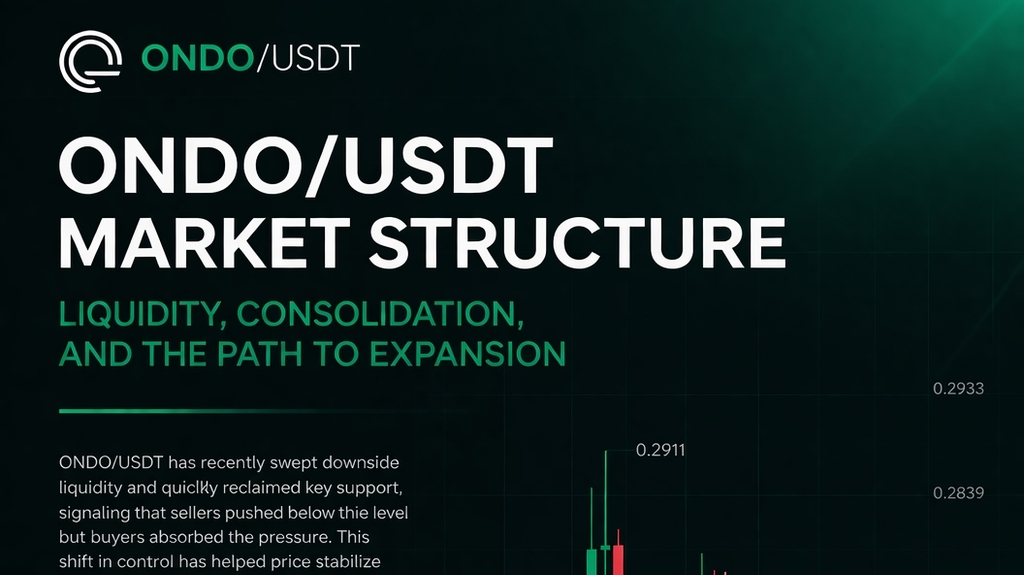
ONDO/USDT has recently been moving in a way that reflects a classic market behavior—liquidity hunts followed by stabilization. When you look at the structure closely, it’s not just random movement. It’s a process. Price seeks liquidity, takes it, and then decides direction based on how participants react around key levels.
In the current phase, ONDO has shown a clear sweep of downside liquidity. That move below support was not sustained, which is important. Instead of continuation, price quickly moved back above the key moving averages. This kind of reaction usually tells me one thing: sellers pushed, but buyers absorbed the pressure. That shift in control is often the early sign of a base forming.
What stands out here is the behavior around the MA50 and MA200 on the 4-hour timeframe. When price starts compressing around these averages, it usually means the market is preparing for expansion. It’s a zone where both short-term and mid-term participants meet. That’s why reactions here matter more than anywhere else in the range.
Another important aspect is how price is respecting the 0.260 level. This area has started to act as a pivot. Every time price dips into it, buyers step in. That doesn’t mean it can’t break, but as long as it holds, the structure remains constructive. For me, trading is less about predicting the next big move and more about understanding which side is currently defending.
Momentum indicators are relatively neutral, which actually supports the idea of consolidation. When RSI hovers around the mid-range, it often means the market is building energy rather than trending aggressively. This aligns with what we see on price—tight candles, reduced volatility, and repeated tests of the same zone.
From a trading perspective, this is not the phase to chase. It’s the phase to observe reactions. If price continues to hold above the moving averages and builds higher lows, it creates a path toward upside levels like 0.272 and potentially 0.281. These levels are not random—they align with previous reaction zones where sellers were active before.
On the other hand, if the market fails to hold the 0.260 region and starts accepting below it, the structure changes. That would mean the recent reclaim was not strong enough, and price could rotate lower to search for new liquidity. This is why level-based trading matters. It keeps decisions clear and removes emotional bias.
One thing I’ve learned over time is that markets reward patience more than aggression. Setups like this don’t require constant action. They require clarity. Either the level holds or it doesn’t. Once that answer is clear, the trade becomes simple.
Risk management also plays a key role here. Even if the setup looks clean, the outcome is never guaranteed. Keeping stops tight and defined ensures that one wrong idea doesn’t affect overall performance. In this case, placing risk below the recent liquidity sweep makes sense because that’s the point where the idea becomes invalid.
Overall, ONDO/USDT is currently in a balanced state, leaning slightly bullish as long as support holds. It’s not a breakout yet, but it’s not weak either. It’s a transition phase—and these are often the setups that lead to the best moves once direction is confirmed.
The key is to stay disciplined, respect levels, and let the market show its hand before committing fully.