

I usually understand a token model only after I stop looking at the branding around it and start looking at how the thing is actually allowed to move.
That is what made this Midnight Network page more interesting to me than I expected. On the surface, it looks like a token supply chart. But the longer I looked at it, the less it felt like a simple issuance diagram and the more it felt like a diagram about control.
Not control in the dramatic sense. More in the sense of defining where a token is active, where it is restricted, and under which conditions it becomes meaningfully usable.
That distinction matters more than a lot of crypto discussions admit. In multi-chain systems, people often talk as if a token showing up in two places automatically means it is equally live in both.
I do not think that assumption holds up very well. Presence is not the same thing as utility. A token can exist across different environments, but the difficult part is making sure it does not become economically overexpressed across those environments at the same time.
@MidnightNetwork $NIGHT #night 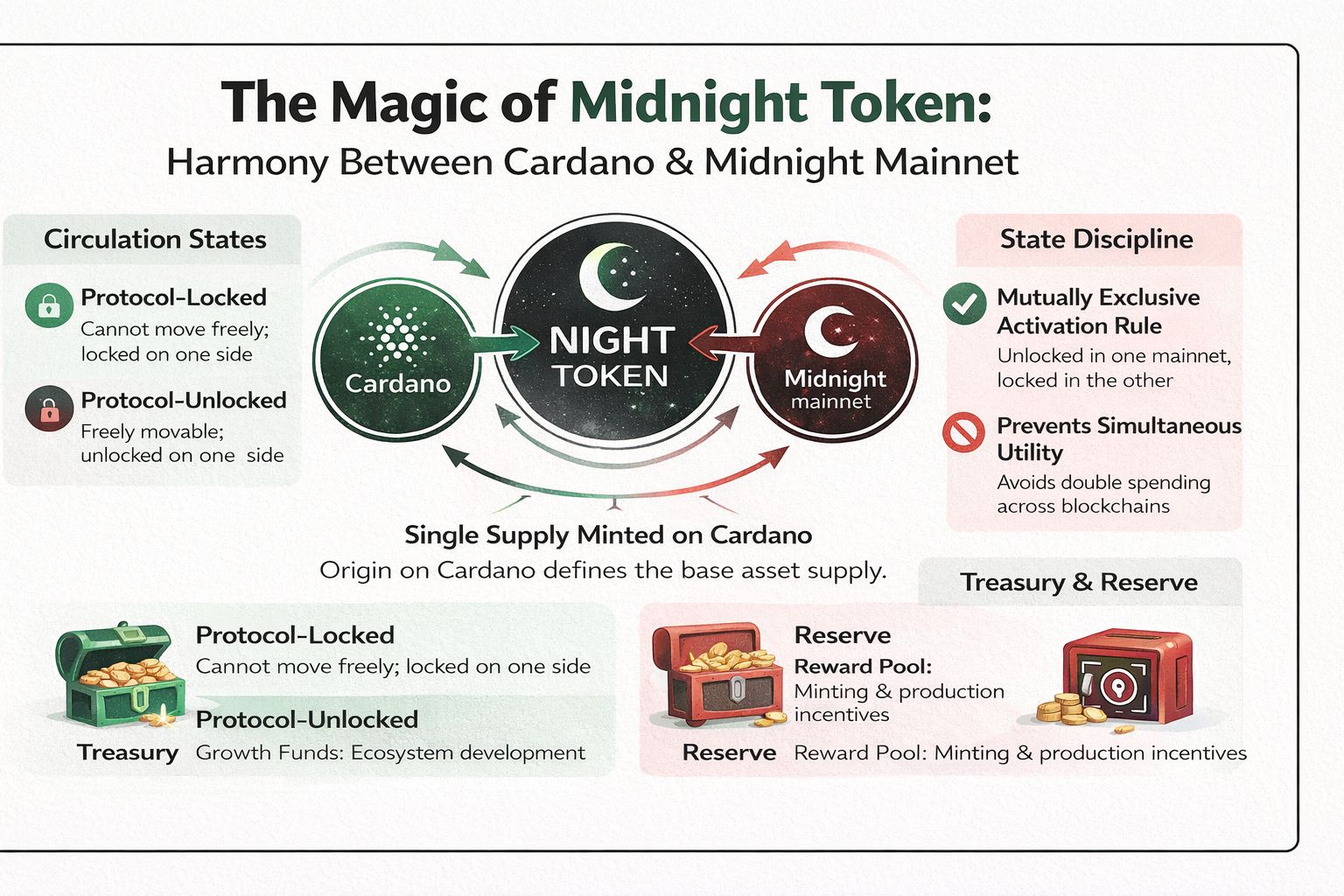
It feels a bit like using one train ticket across two stations, where only one gate can validate it for travel at any moment.
That is the friction I keep returning to here. Once a token extends beyond a single chain context, issuance is only the first step. The more serious problem is state management. Which version is active.
Which version is constrained. Which version is recognized by the protocol as eligible for movement, rewards, governance, or security-related use. Without that discipline, a token starts to look less like one asset and more like a set of overlapping claims that are hard to reason about.
What I find deliberate in this design is that it starts from a clear origin point. The total NIGHT supply is minted on Cardano. I think that matters because it gives the asset a single issuance base rather than a vague multi-origin story. A fixed origin makes the accounting cleaner. It tells you where the token is first defined before the model introduces any cross-chain logic.
That may sound like a small thing, but in systems with multiple environments, clarity at the start tends to reduce confusion later.
The model then separates supply into uncirculated and circulating states. I like that choice because it avoids pretending that every token that exists is already part of the live economic layer.
Some tokens can exist as reserve-backed future distribution, while others are already active in the broader ecosystem. That sounds simple, but it is an important distinction.
It allows the network to structure release paths, reward pools, and treasury functions without collapsing everything into one flat category.
Then the state model becomes more refined. Circulating supply is not treated as a single uniform condition. It is split again into protocol-locked and protocol-unlocked forms. That is probably the most important part of the whole diagram for me.
It shows that the design is not only tracking balances. It is also defining permissions. A token can be in circulation and still not be fully available for every role.
A protocol-locked token is constrained. A protocol-unlocked token is the one that can actually express the broader utility the system intends.
That is where the relationship between Cardano and the main chain starts to feel less like branding around interoperability and more like a serious state machine. The rule appears straightforward: if the token is unlocked on one chain, it is locked on the other.
That one condition does a lot of heavy lifting. It keeps the same unit from functioning as fully active capital in two places at once. It also reduces ambiguity around which environment currently has the authoritative usable form of that token.
I think that is the real harmony here. Not two chains doing the same thing in parallel, but two environments coordinating around mutual exclusivity so the asset keeps one coherent economic identity.
From a mechanism perspective, the design reads like a controlled cross-chain state model rather than a loose mirrored asset system.
Consensus selection matters because block production rewards need an identifiable reserve source and a credible distribution pathway. The state model matters because the protocol has to know whether a token is merely existing, circulating, or actually unlocked for utility.
The cryptographic flow matters because those state changes cannot depend on social trust or informal coordination.
Some verifiable process has to constrain one representation when the other becomes usable. That is the part that makes the system feel architectural rather than cosmetic.
I also think the treasury and reserve are doing more conceptual work than they first appear to be doing. The on-chain treasury looks designed for ecosystem development and broader coordination.
The reserve, by contrast, is more tightly connected to rewarding block producers. I think separating those functions is healthy. Growth funding and security incentives should not automatically be treated as the same budget category.
When they are kept distinct, the token model becomes easier to interpret and arguably easier to govern.
On utility, the framework is familiar in broad form, but more state-aware in how it is applied. Fees support activity on the chain, which ties the token to actual use of network resources.
Staking connects the asset to validator or producer alignment, which matters for honest participation and operational security. Governance gives holders a voice in upgrades and rule changes over time.
None of those roles make much sense, though, unless the protocol is very clear about which tokens are eligible to perform them. That is why the locked versus unlocked distinction is not cosmetic.
It determines when utility is real and when it is intentionally suspended.
This is also why I do not think price should be the main lens for reading a page like this. Price discovery will happen around any token eventually, but this diagram is more useful as a map of permissions than as an invitation to speculate.
The deeper question is whether the asset can move across the two-chain structure without confusing issuance, circulation, and usable state. If the answer is yes, then the token has a more coherent basis for long-term economic meaning. If the answer is no, then price discussion just sits on top of a blurry design.
My overall impression is fairly measured. The network seems to be trying to make a two-chain token behave like one disciplined instrument rather than two loosely connected copies.
I think that is the right instinct. What I still want to see, though, is whether these carefully defined states remain intuitive once the system moves from whitepaper clarity into real user behavior.
@MidnightNetwork $NIGHT #night
