
The Ultimate Guide to Crypto Licensing in Nigeria (2025 Edition)
Nigeria has officially entered the era of structured crypto regulation.
With the enactment of the Investments and Securities Act, 2025 (ISA 2025), virtual asset exchanges and digital asset operators are now formally integrated into Nigeria’s capital markets legal framework. This development has fundamentally reshaped the regulatory landscape for crypto businesses operating in or serving Nigerian users.
For crypto exchanges, custody providers, brokers, token issuers, and digital asset platforms, the key question is no longer whether Nigeria regulates crypto, it is how to become compliant.
This guide provides a comprehensive, legal-grade analysis of:
Nigeria’s crypto regulatory framework under ISA 2025
Who requires a crypto license in Nigeria
The SEC Nigeria VASP registration process
The Accelerated Regulatory Incubation Program (ARIP) sandbox
Fees, capital requirements, and compliance obligations
Enforcement risks for non-compliance
Strategic considerations for global exchanges
This article is designed to serve as the definitive authority resource for crypto licensing in Nigeria.
1. The Legal Foundation: Investments and Securities Act, 2025
The Investments and Securities Act, 2025 repealed the ISA 2007 and modernized Nigeria’s capital markets framework to accommodate digital asset innovation.
Under ISA 2025, the Securities and Exchange Commission (SEC Nigeria) is the apex regulatory authority responsible for:
Registering and regulating virtual and digital asset exchanges
Supervising capital market operators
Protecting investors
Preventing unlawful and fraudulent market practices
Ensuring financial system stability
For the first time, digital asset exchanges are explicitly recognized within statutory law.
This formal recognition removes ambiguity and establishes a mandatory licensing regime.
2. Who Needs a Crypto License in Nigeria?
The licensing requirement applies broadly.
Any entity engaged in digital asset activities involving Nigerian investors may require SEC registration.
This includes:
2.1 Crypto Exchanges: Platforms facilitating the buying, selling, or trading of virtual assets.
2.2 Custody Providers: Entities holding digital assets on behalf of clients.
2.3 Crypto Brokers and Dealers: Intermediaries executing transactions for clients.
2.4 Token Issuers: Entities conducting token offerings accessible to Nigerian investors.
2.5 Investment Platforms: Digital platforms facilitating crypto-based investment products.
2.6 Foreign Exchanges Serving Nigerian Users
Even offshore exchanges may fall within jurisdiction if they:
Allow Nigerian account registration
Market to Nigerian users
Facilitate trading by Nigerian residents
Accept Nigerian identification documents
Process Nigerian bank transfers
Nigeria applies functional jurisdiction similar to Dubai (VARA), the EU (MiCA), and the UK (FCA).
Physical presence is not required for regulatory applicability.
3. The SEC Nigeria VASP Licensing Framework
ISA 2025 establishes SEC authority to license and regulate digital asset operators.
While full licensing requirements may evolve through SEC rules, core compliance expectations include:
Corporate incorporation and governance structure
Fit-and-proper management requirements
Risk management framework
AML/CFT compliance systems
Financial adequacy and capital requirements
Customer protection controls
Reporting and audit obligations
The SEC Nigeria licensing regime reflects global regulatory standards.
4. The ARIP Sandbox: Nigeria’s Strategic Onboarding Mechanism
To facilitate safe market entry, the SEC established the Accelerated Regulatory Incubation Program (ARIP).
ARIP functions as a regulatory sandbox allowing digital asset operators to enter the Nigerian market under regulatory supervision.
It provides:
Approval-in-Principle
Supervised operational testing
Structured transition to full licensing
ARIP is not a loophole.
It is a structured regulatory entry pathway.
5. ARIP Eligibility Criteria
To qualify for ARIP participation, applicants must demonstrate:
Incorporation and legal structure
Resident executive leadership (where applicable)
Demonstrable capacity to conduct digital asset activities
Clear business model and operational plan
Commitment to regulatory compliance
Both domestic and foreign entities may apply, subject to regulatory assessment.
6. ARIP Application Process (Step-by-Step)
Stage 1: Initial Assessment
Submission of preliminary eligibility information.
Stage 2: Formal Application
Detailed submission including:
Corporate documents
Governance structure
Business plan
Risk framework
AML/CFT policies
Technology infrastructure overview
Stage 3: Regulatory Review
SEC evaluates operational readiness and compliance capacity.
Stage 4: Approval-in-Principle
Applicant receives authorization to operate within ARIP parameters.
Stage 5: Transition to Full Licensing
Successful participants progress toward full VASP registration.
7. ARIP Fees and Financial Requirements
Processing Fee:
₦2,000,000 (non-refundable)
Shareholder Funds:
Evidence of sufficient capital adequacy.
Fidelity Bond:
Minimum of 25% of required shareholder funds.
The SEC may impose additional financial conditions based on risk profile.
8. Compliance Obligations Under ARIP
Participants must maintain:
AML/CFT compliance systems
Travel Rule adherence
Periodic reporting (weekly, monthly, quarterly)
Incident reporting protocols
Audit readiness
Governance oversight
The SEC retains inspection and enforcement authority.
9. Enforcement Risks for Non-Compliance
Operating without SEC authorization may result in:
Financial penalties
Suspension of operations
Asset freezing
Regulatory enforcement actions
Reputational damage
ISA 2025 strengthens SEC enforcement powers significantly.
Unlicensed operators face substantial legal exposure.
10. Strategic Advantages of Early Participation
VASPs entering via ARIP benefit from:
Regulatory legitimacy
Early market positioning
Direct regulator engagement
Reduced licensing uncertainty
Enhanced investor trust
Nigeria remains one of the highest crypto adoption markets globally.
Early regulatory positioning offers long-term competitive advantage.
11. Comparing Nigeria’s Framework with Global Jurisdictions
Jurisdiction
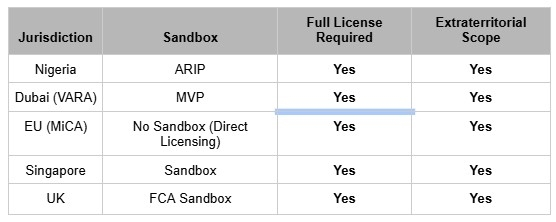
Nigeria aligns with global regulatory standards.
12. Corporate Structuring Considerations
Foreign VASPs considering entry should evaluate:
Local incorporation vs representative structure
Governance localization requirements
Compliance personnel
Tax considerations
Cross-border data policies
Strategic structuring improves licensing probability.
13. Market Entry Strategy Recommendations
VASPs should:
Conduct regulatory readiness assessment
Develop compliance infrastructure
Prepare structured ARIP application
Engage regulatory advisory support
Align global licensing strategy
Regulatory preparation significantly increases approval likelihood.
14. Frequently Asked Questions (FAQs)
Q1: Do foreign crypto exchanges need SEC Nigeria registration?
Yes, if serving Nigerian users or targeting Nigerian investors.
Q2: Is ARIP mandatory before full licensing?
ARIP serves as a transitional pathway but may not replace full licensing requirements.
Q3: How long does the ARIP process take?
Timeline depends on application quality, regulatory workload, and readiness.
Q4: Can an offshore exchange block Nigerian users to avoid registration?
Yes, but must implement robust geo-blocking and marketing restrictions.
Q5: What happens if a crypto exchange operates without SEC approval?
Potential penalties include fines, suspension, asset freezing, and enforcement action.
Q6: Does Nigeria recognize DeFi platforms?
Regulatory interpretation may depend on operational structure and degree of control.
Q7: Are token offerings regulated?
Yes, if offered to Nigerian investors.
Q8: What capital is required?
Capital requirements are determined based on risk profile and operational scale.
Q9: Is physical presence required?
Regulatory assessment may require local presence depending on licensing structure.
Q10: Is Nigeria a high-opportunity market?
Yes. It is among the largest crypto adoption markets globally.
15. Why Regulatory Preparation Matters
Crypto regulation globally is moving toward formal licensing frameworks.
Nigeria is no exception.
Operators that proactively align with regulatory requirements will be best positioned for sustainable growth.
Regulatory compliance is no longer optional.
It is strategic infrastructure.
Conclusion
Nigeria has transitioned from regulatory ambiguity to statutory clarity.
The Investments and Securities Act, 2025 and the ARIP sandbox provide a structured pathway for crypto exchanges to operate legally and sustainably.
For VASPs seeking global expansion, Nigeria represents both opportunity and responsibility.
The time to establish a compliant presence is now.