@MidnightNetwork $NIGHT
They start with the chain. The mechanism. The architecture. Then they move toward the user and try to explain why any of it should matter.
With Midnight, I think it makes more sense to start somewhere else.
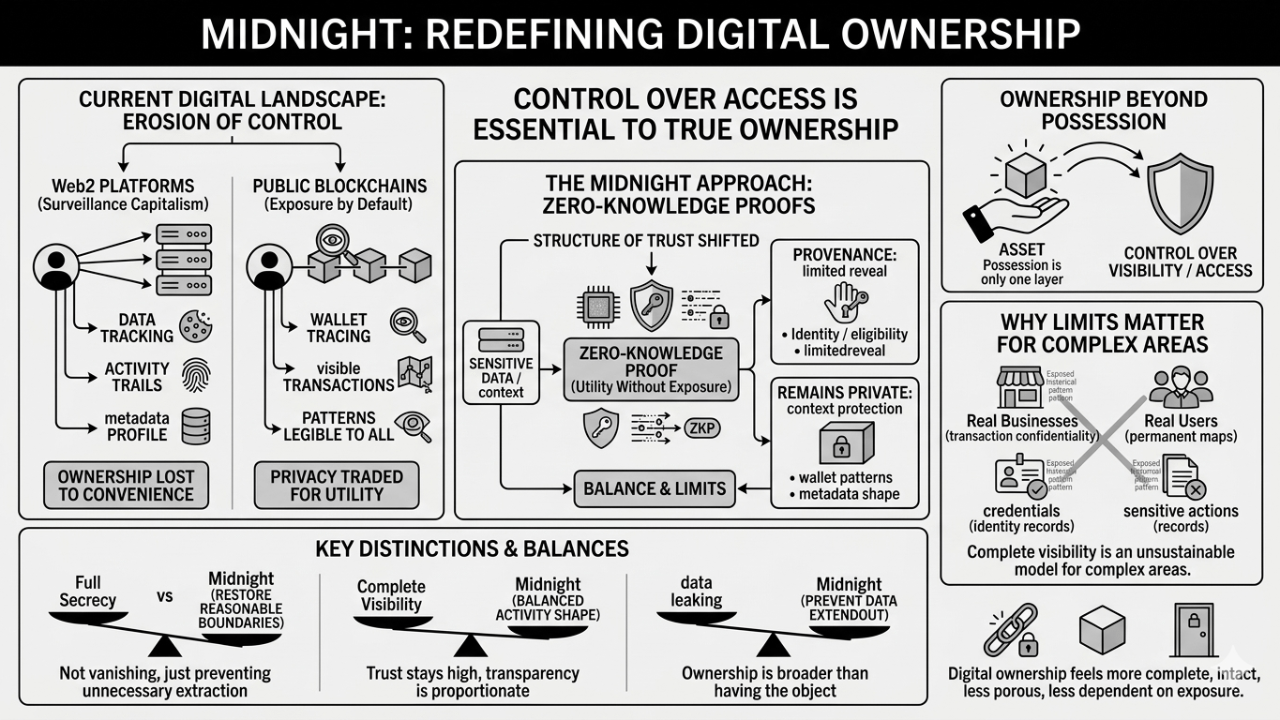
Start with the feeling people already have online, even if they do not always say it clearly: we use digital systems every day, but we rarely feel like we truly own what belongs to us inside them. Not fully. Not comfortably. Our data moves through platforms. Our activity leaves trails. Our choices get stored, measured, linked, and used in ways we do not really control. You can usually tell when convenience has quietly replaced ownership. Things work, but they do not feel like yours.
That is the angle that makes Midnight more interesting to me.
Because Midnight is not just about privacy in the narrow crypto sense. It seems closer to a larger question. What would digital ownership actually look like if it included not only assets, but also information? Not only what you hold, but what you reveal. Not only what is yours, but what remains under your control while you use it.
That question sits underneath everything here.
Midnight is described as a blockchain that uses zero-knowledge proof technology to offer utility without compromising data protection or ownership. That sounds technical at first, maybe even abstract. But the more you sit with it, the less abstract it feels. It starts to sound like an attempt to correct something that has felt off for a long time. Because digital systems have been very good at making things accessible, but not always very good at keeping them intact as yours.
And ownership without boundaries is not really ownership.
That is probably the quiet problem Midnight is trying to address.
Public blockchains did bring one kind of control back to users. They let people hold assets directly. They reduced some reliance on intermediaries. They made verification easier. That part was important. But they also introduced a strange condition. To participate in these systems, you often had to give up a large amount of informational privacy. Transactions became visible. Wallet behavior became traceable. Patterns became legible to anyone with enough interest and enough time.
So even while crypto talked a lot about ownership, the systems themselves often kept exposing context.
That contradiction matters more than people first admit.
Because ownership is not only about possession. It is also about control over access. Control over visibility. Control over who gets to know what, and when, and for what purpose. If you own something, but every action around it leaves a public trail, then your ownership is partly intact and partly weakened. You hold the asset, yes. But you do not fully hold the information around that asset. And sometimes the information matters just as much.
That is where Midnight starts to feel different.
The use of zero-knowledge proofs changes the structure of trust. Instead of requiring all the underlying data to be revealed, the system allows something to be proven without exposing every detail behind it. That is the technical description. But the human description is simpler. It means you do not always have to open everything up just to participate. You do not always have to trade privacy for usefulness.
That’s where things get interesting, because this is not really about secrecy for its own sake.
It is about proportion.
In ordinary life, people do not reveal every detail just because a process requires some form of proof. You prove your identity in a limited way. You prove eligibility in a limited way. You prove ownership in a limited way. The idea is not to hide everything. The idea is to reveal enough and stop there. Healthy systems tend to work like that. They take what is necessary and leave the rest alone.
A lot of digital systems have not worked that way.
Web2 platforms gathered more than they needed because data became valuable. Public blockchains exposed more than they needed because transparency became the default design logic. Different systems, different reasons, but the result often felt similar from the user’s side. Participation came with leakage. Utility came with exposure. It becomes obvious after a while that the real issue is not only centralization or decentralization. It is whether the system respects limits.
Midnight seems to take limits seriously.
And that may be the better way to understand it. Not as a chain trying to make everything private, but as a chain trying to restore reasonable boundaries inside digital activity. That is a smaller claim than the ones crypto usually likes to make. It is also a more believable one.
Because complete visibility was never going to be a stable model for everything.
It worked for early experiments. It worked for communities that treated openness almost like ideology. But once blockchain starts touching more complex areas, the limits show up fast. Real businesses do not want every transaction context visible. Real users do not want their histories mapped out forever. Real applications dealing with identity, records, credentials, or sensitive actions cannot always function in a world where every interaction is laid bare.
So the question changes from this to that.
Not “can blockchain make everything transparent?”
But “can blockchain stay trustworthy without demanding too much transparency?”
That shift matters.
Midnight, at least in concept, seems built around the belief that the answer is yes. That trust does not have to come from full exposure. That proof can do some of the work exposure used to do. And that ownership becomes more complete when people are able to carry out digital actions without constantly giving away the surrounding data.
I think that part is easy to underestimate.
When people hear about privacy-preserving technology, they often focus on what is hidden. But what matters just as much is what remains protected from being turned into a pattern. A balance. A profile. A permanent behavioral map. In digital systems, raw data is only one layer. Metadata, timing, relationships, frequency, connection points — these things build a picture too. Sometimes an even more revealing one.
So protecting ownership means protecting more than the object itself.
It means protecting the shape of your activity around it.
Midnight seems to understand that. And that gives it a slightly different feeling from projects that speak about privacy in a more blunt or narrow way. It does not seem centered on vanishing. It seems centered on preventing unnecessary extraction. That is a subtle distinction, but an important one.
Because people do not really need to disappear. Most of the time, they just need systems to stop taking more than they should.
That is why Midnight feels, in some ways, less like a crypto project chasing a trend and more like a response to a problem the internet has been building for years. We keep creating digital environments where participation leaves too much behind. Then later we act surprised when trust becomes fragile, when users feel watched, when ownership starts sounding thinner than it should.
A blockchain like Midnight appears to be asking whether we can build a different pattern from the start.
Not openness without limits.
Not privacy without accountability.
Something more balanced than either extreme.
That balance is hard, of course. Probably harder than it sounds when written calmly like this. Systems built around zero-knowledge proofs and selective disclosure still have to be usable. They still have to make sense to developers. They still have to work in practice, not just in diagrams or design papers. That challenge is real. Sometimes the most thoughtful ideas become the hardest to make feel natural.
So none of this should be romanticized.
Midnight is still a blockchain project. It still has to prove itself in the ordinary ways projects do. Adoption, usability, reliability, actual relevance. Those questions do not disappear because the underlying philosophy is appealing. And it is better to be honest about that.
Still, the philosophy matters.
Because even before you know how far a project will go, you can usually tell whether it has noticed the right problem. Midnight seems to have noticed that digital ownership is incomplete when data protection is weak. That utility starts to feel compromised when the cost of using a system is too much exposure. That public trust and personal boundaries do not need to cancel each other out.
That is a meaningful starting point.
Maybe the simplest way to say it is this: Midnight treats ownership as something broader than possession. It treats it as the ability to use, prove, and participate without unnecessarily surrendering the context around you. That may not sound dramatic, but it actually reaches deeper than a lot of louder blockchain narratives do.
Because possession is only one layer of control.
If the surrounding data is always exposed, then part of what is yours is always slipping outward.
Midnight seems built around slowing that down.
And that is probably the angle that stays with me most. Not the technical novelty by itself. Not the usual crypto framing. Just the idea that digital ownership should feel more complete than it often does today. More intact. Less porous. Less dependent on exposure as the price of entry.
That is a quiet idea, but not a small one.
And whether Midnight fully delivers on it or not, it is at least pointing at the right absence. The gap between having something and actually holding it on your own terms. In digital life, that gap has been wider than people like to admit.
Maybe this is one attempt to narrow it.
#night

Artikel
Most blockchain projects are explained from the outside in.
Haftungsausschluss: Die hier bereitgestellten Informationen enthalten Meinungen Dritter und/oder gesponserte Inhalte und stellen keine Finanzberatung dar. Siehe AGB.