
Hey everyone, in this wild world of AI where chatbots are spitting out everything from code snippets to video analyses, I’ve been thinking a lot about trust. How do we know if an AI’s output is legit or just hallucinating nonsense? That’s where @Mira - Trust Layer of AI comes in they’re building something pretty revolutionary. As of March 9, 2026, with AI integrations everywhere, projects like Mira Network are stepping up to make sure we can rely on decentralized verification. Let’s break it down.
First off, what is Mira Network? It’s a blockchain based protocol that verifies AI-generated content in a trustless way. Instead of relying on one big AI model that could be biased or wrong, Mira uses a network of diverse AI nodes to cross-check outputs. Think of it as a decentralized jury for AI claims. The process starts with binarization breaking down content into simple, verifiable claims. For example, if an AI says “Paris is the capital of France and has 10 million people,” Mira splits that into separate facts and sends them to different verifiers.
These verifiers, which are AI models run by node operators, stake $MIRA tokens to participate. If they get it wrong or try to cheat, their stake gets slashed that’s the economic incentive keeping everyone honest. It’s a hybrid of Proof-of-Stake and Proof-of-Work, where verifiers answer structured questions to prove they’ve done the work. The end result? A cryptographic certificate that says, “Yeah, this AI output checks out.” Privacy is huge here too; claims are sharded so no single node sees the whole picture.
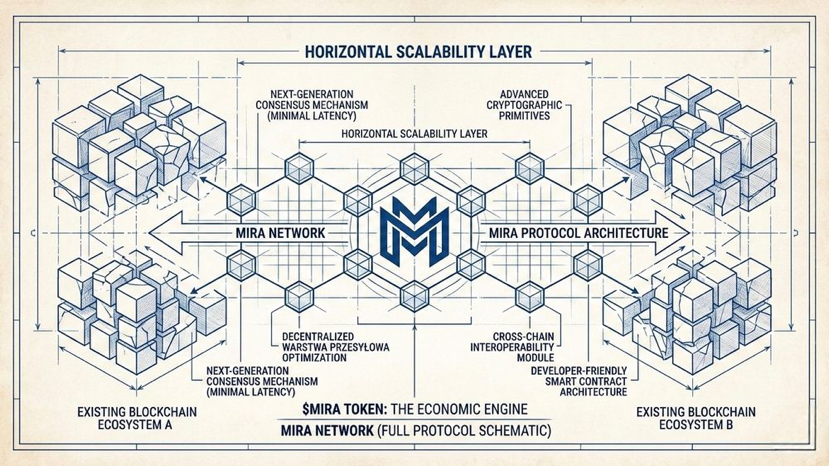
Check out this schematic of Mira’s protocol architecture. It shows how existing blockchains connect through Mira’s horizontal scalability layer, with the $MIRA token powering the economic engine. Cool, right? It’s designed for cross-chain interoperability, minimal latency, and developer-friendly smart contracts.
Now, about the $MIRA token itself. It’s not just hype it’s the fuel for the network. Node operators stake it to run verifiers, and in return, they earn rewards for accurate work. Total supply caps at 1 billion, with about 204 million circulating right now. From what I’ve seen on CoinGecko, utilities include governance and incentives, making it essential for network security. No generic “moon” promises here; it’s tied to real utility in AI verification.
Speaking of performance, let’s look at the market side. As of today, $MIRA is trading around $0.082, down a bit from its all-time high of $2.68 back in September 2025. The past week saw a 9.55% dip, but volume’s holding steady at over $4 million daily. Market cap sits at roughly $16.8 million, ranking it around #879. I’ve been watching this closely I grabbed a small bag last Tuesday when it dipped to $0.081, figuring the tech’s solid. But hey, crypto’s volatile; I once lost 20% on a similar play, so DYOR.
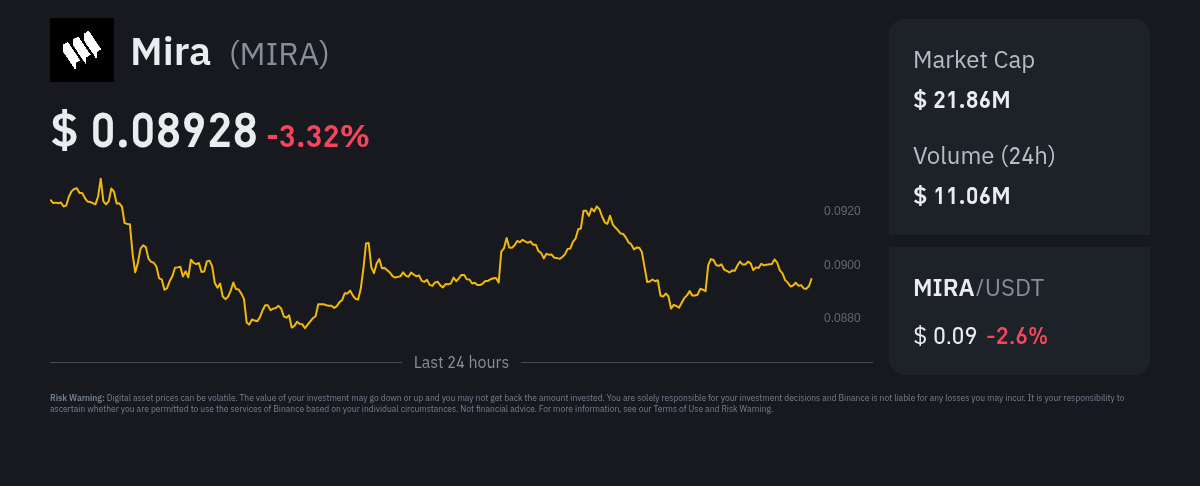
Here’s a recent price chart from Binance. You can see the fluctuations in March 2026 – it’s been consolidating after that February low of $0.077. If the testnet gains traction, we might see some upward momentum.
One thing that excites me is their recent launch of Klok, an AI chat app that uses Mira’s verification. It pulls from models like GPT-4o and Llama, but with that extra layer of trust. Imagine using it for business decisions or creative work without worrying about errors. Potential use cases? Verifying code, fact-checking news, even auditing videos. In a time when AI deepfakes are rampant, this could be a game-changer.
All in all, @Mira - Trust Layer of AI is onto something big with Mira. If you’re into AI-blockchain mashups, keep an eye on $MIRA. I’ve got a feeling as adoption grows, this could climb.
What do you think ready to stake some?
Drop your thoughts below!
