
Web3 integration with the Artificial Intelligence has revealed a serious structural incompatibility in the industry. Blockchain systems represent deterministic systems with code as law, and execution absolute. On the contrary, the current Large Language Models are probabilistic models that are aimed at guessing the most likely sequence of words next and, therefore, they are prone to hallucinations, logical drift, and inheriting biases. We are now trying to erect inflexible, high-stakes financial and independent systems over unpredictable and moving cognitive sands. A three-percent hallucination rate is not a statistical anomaly when it comes to an AI agent, but rather a systemic disaster when they are required to manage a decentralized finance portfolio or make autonomous governance decisions. Smart models are not necessarily needed in the industry: what is required is a trustless verification infrastructure to provide the crucial bridging of the gap between probabilistic generation and deterministic execution.
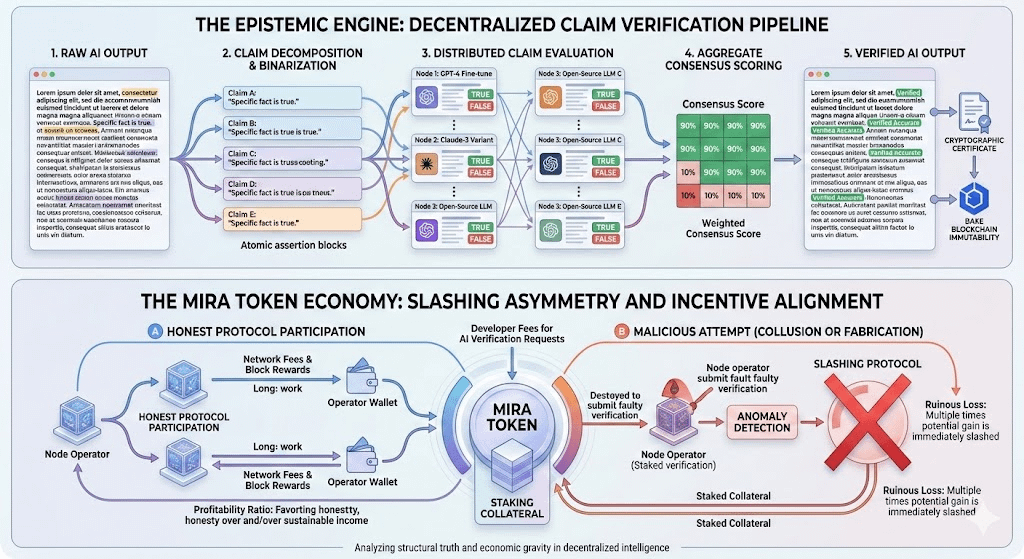
Mira Network solves this crisis of reliability by being an epistemic engine; in other words, it is a system, which is supposed to systematically extract truth out of the noise it generates. Instead of trying to create a perfect foundational model, Mira works on the assumption that the collective and decentralized intelligence would be able to audit and correct failures in single models. The architecture of the protocol is based on the specialized workflow, which is based on the decomposition of claims. As an AI creates a complicated output, the network breaks down this response into independently verifiable assertions which are atoms. These disjointed assertions are then binarized so that complex contextual performances are broken down into hard and fast statements that are simple to adiate.
After being fragmented, these separated claims are directed through a decentralized network of verifier nodes. More importantly, such nodes do not act as a monolith; they use a very diverse set of independent AI models and different training datasets. Mira eliminates the threat of single-model bias by making sure that the verifier set is heterogeneous. The disparate weight of architecture of an open-source counterpart detects and removes a systemic blind spot of one particular corporate language model. These binary assessments are combined in the network to generate a raw consensus score, and finally the verified result is encased in a cryptographic certificate that is stored permanently on the Base blockchain.
The protocol uses a hybrid crypto economic framework based on the use of the MIRA token to ensure this complex verification web. The traditional decentralized networks are based on cryptographic puzzles to demonstrate work, yet Mira takes a completely different meaning of it. More precisely, the work in this ecosystem is the actual performance of meaningful, rigorous AI inferences. But only computation cannot be the guarantee of truthfulness. The network imposes harsh economic staking policy to avoid network node operators just generating random binary responses to farm block rewards with minimal compute cost.
To be part of the consensus, operators are required to provide huge $MIRA as a collateral. Proper verification on consensus, which means verifying the correctness of responses and also the consensus, results in block rewards and network user fees and the statistically abnormal or deliberately malicious behavior will instantly cause the slashing of the staked tokens. This skewed risk-reward table allows making sure that the financial cost of attacking the network or being lazy is by far much greater than the gains that may be obtained. The token serves more than effectively as the gravitational force to focus the raw self-interest with the network-wide truth-seeking.
Tactically, Mira is positioning itself as critical Web3 middleware, which follows the historical pattern of decentralized oracles, but with respect to cognitive computation, as opposed to external pricing data. Similarly to the need to have decentralized networks in order to trust off-chain price feeds in smart contracts, autonomous AI agents need a trust layer in which to authenticate their own off-chain reasoning and then execute on chain behaviors. Mira enables developers to add this verification layer to consumer AI applications, research platform and enterprise governance tools easily through its specialized API and software development kits. Mira does not have to compete with large centralized AI laboratories directly by posing itself as a neutral, agnostic infrastructure layer and benefits instead as the entire artificial intelligence market grows.
Although it is a beautiful crypto economic mechanism, the protocol presents a severe trilemma of cognitive consensus, and developers must now balance verification accuracy, computational overhead, and execution latency. Inherently, there exists operational friction when a single query is routed across multiple distributed nodes than when making a direct query to one centralized provider. Moreover, it can be extremely expensive to compensate a network of node operators to do redundant and cross-checked inference, and this cost is marginalized. In applications that require high-frequency computation, with a frequency in the megahertz range, this trustless architecture might be too slow. The sustainability of the network in the long-run is solely reliant on whether the market is sensitive to deterministic accuracy to the point that it can absorb these latency and costs premiums.
In case it is scaled successfully, this verification protocol can change the course of machine autonomy radically. It allows the artificial intelligence to become a self-reliant economic agent, by offering a mathematical and economic guarantee of accuracy. The last, and most powerful, upgrade to smart contracts is a strong decentralized verification layer that enables more complex, subtle logic to be executed safely giving rise to the next wave of automated decentralized finance and automatic enterprise processes. The most useful network infrastructure of the next decade will not be the one that accomplishes the greatest amount of information but the one that has the power to definitively establish what is actually true about the information.
#Mira $MIRA @Mira - Trust Layer of AI
