
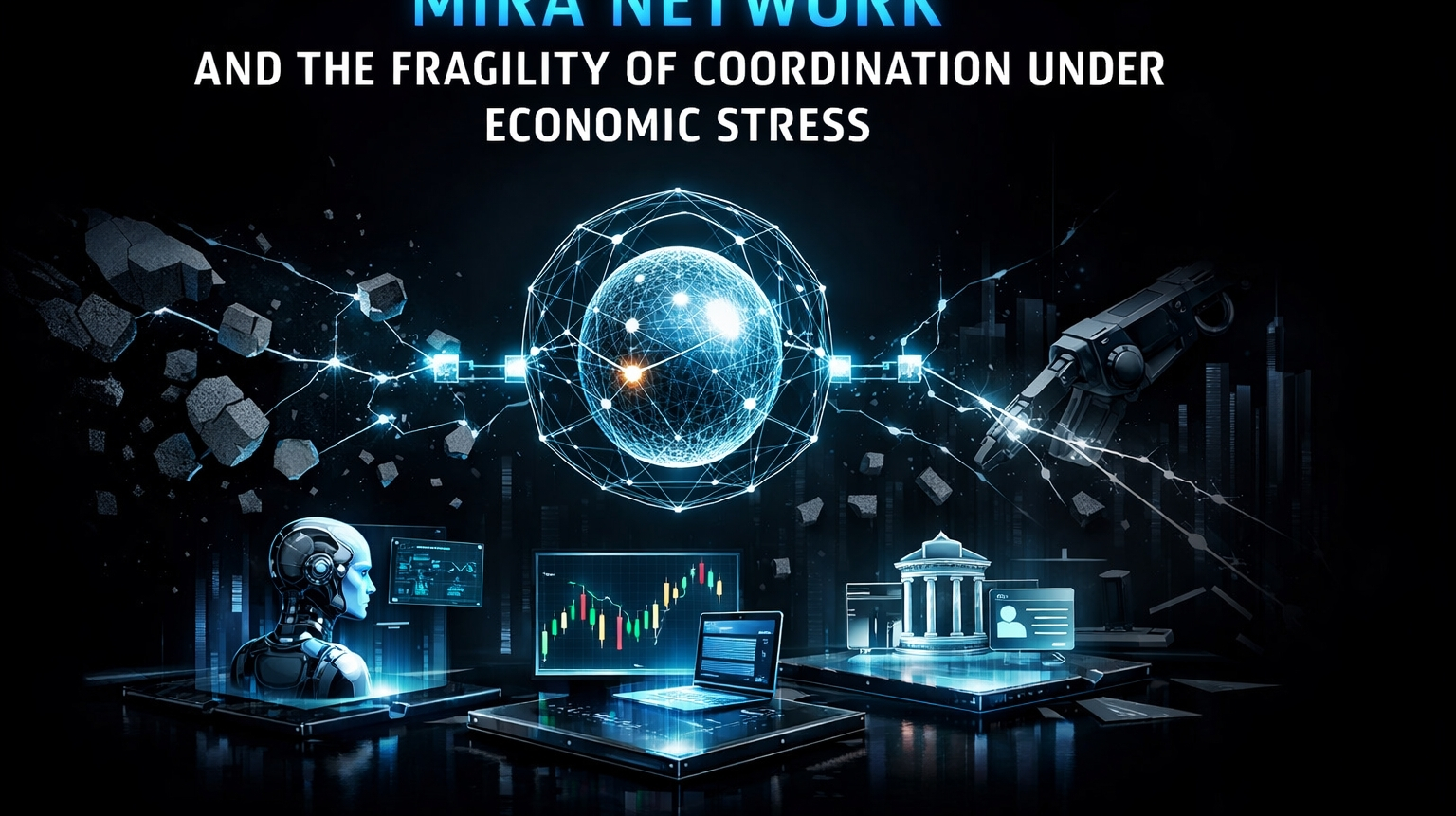
I spend a lot of time watching how systems behave when liquidity tightens. Not when things are growing, not when narratives are expanding, but when attention thins out and capital becomes selective. That is usually the moment when coordination mechanisms reveal their true structure. A protocol designed to remove intermediaries from high-stakes coordination environments—finance, AI verification, governance, identity—does not fail because the idea is wrong. It fails when the cost of participation stops aligning with the reward for maintaining the system. What interests me about a system like Mira Network is not the elegance of decentralized verification, but what happens when the economic conditions that support it begin to shift.
Coordination systems always appear strongest when belief is abundant. Under those conditions, redundancy feels like security and distributed verification feels like resilience. Multiple independent actors verifying the same information seems like a natural way to remove centralized trust. But once capital becomes scarce, the structure begins to reveal something deeper: verification is not just a technical process, it is a market. Each participant evaluating a claim is effectively deciding whether the economic return of validating that claim exceeds the cost of doing so. When I look at decentralized verification networks through that lens, the system becomes less about truth and more about incentive equilibrium.
The first pressure point appears in the economics of participation. Verification networks rely on independent actors who commit resources to evaluate claims generated by AI systems. In theory, this decentralization protects against bias and error. In practice, the network only functions if enough participants remain economically motivated to perform verification honestly and consistently. Under normal market conditions this may not be a problem. Tokens that function as coordination infrastructure distribute rewards, staking mechanisms align incentives, and economic penalties discourage dishonest behavior. But economic stress changes the calculus. If the reward structure weakens or token liquidity dries up, the rational participant begins to reconsider their role.
I have seen this dynamic play out repeatedly across decentralized systems. When the opportunity cost of capital rises, participants stop behaving like guardians of a protocol and start behaving like traders of risk. Verification activity becomes selective. Nodes begin prioritizing claims that offer higher rewards relative to computational cost. Lower-value verification tasks may quietly disappear. The architecture itself does not collapse, but the coverage of the network becomes uneven. A system designed to produce consistent trust begins to produce pockets of reliability instead. The protocol still exists, but coordination becomes probabilistic.
What makes this particularly interesting in a verification network is that the reliability of the system is not simply technical, it is behavioral. The architecture assumes that a sufficiently distributed set of participants will collectively converge on truth. Yet convergence requires participation density. If participation drops below a certain threshold, the consensus process begins to resemble something closer to a thin market than a robust coordination layer. The uncomfortable implication is that verification quality may correlate directly with liquidity conditions.
The second pressure point emerges in latency. Removing intermediaries from high-stakes coordination often requires breaking complex outputs into smaller claims and routing them through distributed evaluators. Architecturally, this is elegant. It transforms opaque AI outputs into modular assertions that can be independently verified. But the moment this structure interacts with real-world decision environments, time becomes an adversary.
In markets, robotics systems, and governance processes, decisions often have value precisely because they happen quickly. Verification introduces delay. Even if that delay is small, it changes how participants behave. Actors who depend on rapid responses begin to price latency into their strategies. Some will accept slower, verified outputs. Others will route around the verification layer entirely if speed provides an advantage. I have watched this pattern appear in financial markets for years. Whenever a process increases reliability but slows execution, liquidity fragments between those who prioritize certainty and those who prioritize speed.
This fragmentation introduces a subtle structural trade-off. A system like Mira can increase confidence in AI-generated information, but the verification process inevitably consumes time and resources. As the network grows, the tension between accuracy and responsiveness becomes harder to ignore. The architecture may promise trustless verification, but the economic environment determines whether participants tolerate the cost of waiting for it.
The behavioral consequence is that the protocol begins to segment its users. Certain applications—those that value high assurance over speed—gravitate toward the verification layer. Others quietly bypass it. The system does not fail in a dramatic way. Instead, it gradually becomes specialized. Verification becomes a premium service rather than a universal layer of trust. When I observe decentralized coordination systems under pressure, this kind of quiet narrowing happens more often than outright collapse.
Another dynamic appears once participants recognize that verification itself is a tradable activity. In a distributed network, participants are not simply validating information; they are allocating attention. Attention becomes a scarce economic resource. Claims that are expensive to evaluate may attract fewer validators unless rewards compensate for the cost. Claims that are easier to verify may attract disproportionate participation. Over time, this can shape the type of information the system is best at validating.
What began as a neutral infrastructure for verifying AI outputs starts developing behavioral biases driven by economic incentives. Certain categories of claims become well-served by the network because they are cheap to validate. Others become structurally under-verified. The protocol may still operate exactly as designed, yet the distribution of trust across different types of information becomes uneven.
I find this pattern especially revealing because decentralized systems often frame themselves as solutions to institutional trust problems. They remove intermediaries and replace them with economic incentives. But incentives are rarely stable. They drift with market conditions, capital flows, and participant psychology. A coordination protocol that works perfectly during expansion may behave very differently during contraction.
This is where the token becomes less interesting as an asset and more interesting as infrastructure. Its role is not primarily speculative; it coordinates participation. It compensates validators, enforces penalties, and signals the economic health of the network. When its value rises, participation tends to increase. When its value weakens, the cost of maintaining verification integrity rises relative to the reward. The token does not just represent the system. It modulates the density of coordination.
Watching these dynamics over time raises a question that most protocol discussions avoid. What happens when verification itself becomes economically irrational for enough participants? Not dishonest—simply irrational. In a purely incentive-driven environment, participants are not obligated to sustain the system during periods of stress. They are free to withdraw attention, liquidity, and computational resources whenever better opportunities appear elsewhere.
The architecture assumes that distributed incentives will maintain equilibrium. But markets are rarely stable enough to preserve equilibrium indefinitely. Capital rotates. Narratives fade. Liquidity evaporates. When that happens, coordination systems built on economic participation begin to thin out at the edges.
The protocol does not necessarily stop functioning. Claims can still be verified. Consensus can still form. Yet the density of participation, the speed of verification, and the distribution of trust all begin to shift in subtle ways. None of these changes are visible in a whitepaper or architectural diagram. They only appear when the system is forced to operate in an environment where belief is no longer abundant.
And that leaves me with a question I cannot quite dismiss when I study systems like this. If the reliability of decentralized verification ultimately depends on a market of participants choosing to care about it, what happens to the system in the moment when caring becomes economically inconvenient?
