
I have been looking at the Fabric Foundation's architecture and I realized that the biggest tragedy in robotics today is that skills are Silicon Refugees. they are trapped inside the hardware they were born in. If a humanoid in a factory learns how to perfectly sort medical supplies that knowledge dies with that specific machine or remains locked in a proprietary database. This is the Cold Start Problem. Every new robot fleet has to spend months of compute power re-learning basic physics because there is no universal bridge for machine intelligence.
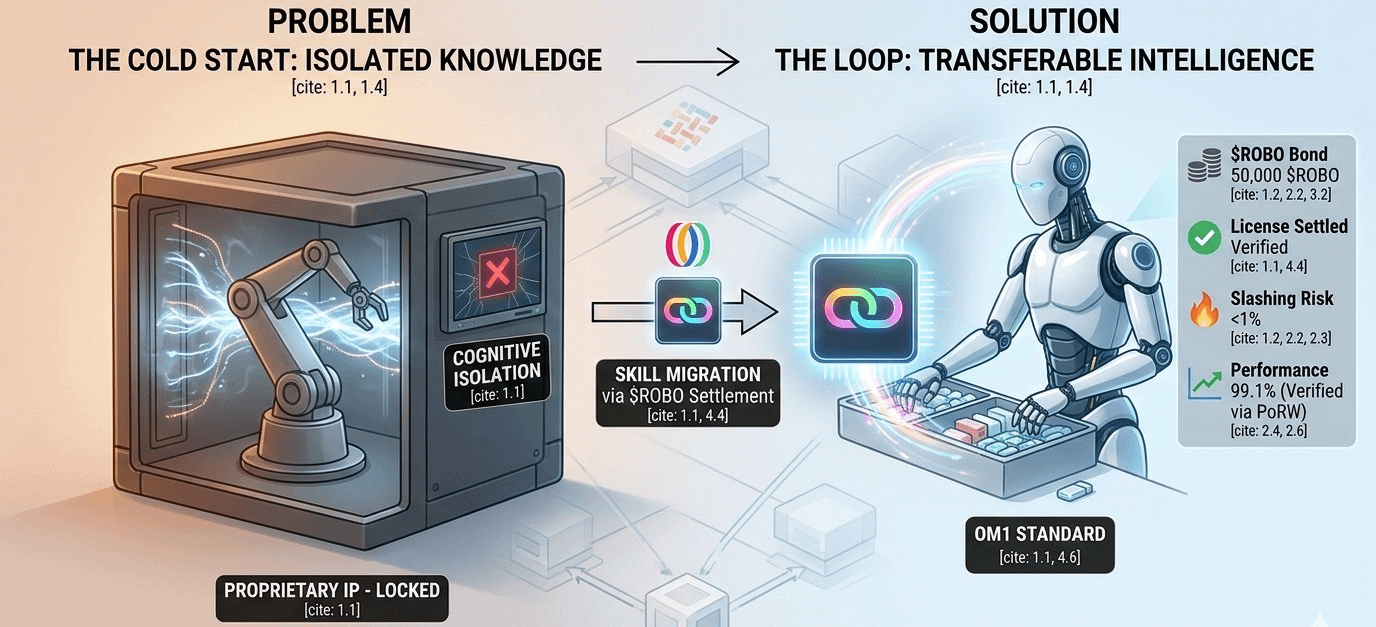
This is why I am tracking the OM1 operating system so closely. It isn't just a driver for motors, it is a Standardized Intelligence Layer.
By using the FABRIC protocol developers are creating Skill Chips which are essentially modular apps for robotic behavior. Because the $ROBO token acts as the settlement layer we are seeing the birth of a liquid market for machine labor. A developer in Tokyo can write a medical sorting skill and sell it to an operator in Berlin. The robot in Berlin doesn't need to learn anything, it just ingests the chip and pays the licensing fee in $ROBO.
➡️ The Zero-Knowledge Labor Layer:
But there is a hidden layer here that most creators are missing.
👉 How does a developer protect their intellectual property (IP) when selling a skill to a stranger's robot?
Fabric uses what I call Zero-Knowledge Labor. The OM1 stack allows the robot to execute the Skill Chip in a secure enclave. The robot performs the work but the how remains encrypted. The ledger only sees the Proof of Robotic Work (PoRW) and releases the payment. This is the only way you get high level industrial companies to share their secrets on a public blockchain.
➡️ Insurance through the Bond:
In the Fabric ecosystem tokens are not just rewards; they are the Access Keys to this global library of work. When you see Work Bonds and Delegation Stakes you are looking at the insurance that guarantees the skill will work as advertised. If the medical sorting chip fails the physical check on the OM1 layer the operator can challenge the developer and the $ROBO bond is slashed to compensate for the downtime.
We are moving away from a world of smart machines and into a world of Transferable Intelligence. If Fabric can prove that a robot can buy a skill and start working in ten minutes instead of ten months then the $ROBO loop is no longer a crypto experiment.
It is the backbone of global industrial productivity. I am watching the Skill Chip Marketplace metrics. If the repeat purchase rate stays high during the cold weeks when there are no campaigns it means the network has solved the most expensive problem in robotics: the cost of learning.